

Inconel 600 round bar (UNS N06600, W.Nr. 2.4816) is a nickel-chromium alloy chosen when high temperature strength, oxidation resistance, and resistance to chloride stress-corrosion cracking are required; for components needing long life in hot, oxidizing or mildly corrosive environments, this alloy offers a reliable, manufacturable option with stable properties from cryogenic temperatures up to about 1093 °C (2000 °F).
1. What is inconel 600
Inconel 600 emerged from mid-20th century nickel alloy development for high-temperature service in furnace equipment, chemical plants, and aerospace parts. The alloy combines a high nickel fraction with moderate chromium and iron content, producing excellent oxidation resistance and good mechanical strength when left in the solution-annealed state or cold worked for higher strength. Manufacturers supply the metal in many forms; round bar stock remains a common form for shafts, fasteners, pins, machine components, and turned parts that must perform under thermal or corrosive stress.
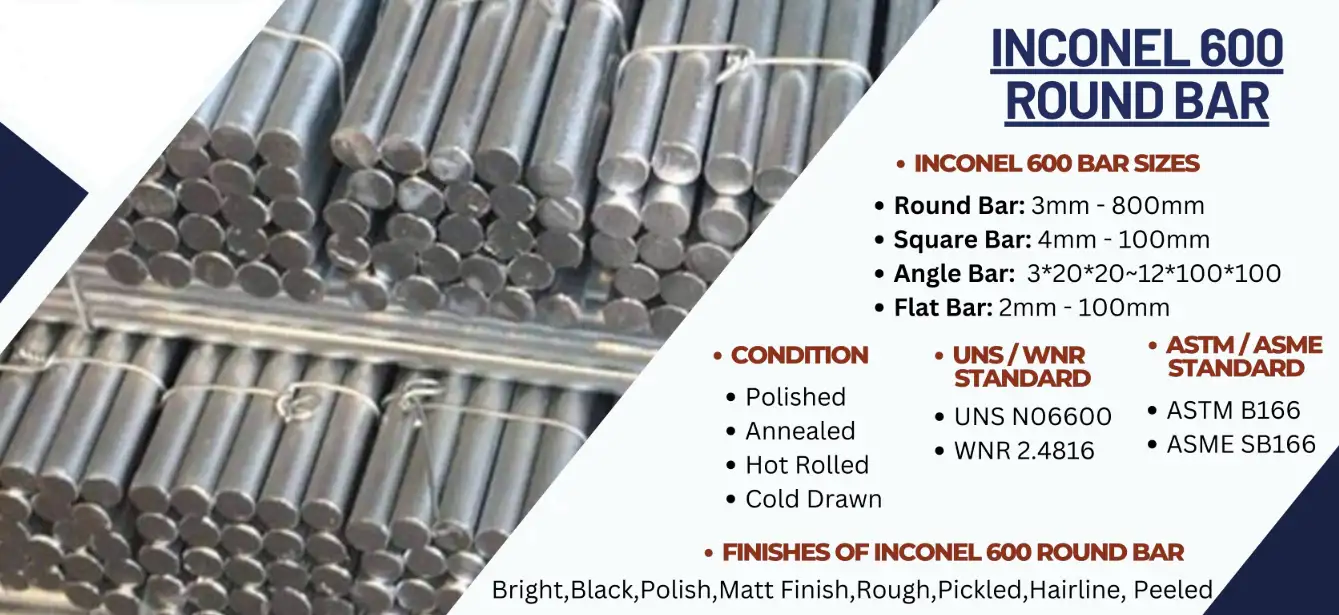
2. Chemical composition and standards
Primary designation: UNS N06600, sometimes referenced by European Werkstoff number W.Nr. 2.4816. Industry specifications used for bar stock include AMS 5665 (bar and wire specifications), ASTM/ASME B166 (bar), and supplier proprietary datasheets. Typical composition ranges follow industry standards; values below represent typical maximum/minimum limits used for procurement and engineering design.
Table 1: Typical chemical composition (wt%)
| Element | Typical range (wt%) |
|---|---|
| Nickel (Ni) | 72.0 min |
| Chromium (Cr) | 14.0 – 17.0 |
| Iron (Fe) | 6.0 – 10.0 |
| Manganese (Mn) | 0 – 1.0 |
| Carbon (C) | 0 – 0.15 |
| Silicon (Si) | 0 – 0.50 |
| Copper (Cu) | 0 – 0.50 |
| Sulfur (S) | ≤ 0.015 |
Sources for composition ranges include manufacturer datasheets and material databases. Use chemical certificates from the mill for design verification.
3. Physical and mechanical properties
3.1 Density and thermal constants
-
Inconel 600 Density: about 8.47 g/cm³ (0.306 lb/in³).
-
Linear coefficient of thermal expansion and specific heat are documented by material data sources and vary with temperature; consult mill data for precise design inputs.
3.2 Mechanical property summary (typical, annealed condition)
Table 2: Representative mechanical properties (annealed)
| Property | Typical value (metric) | Typical value (imperial) |
|---|---|---|
| Ultimate tensile strength (UTS) | ~620–900 MPa (varies with form) | ~90–130 ksi |
| Yield strength (0.2% offset) | ~220–450 MPa | ~32–65 ksi |
| Elongation (in 50 mm) | ~30–50% | |
| Hardness (HB) | ~150–220 HB |
Values depend on production route, cold work, and heat treatment. Cold drawing or cold rolling increases strength and lowers ductility; heat treatment to anneal will restore ductility and reduce strength. Verify mechanical data against supplier mill certificates for critical parts.
3.3 High-temperature strength
Inconel Alloy 600 retains reasonable tensile strength at elevated temperatures and has been used at continuous service temperatures up to roughly 1093 °C (2000 °F) in oxidizing atmospheres. Long-term creep resistance is moderate compared with nickel-based superalloys specifically developed for creep, so selection must account for stress and time-at-temperature.
4. Thermal behavior and maximum service temperatures
Design maximums depend on application type:
-
Intermittent exposure in oxidation environments: up to roughly 1093 °C (2000 °F).
-
Continuous high-stress service: conservative design temperatures often limited to lower ranges to control creep and grain growth.
-
Good resistance to carburization and service in chlorinated environments up to moderate temperatures. For precise creep data use manufacturer time-temperature curves or consult creep rupture charts.
5. Corrosion performance and limiting environments
Alloy 600 offers strong resistance to many corrosive media because of its high nickel content. Specific traits include:
-
High resistance to chloride-induced stress corrosion cracking in many aqueous environments.
-
Good resistance to oxidation and carburization in high-temperature gases.
-
Vulnerability: sulfurous atmospheres and molten salts at high temperature promote embrittlement and intergranular attack under certain conditions. For exposure to strongly oxidizing acids or halide-rich molten salts, select an alloy with higher chromium or deliberate alloying changes.
Engineers must test candidate materials under representative process conditions. Supplier corrosion data and industry case studies form a critical part of material selection for chemical processing or power generation components.
6. Fabrication, forging, machining, and welding notes
6.1 Forming and forging
-
Alloy 600 is workable in hot and cold conditions; hot forging temperatures typically exceed 980 °C, with controlled cooling to avoid surface oxidation or grain growth. Hot working practices follow standard nickel alloy forging charts from the mill.
6.2 Cold working and heat treatment
-
Strength increase from cold work is significant and often used for springs, wires, and heavy drawn bar.
-
The alloy is not age-hardening; full anneal restores ductility. Typical anneal schedules commonly used are in the region of 1000–1100 °C followed by controlled cooling, but follow mill recommendations and applicable specifications (AMS/ASTM).
6.3 Machining
-
Machinability is moderate; tool life depends on hardness, chip control, and heat generation. Use sharp carbide tooling, rigid setups, and conservative feeds to avoid work hardening near surfaces. Cutting fluids that provide cooling and chip evacuation improve performance. For small turned parts use optimized tool geometries and chip breakers.
6.4 Welding and brazing
-
Alloy 600 is readily weldable with matching filler metals. Preheat is rarely required for thin sections, but for thick sections follow procedure qualification protocols. Post-weld solution annealing or stress relieving may be needed for critical pressure parts per code requirements. For welding to dissimilar metals, consider diffusion and galvanic interactions.
7. Typical applications and selection criteria
Common uses for round bar stock include shafts, pins, fasteners, valve stems, furnace rollers, thermocouple wells, and components in chemical plants, power generation, and aerospace ground equipment. Selection drivers:
-
Required service temperature and corrosion environment
-
Mechanical load and fatigue cycles
-
Fabrication route (cold drawn, hot rolled, forged)
-
Certification and traceability needs for pressure equipment or nuclear service
Table 3: Application examples
| Application | Why choose Alloy 600 round bar |
|---|---|
| Furnace roller shafts | Oxidation resistance at high temperature |
| Valve stems and shafts | Strength, corrosion resistance, low magnetic response |
| Chemical plant fittings | Resistance to chloride SCC and many organic acids |
| Nuclear components (non-core) | Proven performance with proper certification |
8. Industrial grades, equivalents, and comparisons
Alloy 600 competes with other nickel alloys and high-grade stainless steels. Practical comparisons:
-
Inconel 625 (UNS N06625) offers higher strength and superior corrosion resistance in many aggressive environments, but at higher cost.
-
Inconel 718 gives excellent high-temperature mechanical strength but is age-hardening and more complex to process.
-
Austenitic stainless steels (304/316) are lower cost but will fail earlier under high temperature oxidizing environments or chloride stress-corrosion cracking stress. Choose 600 when nickel content and service temperature drive material selection.
9. Purchasing, stock sizes, tolerances, and cost drivers
9.1 Common stock sizes and finishes
Round bar stock is sold in bright drawn, peeled, turned, and hot-rolled finishes. Typical diameters range from small rod sizes (a few millimeters) up to large bar diameters (hundreds of millimeters), with common commercial ranges for machined parts between 3 mm and 300 mm depending on supplier capability. Standard tolerances follow AMS/ASTM tables depending on finish.
Table 4: Typical stock forms and tolerances (illustrative)
| Form | Typical diameter range | Typical surface finish | Tolerance class |
|---|---|---|---|
| Bright drawn | 3 mm – 100 mm | smooth | +/- 0.1–0.5 mm |
| Turned ground | 6 mm – 200 mm | precision | h9/h10 equivalents |
| Hot rolled | 25 mm – 800 mm | rough | wider tolerances |
Confirm actual sizes and tolerances with supplier at quote stage.
9.2 Cost drivers
-
Alloy composition and scrap nickel price
-
Processing route (cold drawn or ground costs more)
-
Certification level and inspection requirements (heat traceability, PMI, NDT)
-
Quantity and lead time
Buyers seeking better pricing often commit to larger minimum orders or accept standard mill certificates rather than full inspection packages.
10. Quality control, testing, and certifications
For pressure equipment, aerospace, and nuclear segments, typical quality controls include:
-
Mill heat/lot certificates with full chemical analysis
-
Mechanical testing: tensile, hardness, impact where required
-
Non-destructive testing: ultrasonic testing for internal defects, PMI for verification of chemistry
-
Dimensional inspection and surface condition checks
-
Traceability documentation linking finished bar to heat of melt and processing records
Spec compliance commonly referenced: AMS 5665 (bar), ASTM/ASME B166 (bar), industry codes for pressure parts. Use supplier audits and approved vendor lists for critical procurement.
11. Handling, storage, surface finishes, and passivation
-
Store in dry, protected areas to prevent surface contamination and staining.
-
For high-purity assemblies, request cleaned or pickled finishes from the mill and maintain cleanliness through handling.
-
Passivation is not commonly required for nickel-base alloys in the same way used for stainless steels; however pickling and cleaning may be performed to remove oxides or scale after hot work. Follow supplier guidance for any chemical treatment to avoid damage.
12. Practical design tips and failure modes
-
Account for thermal expansion and differential expansion when joining to steels or dissimilar alloys; long shafts may require flexible supports.
-
When fatigue is critical, minimize surface defects from machining and specify shot peening or surface grinding to raise fatigue life.
-
Watch for carburization or sulfidation in certain furnace atmospheres; high nickel content helps but does not provide absolute immunity.
-
For chloride-rich wet environments with tensile stress, confirm SCC resistance through laboratory tests using representative water chemistry before final selection.
13. Frequently asked questions (FAQs)
Q1: What is the nominal composition of Inconel 600 round bar?
A1: Nominal composition: nickel ~72% min, chromium 14–17%, iron 6–10%, with small amounts of Mn, Si, Cu, and carbon up to 0.15% by weight. Verify with mill certificates for procurement.
Q2: Which standards cover Inconel 600 bar stock?
A2: Common references include AMS 5665 for bar and wire, ASTM/ASME B166 for bar stock, plus national standards such as BS/DIN equivalents. Supplier datasheets identify full compliance.
Q3: Is Inconel 600 age hardening?
A3: No. Strength increases by cold work only; heat treatment (anneal) will restore ductility and reduce strength. This property simplifies heat treatment scheduling.
Q4: Can Inconel 600 be welded to stainless steel?
A4: Yes, with proper filler metals and procedures. Welding dissimilar alloys requires attention to dilution, thermal stress, and potential galvanic effects. Procedure qualification is recommended for critical joints.
Q5: What operating temperature range is safe?
A5: Useful between cryogenic temperatures and roughly 1093 °C (2000 °F) for oxidation resistance. For long-term, high-stress service use lower conservative temperatures guided by creep data.
Q6: How does Alloy 600 compare to Alloy 625?
A6: Alloy 625 provides higher strength and superior corrosion resistance in many aggressive media. Choose Alloy 600 when nickel content and moderate corrosion resistance at elevated temperatures meet requirements and budget.
Q7: Are there common failure modes for round bars?
A7: Fatigue cracking originating from surface damage, high-temperature creep for long dwell times under stress, and localized corrosion in highly sulfurous or molten salt environments. Preventive measures include surface finishing and selecting a higher alloy where needed.
Q8: What finishes and tolerances can I order?
A8: Bright draw, turned ground, peeled, and hot-rolled finishes are widely available. Precision draws and ground bars meet tighter tolerances per AMS or supplier tables. Confirm on quotes.
Q9: Is nickel price the main cost driver?
A9: Yes. Nickel market prices, production route, and certification needs are the largest contributors to final bar cost. Bulk buying reduces per-unit price.
Q10: What tests should be requested on purchase for critical parts?
A10: Request full mill chemical analysis, tensile testing, hardness, PMI or spectro analysis, ultrasonic testing for large bars, and traceability to heat number with certified documentation. Additional tests may include metallography and creep testing when required by application codes.
14. Final selection checklist (quick)
-
Confirm service temperature and environment.
-
Confirm required mechanical loads and fatigue cycles.
-
Obtain mill certificates and traceability.
-
Specify surface finish and machining allowance.
-
Decide inspection level and NDT needs.
-
Compare total life cost with alternative alloys.
15. Closing remarks
Inconel 600 round bar remains a widely used, proven choice when moderate high-temperature strength and reliable oxidation resistance are priority factors. Proper selection balances environmental exposure, mechanical demand, and procurement constraints. Suppliers publish detailed mill data for designers; always incorporate supplier certification into final material acceptance.