
Hastelloy C276 tubing (UNS N10276, ASTM B622 seamless and ASTM B619 welded) is the most widely specified corrosion-resistant alloy tube product in the chemical processing, oil and gas, and pharmaceutical industries, delivering wall thickness tolerances within ±10% for seamless and ±12.5% for welded configurations, pressure ratings governed by ASME B31.3 and Section VIII calculations using allowable stresses of 148 MPa at ambient temperature, and corrosion rates below 0.1 mm/year in reducing acids, mixed acid environments, and chloride-rich process streams where 316L stainless, duplex 2205, and even Inconel 625 tubing corrode at unacceptable rates. At MWalloys, we supply custom seamless and welded Hastelloy C276 tubing cut to length, in custom outside diameters, wall thicknesses, and temper conditions, with full EN 10204 Type 3.1 mill certifications, to heat exchanger fabricators, chemical reactor builders, and offshore equipment manufacturers across global markets.
The distinction between sourcing standard catalog C276 tube and genuinely custom supply covers dimensions, testing requirements, end preparation, and documentation that catalog suppliers cannot accommodate.
What Is Hastelloy C276 Tubing and Why Has It Become the Industry-Standard Corrosion-Resistant Tube?
Hastelloy C276 tubing is produced from UNS N10276, a nickel-chromium-molybdenum-tungsten alloy specifically formulated with very low carbon (0.010% maximum) and silicon (0.08% maximum) to prevent carbide and silicide precipitation in heat-affected zones during welding. This compositional discipline, combined with approximately 16% molybdenum and 3.75% tungsten, produces a tube material that simultaneously resists pitting, crevice corrosion, stress corrosion cracking, and uniform corrosion in environments that destroy every common stainless steel and most other nickel alloys.
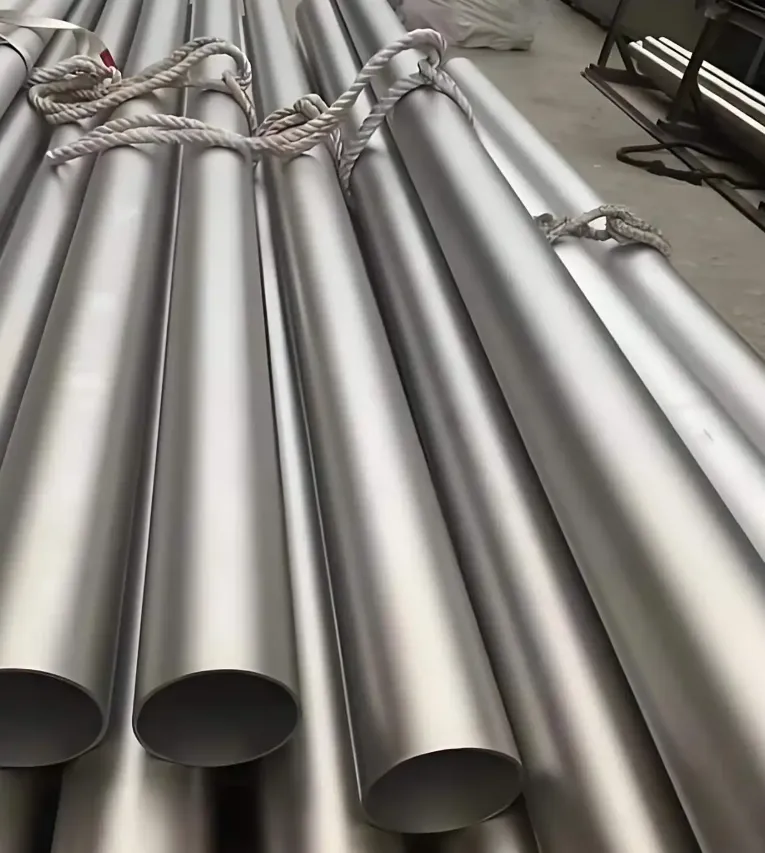
The product achieved industry-standard status through several decades of documented field performance across chemical plant heat exchangers, pharmaceutical reactor coils, offshore umbilical systems, and power generation equipment. No other single tube alloy covers as broad a range of chemically aggressive environments at comparable cost, which is why C276 tube is the default specification in most corrosion engineering evaluation frameworks when the environment falls outside the capability of duplex stainless steels.
Why C276 Replaced the Original Hastelloy C in Tube Form
The original Hastelloy C alloy, developed in the 1930s, suffered from severe intergranular corrosion in welded tube joints because carbon and silicon content levels that were acceptable in cast and wrought bar form caused carbide and silicide precipitation in heat-affected zones during welding. This made welded tube fabrication from original Hastelloy C essentially impractical for corrosion service.
C276's development in the 1960s solved this by reducing carbon to 0.010% maximum and silicon to 0.08% maximum, effectively eliminating the precipitation-forming elements while maintaining the Ni-Cr-Mo-W corrosion-resistant chemistry. The result was a tube alloy that could be welded using GTAW and GMAW processes without the post-weld heat treatment that original Hastelloy C required, opening up the full range of tube fabrication techniques including welded tube production.
C276 Tubing in the Context of the Corrosion-Resistant Tube Market
From our experience at MWalloys supplying corrosion-resistant tubing, C276 occupies the mid-to-upper tier of the alloy tube market: more capable than duplex and super duplex stainless steel grades in reducing and mixed acid environments, comparable to or slightly below C22 in oxidizing environments, and significantly less expensive than titanium for most non-HF acid applications. This positioning makes C276 the first material evaluated when duplex or super duplex tube has already been eliminated from consideration by the process chemistry.
What Are the Chemical Composition and Metallurgical Properties of Hastelloy C276 Tube?
The chemical composition of C276 tube must conform to ASTM B622 (seamless) or ASTM B619 (welded) specifications on a heat-by-heat basis. Understanding each element's functional role helps engineers evaluate whether a particular heat's chemistry will perform at the expected level.
Hastelloy C276 Chemical Composition Per ASTM B622 / B619
| Element | UNS N10276 Min (%) | UNS N10276 Max (%) | Functional Role in Tube Performance |
|---|---|---|---|
| Nickel (Ni) | Balance | Balance (~57%) | Base matrix; chloride SCC immunity; electrochemical stability |
| Chromium (Cr) | 14.5 | 16.5 | Passive film formation; oxidizing acid resistance |
| Molybdenum (Mo) | 15.0 | 17.0 | Primary reducing acid resistance; pitting resistance amplifier |
| Tungsten (W) | 3.0 | 4.5 | Synergistic pitting and crevice corrosion resistance with Mo |
| Iron (Fe) | 4.0 | 7.0 | Controlled residual; affects reducing acid performance at high levels |
| Cobalt (Co) | – | 2.5 | Controlled residual |
| Carbon (C) | – | 0.010 | Critically minimized: prevents HAZ sensitization during tube welding |
| Silicon (Si) | – | 0.08 | Critically minimized: prevents silicide precipitation in HAZ |
| Manganese (Mn) | – | 1.0 | Deoxidation during melt |
| Phosphorus (P) | – | 0.025 | Impurity control |
| Sulfur (S) | – | 0.010 | Impurity; affects hot formability in tube extrusion |
| Vanadium (V) | – | 0.35 | Minor residual |
The PREN Value and Its Significance for C276 Tube Selection
The Pitting Resistance Equivalent Number (PREN) calculated for C276 using the formula:
PREN = %Cr + 3.3 × (%Mo + 0.5 × %W) + 16 × %N
For C276 at nominal composition:
PREN = 15.5 + 3.3 × (16.0 + 0.5 × 3.75) + 0 = 15.5 + 3.3 × 17.875 = 15.5 + 58.99 = ~74
This PREN of approximately 74 significantly exceeds super duplex stainless steel 2507 (PREN ~42) and Inconel 625 (PREN ~52), placing C276 tube among the most pitting-resistant commercially available alloys. In practical terms, this means C276 tube does not exhibit measurable pitting in seawater at temperatures up to approximately 90°C under static conditions, whereas 316L stainless tube pits within weeks at ambient seawater temperature and super duplex 2507 shows pitting risk above approximately 60°C.
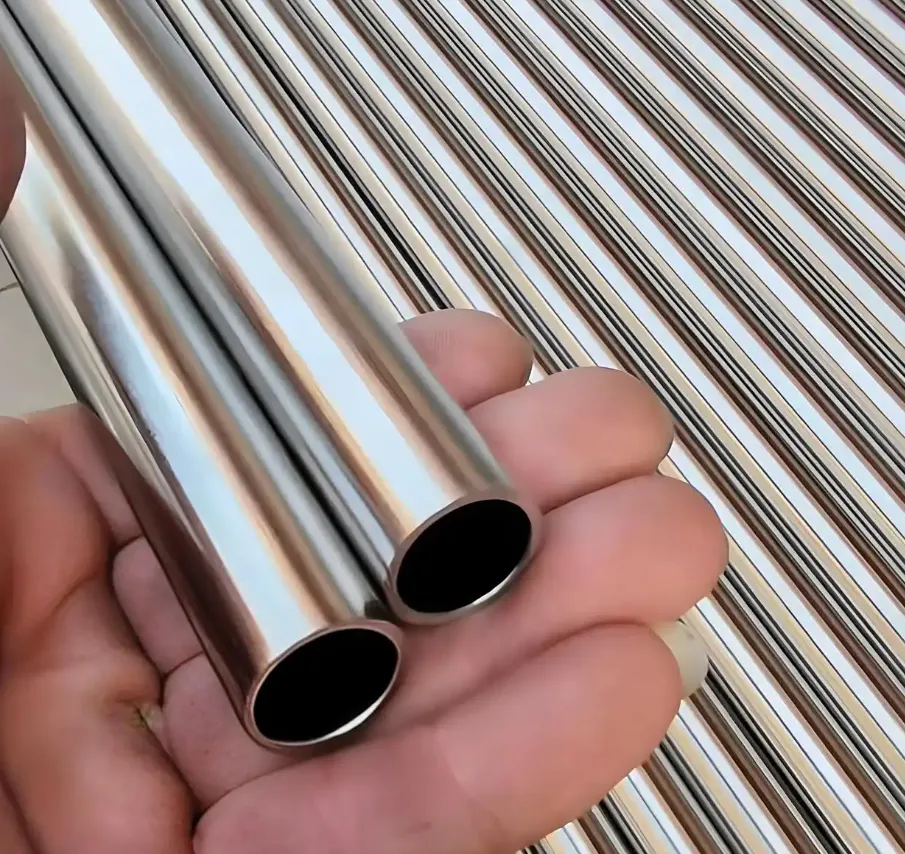
What Is the Fundamental Difference Between Seamless and Welded Hastelloy C276 Tubing?
The choice between seamless and welded C276 tubing is one of the most consequential decisions in tube specification, affecting not only pressure capability but also inspection requirements, regulatory acceptability, and cost.
Manufacturing Process Comparison
Seamless C276 Tubing (ASTM B622):
Seamless tube is produced by hot extrusion of a solid billet through a die, or by rotary piercing followed by cold working. The absence of a longitudinal weld seam is the defining characteristic. The production sequence for C276 seamless tube involves:
- VIM + VAR (or ESR) billet production for cleanliness.
- Hot extrusion at 1050 – 1200°C to produce hollows.
- Multiple cold draw and intermediate anneal passes to final dimensions.
- Final solution anneal at minimum 1121°C followed by rapid quench.
- Straightening, cutting, and dimensional verification.
- Non-destructive testing (eddy current, ultrasonic per ASTM B622)
Welded C276 Tubing (ASTM B619 / B626):
Welded tube is produced by forming flat strip into a tube shape and welding the longitudinal seam. Two variants exist:
- ASTM B619: Welded pipe (NPS 1/8 to NPS 12, heavier wall, structural applications)
- ASTM B626: Welded tube (tubing for heat exchangers and instrumentation, lighter wall)
The weld seam in C276 welded tube is produced by GTAW (TIG) without filler metal addition (autogenous welding) or with matching ERNiCrMo-4 filler. C276's low carbon and silicon content makes the weld seam corrosion resistant without post-weld heat treatment, which is the key advantage of C276 over earlier Hastelloy grades in welded tube form.
Seamless vs Welded C276 Tube: Technical Comparison
| Parameter | Seamless (ASTM B622) | Welded (ASTM B619 / B626) | Practical Implication |
|---|---|---|---|
| Weld seam presence | None | Longitudinal seam | Seamless preferred for pressure-critical |
| Pressure rating per ASME | Higher (no seam efficiency factor) | E = 0.85 (some codes) | Seamless allows thinner wall at same pressure |
| Joint efficiency (E) | 1.0 | 0.85 – 1.0 (depending on radiography) | Welded with RT: E = 1.0 per ASME VIII |
| Wall thickness uniformity | ±10% per ASTM B622 | ±10% (strip-based tolerance) | Similar dimensional capability |
| OD range (common) | 3mm – 168mm OD | 6mm – 300mm OD | Welded available in larger diameters |
| Wall thickness range | 0.5mm – 25mm | 0.5mm – 12mm | Seamless for heavy wall |
| Cost (equivalent dimensions) | 20 – 40% higher than welded | Lower baseline cost | Welded preferred where code allows |
| ASME Code acceptance | All services | Most services with RT | Many pressure vessel codes prefer seamless |
| NDE requirements | Eddy current standard | Eddy current + seam RT | Higher NDE burden for critical welded |
| Surface quality (ID) | Excellent (drawn bore) | Good (seam region may vary) | Seamless preferred for heat exchanger inner surface |
| Lead time | Longer (complex production) | Shorter (strip-based production) | Welded advantages urgent projects |
When to Specify Each Type
Specify seamless C276 tube when:
- The application is governed by ASME Section VIII, Division 1 with no radiography of the tube seam planned.
- Service pressure exceeds 100 bar (the wall thickness difference between seamless and welded matters at high pressure)
- The tube ID surface contacts the process fluid and surface quality is critical (pharmaceutical, food-grade)
- NACE MR0175 sour service specifies seamless tube.
- The application involves tube bending where the weld seam location cannot be controlled relative to the neutral bending axis.
Specify welded C276 tube when:
- Large diameter (above 100mm OD) is required, where seamless availability is limited.
- Full radiographic testing of the weld seam will be performed (achieving E = 1.0)
- Cost pressure exists and the service conditions do not require seamless.
- Urgency of delivery favors shorter-lead welded tube.
What Custom Dimensions, Wall Thicknesses, and Size Ranges Are Available for Hastelloy C276 Tubing?
The dimensional range of C276 tubing is broader than most procurement professionals realize, and custom dimensions beyond standard catalog offerings are more accessible than engineers often assume.
Standard Dimensional Range for C276 Seamless Tube (ASTM B622)
| OD Range | Common Wall Thicknesses | Typical Application | Standard |
|---|---|---|---|
| 3 – 12mm OD | 0.5 – 2.0mm | Instrumentation, sampling lines | ASTM B622 |
| 12 – 25mm OD | 1.0 – 4.0mm | Process tubing, small heat exchangers | ASTM B622 |
| 25 – 50mm OD | 1.5 – 8.0mm | Heat exchanger tubes, reactor coils | ASTM B622 |
| 50 – 89mm OD | 2.0 – 12.0mm | Process piping, larger HX tubes | ASTM B622 |
| 89 – 168mm OD | 3.0 – 20.0mm | Pressure piping, large diameter | ASTM B622 |
Standard NPS Pipe Sizes for C276 Welded Pipe (ASTM B619)
| NPS | OD (mm) | Common Schedules | Wall Thickness Range |
|---|---|---|---|
| 1/4 | 13.72 | 10S, 40S, 80S | 1.65 – 3.02mm |
| 3/8 | 17.15 | 10S, 40S, 80S | 1.65 – 3.18mm |
| 1/2 | 21.34 | 5S, 10S, 40S, 80S | 1.65 – 3.73mm |
| 3/4 | 26.67 | 5S, 10S, 40S, 80S | 1.65 – 3.91mm |
| 1 | 33.40 | 5S, 10S, 40S, 80S | 1.65 – 4.55mm |
| 1.5 | 48.26 | 5S, 10S, 40S, 80S | 1.65 – 5.08mm |
| 2 | 60.33 | 5S, 10S, 40S, 80S | 1.65 – 5.54mm |
| 3 | 88.90 | 5S, 10S, 40S | 2.11 – 5.49mm |
| 4 | 114.30 | 5S, 10S, 40S | 2.11 – 6.02mm |
| 6 | 168.28 | 5S, 10S, 40S | 2.77 – 7.11mm |
| 8 | 219.08 | 5S, 10S | 2.77 – 8.18mm |
Custom Dimensions Available at MWalloys
Beyond catalog dimensions, MWalloys provides custom C276 tubing in configurations that standard distributors cannot supply:
| Custom Capability | Range | Lead Time | Application |
|---|---|---|---|
| Custom OD (non-standard) | Any OD from 3mm to 200mm | 8 – 16 weeks (mill order) | Special heat exchanger tube sheets |
| Custom wall thickness | Any wall within drawing limits | 8 – 16 weeks | Specific pressure-temperature calculations |
| Extra-heavy wall (thick wall) | Up to 30mm wall | 12 – 20 weeks | High-pressure reactor service |
| Precision tube (tight tolerance) | OD ±0.05mm, wall ±0.05mm | 10 – 18 weeks | Analytical instrument tubing |
| Cut-to-exact-length | Any length from 100mm to 12000mm | From stock: 3 – 7 days | Eliminates customer cutting operation |
| Special surface finish (ID/OD) | Electropolished, bright annealed | Per request | Pharmaceutical, semiconductor |
| Double random length (DRL) | 10.7 – 13.7m average | From stock or mill order | Offshore pipeline projects |
| U-bend tubes | Per drawing | 4 – 8 weeks | U-tube heat exchanger bundles |
Dimensional Tolerance Standards for C276 Tube
| Dimension | ASTM B622 (Seamless) | ASTM B619 (Welded Pipe) | ASTM B626 (Welded Tube) |
|---|---|---|---|
| Outside diameter (OD) | ±0.5% or ±0.38mm (whichever larger) | ±0.79mm (< 114.3mm OD) | ±0.25mm (< 25.4mm OD) |
| Wall thickness | ±10% of nominal | ±12.5% of nominal | ±10% of nominal |
| Length (cut lengths) | +6.4mm / -0mm | +6.4mm / -0mm | Per order specification |
| Straightness | 3.2mm per 3m (0.1% of length) | 3.2mm per 3m | Per specification |
| Ovality | Included in OD tolerance | Included | Per specification |
What Mechanical Properties and Pressure Ratings Does C276 Tubing Provide?
Room Temperature Mechanical Properties
| Property | ASTM B622 / B619 Minimum | Typical Achieved | Test Standard |
|---|---|---|---|
| Tensile Strength | 790 MPa (115 ksi) | 820 – 880 MPa | ASTM E8 |
| Yield Strength (0.2%) | 355 MPa (52 ksi) | 380 – 430 MPa | ASTM E8 |
| Elongation (in 50mm) | 40% | 45 – 55% | ASTM E8 |
| Hardness (Rockwell B) | – | 85 – 95 HRB | ASTM E18 |
ASME Allowable Stresses for C276 Tubing in Process Piping and Pressure Vessel Applications
| Temperature (°C) | Allowable Stress (MPa) | Allowable Stress (ksi) | Applicable Code Section |
|---|---|---|---|
| Ambient (40°C) | 148 | 21.5 | ASME B31.3 / Section VIII |
| 100 | 140 | 20.3 | ASME Section II Part D |
| 200 | 132 | 19.1 | ASME Section II Part D |
| 300 | 127 | 18.4 | ASME Section II Part D |
| 400 | 123 | 17.8 | ASME Section II Part D |
| 500 | 118 | 17.1 | ASME Section II Part D |
| 538 | 108 | 15.7 | ASME Section II Part D |
Pressure-Temperature Ratings for Common C276 Tube Sizes
Using ASME B31.3 formula for allowable pressure: P = 2SE(t - c) / (D - 2y(t - c))
Where S = allowable stress, E = joint efficiency (1.0 seamless), t = wall thickness, D = OD, c = corrosion allowance, y = temperature coefficient
| Tube Size | Wall (mm) | Max Allowable Pressure (MPa) at 40°C | Max Allowable Pressure at 300°C | Application Context |
|---|---|---|---|---|
| 25.4mm OD × 1.65mm | 1.65 | 17.8 | 13.7 | Instrumentation tubing |
| 25.4mm OD × 3.0mm | 3.0 | 35.0 | 27.1 | Process tubing |
| 38.1mm OD × 2.0mm | 2.0 | 14.9 | 11.5 | Heat exchanger tube |
| 50.8mm OD × 3.0mm | 3.0 | 17.0 | 13.1 | HX tube, larger diameter |
| 88.9mm OD × 5.0mm | 5.0 | 16.2 | 12.5 | Process piping |
| 88.9mm OD × 8.0mm | 8.0 | 27.0 | 20.9 | High-pressure process piping |
| 114.3mm OD × 6.0mm | 6.0 | 15.1 | 11.7 | Large diameter process pipe |
Note: These calculations exclude corrosion allowance and assume clean bore. Always perform full engineering calculations for actual design conditions.
Physical Properties Relevant to Tube Design
| Physical Property | Value | Relevance to Tube Applications |
|---|---|---|
| Density | 8.89 g/cm³ | Weight per meter calculations |
| Modulus of elasticity (20°C) | 205 GPa | Tube deflection, vibration analysis |
| Coefficient of thermal expansion (20 – 100°C) | 11.2 µm/m·°C | Differential expansion in heat exchangers |
| Thermal conductivity (100°C) | 10.2 W/m·K | Heat transfer coefficient calculations |
| Specific heat | 427 J/kg·K | Thermal transient analysis |
| Magnetic permeability | < 1.002 | Non-magnetic; compatible with MWD, MRI environments |
The low thermal conductivity of C276 (10.2 W/m·K compared to 316L's 16.3 W/m·K) is a significant factor in heat exchanger design. The tube-side heat transfer coefficient is the same for both materials, but the tube wall thermal resistance is approximately 60% higher for C276 than 316L of equivalent wall thickness. This means that for a heat exchanger being retrofitted from 316L to C276 tubing, the thermal performance must be recalculated to verify that the thicker thermal resistance of C276 does not cause the heat exchanger to be undersized.
What Corrosion Performance Data Justifies Hastelloy C276 Tubing Specification?
The corrosion resistance of C276 tubing in actual service environments is the foundation of every specification decision. The following data covers the environments most relevant to tube applications.
Corrosion Rate Comparison in Key Process Environments
| Environment | 316L SS | Duplex 2205 | Super Duplex 2507 | Inconel 625 | C276 | C22 |
|---|---|---|---|---|---|---|
| 10% HCl, 70°C | Fails | Fails | Fails | 8 – 12 mpy | 5 – 8 mpy | 7 – 11 mpy |
| 20% HCl, 60°C | Fails | Fails | Fails | Fails | 8 – 15 mpy | 12 – 20 mpy |
| 10% H₂SO₄, boiling | Fails | Fails | Fails | 15 – 25 mpy | 10 – 18 mpy | 12 – 20 mpy |
| 65% HNO₃, boiling | Passive | Passive | Passive | 5 – 10 mpy | 15 – 25 mpy | 2 – 4 mpy |
| FeCl₃ (10%), 50°C | Fails | Fails | Moderate | 3 – 6 mpy | 4 – 6 mpy | 1 – 2 mpy |
| Seawater (ambient, static) | Pitting | No pitting | No pitting | No pitting | No pitting | No pitting |
| H₂S sour service | SCC risk | Acceptable | Acceptable | Excellent | Excellent | Excellent |
| FGD scrubber slurry | Fails | Fails | Marginal | Good | Good | Excellent |
| 10% H₃PO₄, boiling | 3 – 8 mpy | 5 – 12 mpy | Moderate | 3 – 6 mpy | 2 – 4 mpy | 2 – 5 mpy |
mpy = mils per year; values are approximate from published immersion test data
Critical Pitting Temperature and Crevice Corrosion Performance
For tube applications involving heat exchangers, crevice corrosion at tube-to-tubesheet joints is a primary failure mode for less resistant alloys:
| Alloy | Critical Pitting Temp (ASTM G48C) | Critical Crevice Temp (ASTM G48D) | Seawater Service Limit |
|---|---|---|---|
| 316L | ~15°C | < 0°C | Not recommended immersion |
| Duplex 2205 | ~35°C | ~20°C | Ambient only with caution |
| Super duplex 2507 | ~80°C | ~50°C | Up to ~60°C immersion |
| Inconel 625 | > 85°C | ~65°C | Up to ~75°C immersion |
| C276 | > 85°C | 72 – 80°C | Up to ~80°C immersion |
| C22 | > 85°C | 80 – 90°C | Up to ~85°C immersion |
C276 tube shows essentially no pitting in standard ferric chloride immersion testing at temperatures up to 85°C. For crevice corrosion (the more aggressive test relevant to tube-to-tubesheet joints), C276 provides reliable protection up to approximately 75°C, above which C22 tubing should be evaluated.
Resistance to Stress Corrosion Cracking in Tube Applications
Stress corrosion cracking (SCC) is the most catastrophic failure mode for heat exchanger and reactor tubes because it causes sudden fracture without significant preceding corrosion or dimensional change:
| Alloy | Chloride SCC Resistance | H₂S SCC Resistance | Polythionic Acid SCC |
|---|---|---|---|
| 316L | Fails above ~60°C | Susceptible | Susceptible |
| Duplex 2205 | Moderate (sensitive to conditions) | Acceptable | Less susceptible |
| Inconel 625 | Excellent (immune in normal service) | Excellent | Excellent |
| C276 | Excellent (immune in normal service) | Excellent | Excellent |
| C22 | Excellent | Excellent | Excellent |
C276 tubing has never shown susceptibility to chloride SCC in natural seawater or industrial chloride solutions under any practical combination of temperature, stress level, and chloride concentration encountered in chemical plant service. This immunity stems directly from the nickel content exceeding 40%, which shifts the alloy's electrochemical behavior away from the susceptibility zone for chloride SCC.
What Are the Key Standards, Testing Requirements, and Certifications That Govern C276 Tubing?
Primary Governing Standards for C276 Tubing
| Standard | Issuing Body | Product Form | Key Requirements |
|---|---|---|---|
| ASTM B622 | ASTM International | Seamless pipe and tube | Chemistry, mechanical properties, NDE, dimensions |
| ASTM B619 | ASTM International | Welded pipe | Chemistry, mechanical, weld quality, NDE |
| ASTM B626 | ASTM International | Welded tube | Chemistry, mechanical, weld NDE, dimensions |
| ASME SB-622 | ASME | Seamless (Code construction) | Same as B622 with ASME approval |
| ASME SB-619 | ASME | Welded pipe (Code construction) | Same as B619 with ASME approval |
| ASME SB-626 | ASME | Welded tube (Code construction) | Same as B626 with ASME approval |
| NACE MR0175 / ISO 15156 | AMPP / ISO | Sour service qualification | Hardness limits, environmental conditions |
| API 5LC | API | CRA line pipe | Line pipe specification for subsea |
| EN 10095 | CEN | European equivalent | Heat-resistant Ni alloy tube |
| MSS SP-43 | MSS | Fittings (reference) | Tube fitting dimensions |
Mandatory Testing Requirements Per ASTM B622
Every lot of C276 seamless tubing must pass the following tests before release:
| Test | Standard | Acceptance Criteria | Notes |
|---|---|---|---|
| Chemical analysis | ASTM E1473 | UNS N10276 composition limits | Per heat |
| Tensile test | ASTM E8 | UTS ≥ 790 MPa; YS ≥ 355 MPa; El ≥ 40% | Per lot |
| Hardness test | ASTM E18 or E92 | Per purchaser specification | Optional standard; mandatory for NACE |
| Flattening test | ASTM B622 | No cracks or imperfections | Per lot |
| Reverse bend / flange test | ASTM B622 (small OD) | No cracks | Per lot (small OD tubes) |
| Eddy current NDE | ASTM E426 | Calibration notch standard | 100% of tube length |
| Hydrostatic test (if required) | ASTM B622 | No leaks at test pressure | Optional; specified by purchaser |
| Intergranular corrosion | ASTM G28 Method A | No significant attack | Per lot when specified |
| Dimensional inspection | ASTM B622 | Per tolerance tables | Per piece |
| Visual inspection | ASTM B622 | Free from injurious defects | Per piece |
Supplemental Testing for Critical Applications
Beyond mandatory ASTM B622 requirements, critical applications specify supplemental tests:
| Supplemental Test | When Required | Standard |
|---|---|---|
| Ultrasonic testing (UT) | Pressure vessel Code, offshore, nuclear | ASTM E213 |
| Radiographic testing (RT) of welds | Welded tube, Code construction | ASTM E1030 |
| Intergranular corrosion (IGC) per ASTM G28 | Chemical plant, pharmaceutical | ASTM G28 Method A |
| PMI on every tube | Offshore, nuclear, pharmaceutical | XRF per customer spec |
| Hardness per NACE MR0175 | Sour oil and gas service | ASTM E18 (≤ 40 HRC required) |
| Hydrostatic pressure test | Pressure-retaining applications | ASTM B622 Section 10 |
| Dye penetrant testing (PT) | Weld zone inspection | ASTM E165 |
| Ferrite content (FN) | Welded tube with austenitic microstructure verification | ASTM A799 |
EN 10204 Certificate Types and Application
| Certificate Type | Content | Minimum Requirement |
|---|---|---|
| Type 2.2 | Works test report, non-specific | Not recommended for C276 |
| Type 3.1 | Specific heat test results, manufacturer QC | Standard minimum for all C276 tube |
| Type 3.2 | Specific heat results, independent third party | Offshore, nuclear, pharmaceutical |
MWalloys provides EN 10204 Type 3.1 as standard on all C276 tubing orders, with Type 3.2 available with advance notice for critical applications.
How Is Hastelloy C276 Tubing Correctly Fabricated, Bent, and Welded?
Tube Bending of C276
Bending C276 tubing requires adjustments for its higher yield strength and work-hardening rate compared to stainless steel:
| Bending Parameter | 316L SS | C276 | Adjustment Reason |
|---|---|---|---|
| Minimum bend radius (cold bend) | 2 × OD | 3 × OD | Higher yield requires larger radius |
| Maximum wall thinning at OD | 15% | 20% (allow extra for C276) | Higher springback thins wall more |
| Springback allowance | 3 – 5° | 5 – 8° | Higher elastic component in C276 |
| Mandrel requirement | OD/t > 10 | OD/t > 8 | C276 needs mandrel at lower ratios |
| Post-bend annealing required | No (most cases) | No (if cold bent) | C276 does not sensitize in cold bend |
| Wrinkling risk (ID) | Standard | Slightly higher | Use filled mandrel or sand fill |
| Tooling material | Standard steel | Non-contaminating preferred | Prevent iron pickup |
For U-bend tubes in heat exchangers, bending should be performed before final solution anneal when possible, or on annealed tube with tight radius requirements verified against the alloy's ductility.
Welding C276 Tubing: Process and Procedure
Field Welding of C276 Tube:
| Parameter | Requirement | Notes |
|---|---|---|
| Filler metal (GTAW) | ERNiCrMo-4 (AWS A5.14) | Matching composition |
| Shielding gas | 100% Ar (99.99% purity) | No active gas additions |
| Purge gas (bore) | 100% Ar, O₂ < 20 ppm | Critical for root pass corrosion resistance |
| Current type | DCEN (direct current electrode negative) | Standard for GTAW nickel alloys |
| Preheat | Not required (< 25mm wall) | Avoid: promotes sensitization risk |
| Interpass temperature | 150°C maximum | Monitor with contact thermometer |
| Heat input | Low to medium (< 1.0 kJ/mm for thin wall) | Minimizes HAZ width |
| Post-weld treatment | Mandatory: heat tint removal | Pickling or electrochemical cleaning |
| Back purge duration | Maintain until weld cools below 300°C | Prevents weld root oxidation |
Tube-to-Tubesheet Welding:
For heat exchanger construction, the tube-to-tubesheet joint is the most critical weld in C276 tube systems:
| Joint Type | Configuration | Advantages | Disadvantages |
|---|---|---|---|
| Strength weld + expand | Weld then hydraulic expand | Maximum pull-out strength; eliminates crevice | Most complex process |
| Weld only (no expand) | GTAW weld at tubesheet face | Simple; applicable all tubesheet thicknesses | Crevice corrosion risk at gap |
| Expand then weld | Expand then seal weld | Good for thin tubesheet | Less strength than weld + expand |
| Flush weld | Tube flush with tubesheet + weld | No crevice if done correctly | Requires precise tube projection control |
For C276 tube in corrosive service, the strength weld plus hydraulic expand combination is the standard recommendation because it eliminates the crevice between tube OD and tubesheet bore that creates a stagnant, locally concentrated corrosive zone.
Post-Weld Heat Tint Removal: Why It Is Non-Negotiable
The heat tint adjacent to welds in C276 tubing is a chromium-depleted oxidized zone that can be 3 – 10 times less corrosion resistant than the parent metal. In tube applications where both internal and external surfaces contact corrosive media, failure to remove heat tint creates the most corroded spots in the entire tube bundle, which invariably become the first failure locations.
| Removal Method | Effectiveness | Safety | Preferred Application |
|---|---|---|---|
| HNO₃ + HF pickling (10% + 2%) | Excellent | Requires strict HF protocols | Shop-applied to tube bundles |
| Electrochemical cleaning (gel) | Very Good | Safe; portable | Field welding, installed systems |
| Glass bead blast + passivation | Good | Safe | Where chemical access is limited |
| Citric acid passivation | Acceptable (light tint only) | Safe | Light tint only; limited penetration |
How Is C276 Tubing Applied in Heat Exchangers, Reactors, and Subsea Systems?
Heat Exchanger Applications for C276 Tubing
C276 tubing is specified in heat exchangers when the tube-side or shell-side fluid would cause unacceptable corrosion rates in stainless steel or duplex alloy tubing:
| Heat Exchanger Type | C276 Tube Application | Why C276 Required |
|---|---|---|
| Shell and tube (BEM, AEL, AES) | Tube bundle in corrosive service | Primary corrosive fluid contacts tube |
| U-tube heat exchangers | U-bend bundle configuration | Single tube sheet; cost advantage |
| Double-pipe exchangers | Inner tube or annulus | Highly corrosive concentrated acid |
| Spiral tube (coil-in-shell) | Coil tubing | Aggressive organic or mixed acid service |
| Air-cooled heat exchangers | Finned tube | Corrosive process gas cooling |
| Scraped surface exchangers | Inner tube | Viscous acid or corrosive slurry |
| Falling film evaporators | Tube bundle | Concentrating acid or corrosive solution |
TEMA Heat Exchanger Design Considerations for C276 Tube:
| Design Parameter | Value for C276 Tubing | Design Note |
|---|---|---|
| Maximum tube length (standard) | 6.0m (can extend to 12m) | Longer lengths increase cost |
| Standard tube OD for shell-and-tube | 15.875mm (5/8") or 19.05mm (3/4") | Most common HX tube sizes |
| Standard wall for HX tube | 1.245mm (18 BWG), 1.651mm (16 BWG) | Selected by corrosion + pressure |
| Tube pitch (triangular, standard) | 1.25 × tube OD | Standard TEMA pitch |
| Tube pitch (square, cleanable) | 1.25 × tube OD | Square pitch for shell-side cleaning |
| Maximum unsupported length | Per TEMA vibration analysis | Critical for C276 (high density) |
| Corrosion allowance (tube side) | 0 – 0.5mm (C276 excellent resistance) | Minimal CA needed vs CS |
| Thermal conductivity factor | Apply 10.2 W/m·K for C276 | Lower than SS; affects UA calculation |
Reactor and Pressure Vessel Tube Applications
| Application | Configuration | C276 Tube Function | Key Design Requirement |
|---|---|---|---|
| Reactor coil | Coiled tube inside reactor vessel | Internal heating/cooling coil | High-pressure; corrosive process fluid |
| Jacketed reactor tube | C276 inner tube, carbon steel jacket | Inner process tube | Corrosive inner + steam outer |
| Thermowell tube | Closed-end tube into vessel | Temperature sensing protection | Vibration resistance; corrosion |
| Dip tube | C276 tube into corrosive vessel | Liquid injection / withdrawal | Open end; high velocity internal |
| Bayonet heater tube | Closed-end tube with inner tube | Heating in corrosive vessel | High temp + corrosion combined |
Subsea and Offshore Applications for C276 Tube
| Subsea Application | C276 Tube Size | Why C276 | Key Specification |
|---|---|---|---|
| Chemical injection lines | 6 – 25mm OD | Corrosion inhibitor + seawater | NACE MR0175, ASME B31.3 |
| Hydraulic control umbilicals | 6 – 19mm OD | Seawater + hydraulic fluid | High pressure, small OD |
| Methanol injection tubing | 6 – 25mm OD | Hydrate inhibitor service | H₂S + seawater + methanol |
| Gas lift tubing | 25 – 89mm OD | Sour gas lifting service | High pressure, NACE compliance |
| Instrumentation tubes | 6 – 12mm OD | Process measurement in sour service | Precision OD, tight tolerance |
| Flexible riser inner carcass | 25 – 100mm OD | Produced fluid contact | Sour service, fatigue resistance |
How Does C276 Tubing Compare to C22, Inconel 625, and Duplex Alternatives?
Comprehensive Tube Alloy Comparison
| Property | C276 (N10276) | C22 (N06022) | Inconel 625 (N06625) | Super Duplex 2507 | 316L |
|---|---|---|---|---|---|
| PREN | ~74 | ~71 | ~52 | ~42 | ~24 |
| Reducing acid resistance | Excellent | Good | Moderate | Limited | Poor |
| Oxidizing acid resistance | Moderate | Excellent | Good | Limited | Limited |
| Mixed environment | Good | Excellent | Good | Poor | Poor |
| Seawater pitting (ambient) | Excellent | Excellent | Excellent | Good | Fails |
| Crevice temp (ASTM G48D) | 72 – 80°C | 80 – 90°C | ~65°C | ~50°C | < 0°C |
| Chloride SCC resistance | Excellent | Excellent | Excellent | Moderate | Poor above 60°C |
| NACE MR0175 compliance | Yes | Yes | Yes | Yes | Limited |
| Seamless tube availability | Good | Good | Excellent | Excellent | Excellent |
| Relative tube cost vs 316L | ~8× | ~10× | ~9× | ~3× | 1× |
| Thermal conductivity (W/m·K) | 10.2 | 10.1 | 9.8 | 13.5 | 16.3 |
| Tensile strength (MPa) | 790 min | 690 min | 830 min | 750 min | 485 min |
When to Choose C276 Over Each Alternative
C276 vs C22 tubing:
Choose C276 when the process stream is primarily reducing (HCl, H₂S, concentrated H₂SO₄ at most conditions). Choose C22 when any oxidizing species (HNO₃, ferric chloride, bleach compounds) are present, or when the environment cycles between oxidizing and reducing conditions such as in FGD and pharmaceutical CIP service.
C276 vs Inconel 625 tubing:
Choose C276 when reducing acid resistance is the primary selection driver (C276's 16% Mo versus 625's 9% Mo provides superior reducing acid performance). Choose 625 when high cycle fatigue in seawater is the primary concern (625's superior fatigue properties), or when weld-overlay cladding is the application (625 is the standard overlay alloy). In purely chloride pitting environments without acid, either alloy performs comparably.
C276 vs super duplex 2507:
Choose C276 when service temperature for seawater exceeds 60°C (C276's crevice temperature is 72 – 80°C vs 2507's ~50°C), when reducing acid is present, when H₂S partial pressure is high, or when chloride SCC risk at elevated temperatures is a concern. Choose 2507 when the environment is seawater at ambient to moderate temperatures and cost is constrained (2507 costs approximately one-third of C276).
FAQs: Hastelloy C276 Tubing Supply and Specification
1: What is the difference between Hastelloy C276 seamless tube and welded tube in terms of corrosion resistance?
Hastelloy C276 seamless tube and correctly manufactured welded tube exhibit equivalent corrosion resistance in the base metal, but welded tube carries a higher risk of localized corrosion at the weld seam if heat tint from the welding operation is not completely removed and the post-weld solution anneal (required for some welded tube standards) is not properly executed. The corrosion resistance of C276 is determined by its chemical composition and microstructure, both of which are identical in seamless and welded tube of the same heat. However, the welding process introduces a heat-affected zone where the thermal cycle could theoretically promote localized changes. C276's ultra-low carbon (0.010% maximum) and silicon (0.08% maximum) content was specifically designed to prevent carbide and silicide precipitation in the HAZ, so correctly manufactured C276 welded tube does not show sensitization. The key practical difference is the weld seam's surface condition: if heat tint is not removed by pickling after seam welding during manufacture, the chromium-depleted oxide layer at the seam becomes a preferential corrosion initiation site. ASTM B619 and B626 require that welded C276 tube meet intergranular corrosion testing requirements, and this verification, combined with proper post-weld treatment, ensures the weld seam does not compromise tube performance in service.
2: What is the maximum operating temperature for Hastelloy C276 tubing?
Hastelloy C276 tubing can be used at temperatures up to 1038°C in oxidizing atmospheres and up to approximately 760°C in reducing atmospheres, but for pressure-containing Code applications, the ASME allowable stress is listed up to 538°C, above which creep becomes the limiting mechanism and additional design analysis is required. The distinction between the material's physical temperature capability and its Code-permitted pressure design temperature is important: C276 does not melt or oxidize catastrophically below 1038°C in air, but its mechanical strength drops progressively with temperature and the ASME Code does not list allowable stresses above 538°C for SB-622 N10276 in pressure piping design. For tube applications above 538°C in ASME Code pressure systems, special approval or alternative stress justification is required. A secondary temperature consideration is the sensitization range: sustained thermal exposure in the 500 – 900°C range can cause sigma phase and mu phase precipitation that reduces both toughness and corrosion resistance. C276 should not be used in applications where tube wall temperatures regularly exceed 500°C for extended periods without a full solution anneal to restore properties.
3: How do I calculate the correct wall thickness for a C276 seamless tube in pressure service?
The minimum required wall thickness for Hastelloy C276 seamless tube in ASME B31.3 process piping service is calculated using the formula t = PD / (2SE + 2yP), where P is design pressure, D is outside diameter, S is ASME Section II Part D allowable stress for N10276 at the design temperature, E is joint quality factor (1.0 for seamless), y is the Boardman coefficient (0.4 for temperatures below 482°C), and a corrosion allowance of 0.5 to 1.5mm is typically added for C276 in mild to moderate corrosive service. At ambient temperature (40°C), the allowable stress for C276 seamless tube per ASME SB-622 is 148 MPa (21.5 ksi). For a 50.8mm OD tube at 7 MPa design pressure: t = (7 × 50.8) / (2 × 148 × 1.0 + 2 × 0.4 × 7) = 355.6 / (296 + 5.6) = 355.6 / 301.6 = 1.18mm minimum wall, plus corrosion allowance. The next standard wall thickness above this minimum would be selected from the tube's available dimensional schedule. Always verify wall thickness calculations with a qualified pressure vessel or piping engineer and confirm the applicable code edition and addenda before finalizing tube specifications.
4: Is Hastelloy C276 tubing suitable for handling hydrofluoric acid?
No, Hastelloy C276 tubing is NOT recommended for hydrofluoric acid service because HF destabilizes the chromium oxide passive film that C276 relies on for corrosion protection, causing significantly elevated corrosion rates that make C276 unsuitable for HF-containing process streams. C276's corrosion resistance in most chemical environments depends on its chromium content (15.5%) forming a stable Cr₂O₃ passive film. Fluoride ions (F⁻) from HF aggressively attack this film by preferentially dissolving chromium oxide, exposing fresh metal that corrodes at high rates. For hydrofluoric acid service, the correct tube material choices are: Monel 400 (UNS N04400) for most HF concentrations and temperatures, which forms stable NiF₂ and CuF₂ corrosion products that slow further attack, or for high-concentration HF at elevated temperature, Hastelloy B-3 (UNS N10675) which has near-zero chromium and resists HF through its high molybdenum content rather than chromium passivity. Platinum-lined tubing is used in the most severe HF environments where even Monel is inadequate. When reviewing C276 for any application involving HF, even trace HF concentrations in a mixed acid stream, the specification should be reconsidered and an HF-resistant alloy substituted.
5: What non-destructive testing is required for Hastelloy C276 seamless tubing?
Hastelloy C276 seamless tubing manufactured to ASTM B622 requires 100% eddy current testing of the full tube length per ASTM E426 as the standard NDE method, with supplemental ultrasonic testing (ASTM E213) required for ASME Code pressure vessel applications and additional radiographic testing (ASTM E1030) when specified for critical applications. The eddy current test verifies the integrity of the tube wall along its full length by detecting discontinuities that disturb the electromagnetic field within calibrated sensitivity limits. ASTM B622 specifies the calibration standard (notch dimensions) for the eddy current test of C276 tube. For offshore oil and gas applications governed by API 5LC or NORSOK standards, supplemental UT may be required in addition to eddy current. For ASME Code heat exchanger tube sheets, the hydrotest of the completed tube bundle after roll expansion and seal welding provides an additional post-fabrication integrity verification. Critical services in pharmaceutical, nuclear, or high-pressure chemical applications typically specify: incoming PMI on every tube, eddy current per ASTM B622, hydrostatic test at 1.5× design pressure, dye penetrant on all weld ends, and ASTM G28 intergranular corrosion verification from the same heat. Always specify the required NDE package explicitly in the purchase order rather than relying on minimum standard requirements.
6: Can Hastelloy C276 tubing be used directly in contact with C276 or 316L stainless steel tube sheets?
Yes, Hastelloy C276 tubes can be installed in both C276 and 316L stainless steel tube sheets without significant galvanic corrosion concerns, because C276 and 316L stainless steel are relatively close in the galvanic series in most process environments, and the tube-to-tubesheet joint geometry limits the effective galvanic couple area. In natural seawater, C276 is slightly more noble than 316L stainless steel, which means 316L would theoretically be the anode in a galvanic couple. However, the galvanic driving force between these two alloys in most chemical plant environments is small (typically less than 100 mV), and the corrosion acceleration on the 316L side is generally negligible compared to the inherent corrosion rate of the stainless steel in its service environment. The galvanic combination that absolutely must be avoided is C276 tube (noble) in direct contact with carbon steel or low-alloy steel tube sheets in the presence of an electrolyte: the large area ratio of noble C276 to active carbon steel would accelerate carbon steel dissolution rapidly. For economic optimization of heat exchangers, C276 tubes in 316L tube sheets (clad on the tube-side face) is a common construction that provides the superior corrosion resistance of C276 in the tube bore while using less expensive 316L-clad carbon steel for the tube sheet structural mass.
7: What is the lead time for custom Hastelloy C276 tubing from MWalloys?
Standard C276 seamless tubing in common dimensions (19 – 50mm OD, 1.5 – 4mm wall) from MWalloys stock inventory is available in 1 to 5 business days cut to length; non-standard dimensions or heavy-wall configurations require mill production orders with lead times of 10 to 18 weeks for seamless and 8 to 14 weeks for welded tube. The stock dimensions we maintain at MWalloys cover the heat exchanger tube sizes most commonly specified in chemical plant turnaround and new construction work: 19.05mm × 1.65mm, 25.4mm × 1.65mm, 25.4mm × 2.11mm, 38.1mm × 2.11mm, and key NPS pipe sizes from 1/4" to 4" in both seamless and welded. For project quantities exceeding our stock holdings, or for non-standard dimensions, we recommend initiating orders at minimum 16 weeks before required delivery date to allow mill scheduling, production, testing, and shipping time. Emergency availability checks for urgent maintenance situations can be handled within 24 hours of inquiry, with same-day response on stock status. Contact our technical sales team with your OD, wall thickness, length, quantity, and certification requirements for an immediate availability confirmation and delivery schedule.
8: How should Hastelloy C276 tubing be cut and prepared for welding on site?
Hastelloy C276 tubing should be cut using dedicated non-ferrous cutting equipment (tube cutters with carbide wheels, band saws with bimetal or carbide blades, or abrasive cutting with aluminum oxide or silicon carbide wheels), with all iron-contamination sources eliminated from the work area, and weld ends prepared by machining or filing to a clean 37.5° bevel with a 1.6mm maximum root face, followed by wiping with clean acetone or isopropyl alcohol immediately before welding. The prohibition on using cutting tools previously used on carbon steel applies absolutely: carbon steel particles embedded in the C276 cut face create galvanic micro-cells that initiate corrosion pits at the pipe end, potentially within the first weeks of service. Angle grinders with aluminum oxide discs dedicated exclusively to nickel alloys are the standard cutting and grinding tool for field C276 work. After cutting, the bore and OD in the weld zone (minimum 25mm back from the bevel) should be cleaned with clean stainless steel wool (not regular steel wool) and degreased with acetone. The back-purge argon flow should be established and verified at < 20 ppm oxygen before striking the welding arc, and maintained until the weld cools below 300°C. Never use chloride-containing solvents, cutting oils, or lubricants anywhere near C276 weld preparation areas.
9: What is the correct specification for Hastelloy C276 tube for sour service under NACE MR0175?
Hastelloy C276 seamless or welded tubing for NACE MR0175 / ISO 15156-3 sour service must be specified as UNS N10276, solution-annealed condition, with maximum hardness of 40 HRC verified by hardness testing documented on the material test certificate, in the appropriate product form standard (ASTM B622 for seamless, ASTM B619 for welded pipe), with EN 10204 Type 3.1 certification including explicit hardness results. The NACE limit of 40 HRC for C276 (listed in ISO 15156-3 Table B.2 for nickel-chromium-molybdenum alloys) is easily met in the solution-annealed condition: standard annealed C276 tube typically achieves 85 – 95 HRB (approximately 15 – 20 HRC), well within the limit. The risk of exceeding the 40 HRC limit arises only if the tube has been cold-worked without subsequent annealing. Purchase specifications for sour service must explicitly state: "Material to be in the solution-annealed condition per ASTM B622; maximum hardness 40 HRC (Rockwell C); hardness test results to be reported on EN 10204 Type 3.1 certificate." The environmental qualification limits for specific H₂S partial pressure, temperature, and chloride content must be verified against the actual service conditions using ISO 15156-3 criteria before confirming C276 as the specified material.
10: Can Hastelloy C276 tubes be expanded into tube sheets, and what method is recommended?
Yes, Hastelloy C276 tubes can be expanded into tube sheets using hydraulic expansion (preferred method) or mechanical rolling, with hydraulic expansion strongly preferred because it produces more uniform expansion force distribution, achieves better tube-to-tubesheet contact for reduced crevice risk, and causes less work hardening of the C276 tube wall in the expansion zone compared to mechanical rolling. Mechanical rolling of C276 tubes into tube sheets is achievable with standard roller expanders, but requires higher rolling torque than for 316L stainless steel due to C276's higher yield strength and work-hardening rate. Over-rolling (exceeding the target wall reduction) can locally cold-work the C276 expansion zone to hardness levels that may approach or exceed the NACE MR0175 hardness limit in sour service applications: this is a genuine risk in sour service heat exchangers that must be controlled through roller torque limitation and post-expansion hardness verification on representative samples. Hydraulic expansion using controlled fluid pressure inside the tube produces a uniform, predictable wall reduction (typically 5 – 8% wall reduction) without the torque-related over-rolling risk. For leak-free performance in corrosive service, the preferred joint configuration is hydraulic expansion followed by a seal weld at the tube face, combining the mechanical integrity of expansion with the corrosion sealing of the weld. After expansion and welding, the tube-to-tubesheet joint zone should be inspected by dye penetrant testing on the weld and eddy current on the expanded zone.
Conclusion: Hastelloy C276 Tubing Selection and Custom Supply Done Right
Hastelloy C276 tubing is the benchmark corrosion-resistant tube product for chemical processing, offshore energy, and pharmaceutical applications where the combination of reducing acid resistance, chloride immunity, and pressure-retaining capability cannot be achieved by stainless steels or duplex alloys. The alloy's position as the most commonly specified corrosion-resistant tube in the global market reflects decades of verified performance in environments where every alternative has been exhausted.
The critical success factors for C276 tubing projects:
- Specify seamless (ASTM B622) for pressure-critical and pharmaceutical applications; welded (ASTM B619 / B626) where larger diameters or cost reduction is prioritized with verified weld quality.
- Always require EN 10204 Type 3.1 minimum; Type 3.2 for offshore, nuclear, and pharmaceutical.
- Specify ASTM G28 intergranular corrosion testing when the tube will contact oxidizing or mixed acid environments that could attack a sensitized HAZ.
- Remove heat tint from all field welds before service using pickling or electrochemical cleaning.
- For sour service, explicitly state maximum hardness (40 HRC) and request NACE MR0175 compliance statement on the certificate.
- Account for C276's lower thermal conductivity (10.2 W/m·K) in heat exchanger thermal design recalculations.
- Consider C22 tube if the process has any oxidizing character; the 15 – 20% cost premium of C22 over C276 pays back through substantially longer service life.
Source Custom Hastelloy C276 Tubing from MWalloys
MWalloys supplies custom Hastelloy C276 seamless and welded tubing from certified mill sources in OD ranges from 3mm to 300mm, standard and non-standard wall thicknesses, cut to customer-specified lengths, with full ASTM B622 and ASME SB-622 compliance and EN 10204 Type 3.1 certification.
Our C276 tubing supply capabilities include:
- Stock inventory in heat exchanger tube sizes for immediate delivery.
- Custom OD and wall thickness configurations via mill production orders.
- Cut-to-exact-length service from 100mm to 12,000mm.
- U-bend tube fabrication for heat exchanger bundle assembly.
- NACE MR0175 compliant supply with hardness verification.
- ASTM G28 intergranular corrosion testing documentation.
- PMI (XRF) on every tube as standard practice.
- EN 10204 Type 3.1 standard; Type 3.2 with third-party inspection available.
- Electropolished ID surface for pharmaceutical and bioprocessing applications.
- Technical consultation on tube selection, pressure rating calculations, and welding procedures.
Contact MWalloys today to submit your C276 tubing requirements. Provide OD, wall thickness, length, quantity, applicable standard, certification level, and service environment description for a same-day technical review and quotation. Our tube products engineering team responds to all technical inquiries within one business day.
Verified and Authoritative Sources
- Haynes International – Hastelloy C-276 Alloy Technical Brochure (H-2002E).
- ASTM International – ASTM B622: Standard Specification for Seamless Nickel and Nickel-Cobalt Alloy Pipe and Tube.
- ASTM International – ASTM B619: Standard Specification for Welded Nickel and Nickel-Cobalt Alloy Pipe.
- ASTM International – ASTM B626: Standard Specification for Welded Nickel and Nickel-Cobalt Alloy Tube.
- ASME Boiler and Pressure Vessel Code, Section II, Part B – Nonferrous Material Specifications (SB-622, SB-619, SB-626). American Society of Mechanical Engineers.
- ASME Boiler and Pressure Vessel Code, Section II, Part D – Properties (Allowable Stresses for N10276). American Society of Mechanical Engineers.
- ASME B31.3 – Process Piping. American Society of Mechanical Engineers.
- NACE International (AMPP) – NACE MR0175 / ISO 15156: Petroleum and Natural Gas Industries – Materials for Use in H₂S-Containing Environments. Parts 1, 2, and 3.
- ASTM International – ASTM G28: Standard Test Methods for Detecting Susceptibility to Intergranular Corrosion in Wrought, Nickel-Rich, Chromium-Bearing Alloys.
- ASTM International – ASTM E426: Standard Practice for Electromagnetic (Eddy-Current) Examination of Seamless and Welded Tubular Products.
- AWS A5.14 / ASME SFA-5.14 – Specification for Nickel and Nickel-Alloy Bare Welding Electrodes and Rods. American Welding Society.
- TEMA Standards – Standards of the Tubular Exchanger Manufacturers Association, 10th Edition. TEMA, Tarrytown, New York.
- Schweitzer, P.A. – Corrosion Engineering Handbook: Heat Exchangers, 2nd Edition. CRC Press. ISBN 978-0-8493-8234-2.
- EN 10204:2004 – Metallic Products: Types of Inspection Documents. European Committee for Standardization, Brussels.
- API 5LC – Specification for CRA Line Pipe. American Petroleum Institute.
- ASM International – ASM Handbook, Volume 13C: Corrosion: Environments and Industries. ASM International. ISBN 978-0-87170-709-3.