

As of April 2026, Hastelloy C276 price per pound ranges from USD 20 to USD 55 per pound depending on product form, order quantity, and source region, with sheet and plate averaging USD 22–32/lb, round bar USD 25–38/lb, and seamless tube USD 38–55/lb. At MWalloys, we track C276 pricing across North American, European, and Asian markets daily, and the data consistently shows that nickel spot prices, molybdenum supply tightness, and regional trade policy are the three variables that move this market most aggressively.
If your project requires the use of Aluminum Degassing Equipment, you can contact us for a free quote.
What Is Hastelloy C276 and Why Does Its Chemistry Make It Expensive?
Hastelloy C276, designated UNS N10276 and covered under ASTM B574 (rod and bar), ASTM B575 (sheet and plate), ASTM B619 (welded pipe), and ASTM B622 (seamless pipe and tube), is a nickel-molybdenum-chromium superalloy with minor additions of tungsten and iron. Haynes International originally commercialized it, and it remains one of the most broadly corrosion-resistant engineering alloys ever produced at industrial scale.
The alloy's exceptional resistance to both oxidizing and reducing corrosive environments traces directly to its chemistry. Nickel provides the base matrix, chromium resists oxidizing attack, and molybdenum at 15–17% weight provides outstanding resistance to pitting and crevice corrosion. Tungsten at 3–4.5% amplifies the molybdenum effect in highly aggressive chloride environments. The ultra-low carbon content, capped at 0.010% maximum, prevents carbide precipitation in heat-affected zones during welding, which is the primary reason C276 holds a corrosion resistance advantage over earlier nickel alloys in as-welded applications.
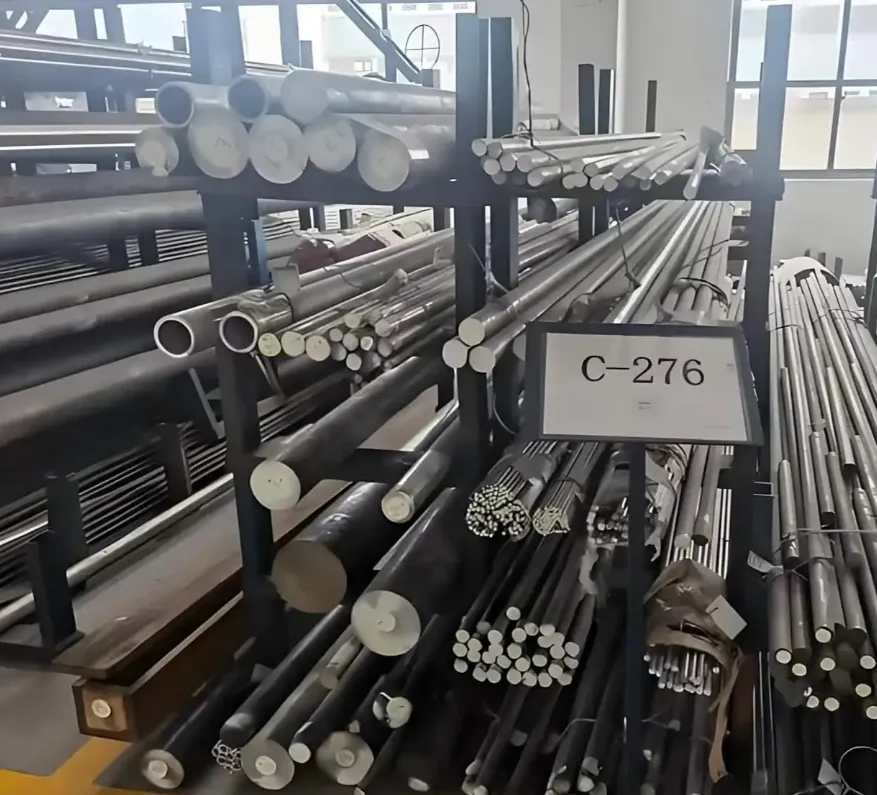
Hastelloy C276 Chemical Composition (UNS N10276)
| Element | Composition (wt%) | Function |
|---|---|---|
| Nickel (Ni) | Balance (~57%) | Corrosion-resistant matrix |
| Molybdenum (Mo) | 15.0–17.0% | Pitting and crevice corrosion resistance |
| Chromium (Cr) | 14.5–16.5% | Oxidizing acid and oxidant resistance |
| Iron (Fe) | 4.0–7.0% | Cost modifier, structural filler |
| Tungsten (W) | 3.0–4.5% | Enhanced localized corrosion resistance |
| Cobalt (Co) | Max 2.5% | Solid solution strengthening |
| Manganese (Mn) | Max 1.0% | Deoxidizer |
| Silicon (Si) | Max 0.08% | Controlled for weldability |
| Carbon (C) | Max 0.010% | Ultra-low for weld zone stability |
| Vanadium (V) | Max 0.35% | Grain refinement |
| Phosphorus (P) | Max 0.04% | Controlled impurity |
| Sulfur (S) | Max 0.03% | Controlled impurity |
Source: ASTM B575 / ASTM B574, Haynes International Hastelloy C276 Technical Bulletin H-2002C.
The molybdenum content at 15–17% is the single most cost-influential element after nickel. At current molybdenum oxide prices of approximately USD 20–24 per pound (Ryan's Notes, March 2026), molybdenum alone contributes roughly USD 6–9 per pound to the finished alloy's raw material cost before any processing is applied. This is a cost layer that does not exist in standard stainless steels and only partially exists in lower-grade nickel alloys.
We frequently explain to first-time buyers that C276 is not simply a premium stainless steel. It is a precision engineered alloy where every percentage point of molybdenum, chromium, and tungsten has been optimized over decades of corrosion testing, and the manufacturing discipline required to produce it consistently is what justifies the price premium.
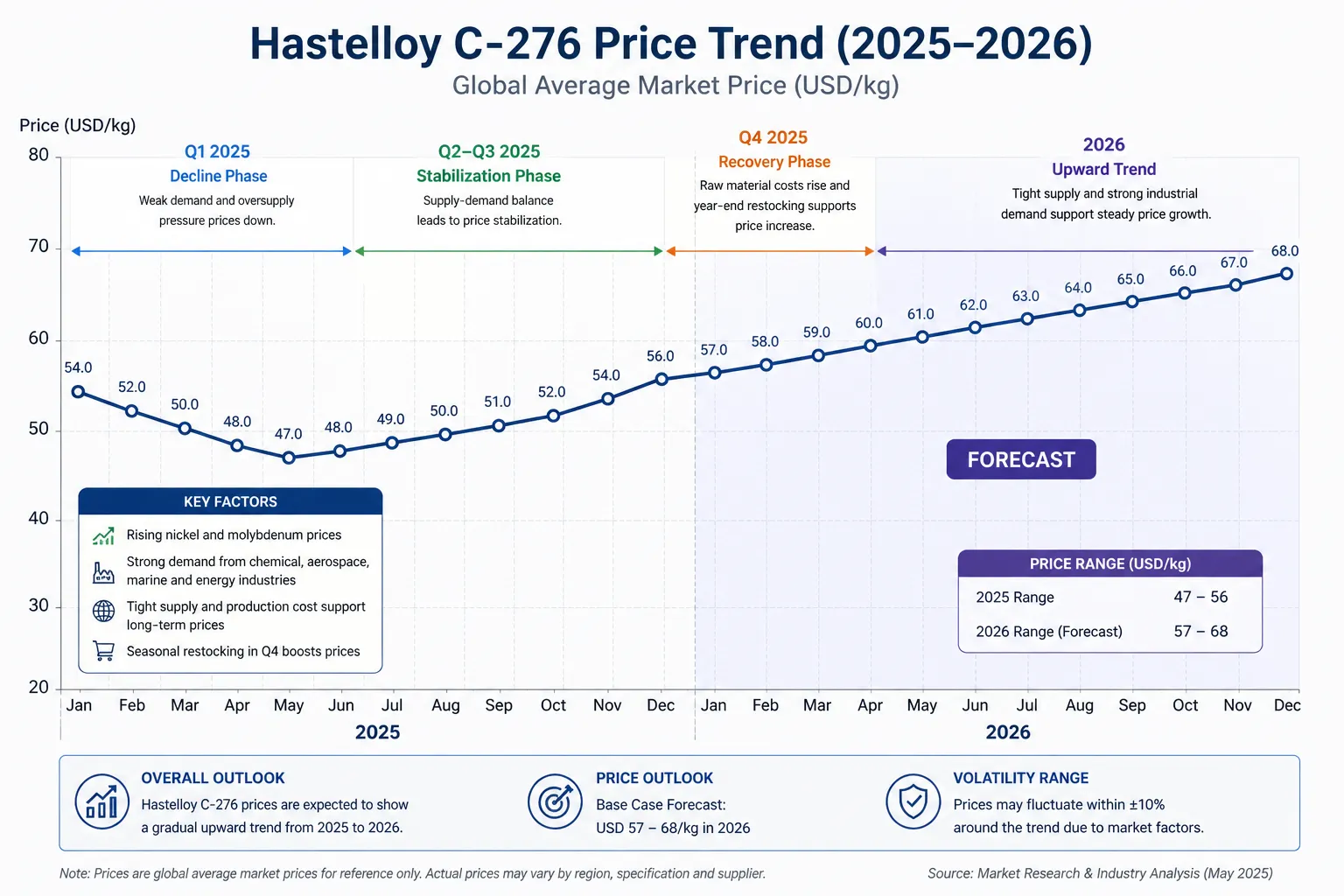
What Is the Current Hastelloy C276 Price per Pound by Product Form in 2026?
Product form is the primary variable in C276 pricing after raw material cost. Converting a nickel alloy ingot into a precision seamless tube involves fundamentally different manufacturing complexity than hot-rolling it into plate, and this processing difference is directly reflected in the price buyers pay.
Hastelloy C276 Price per Pound by Product Form (April 2026 Estimated Market Rates)
| Product Form | ASTM Standard | Price Range (USD/lb) | Price Range (USD/kg) | Notes |
|---|---|---|---|---|
| Sheet and Plate | B575 | USD 20–32/lb | USD 44–70/kg | Widest availability, most competitive |
| Round Bar and Rod | B574 | USD 23–38/lb | USD 51–84/kg | Varies by diameter and tolerance |
| Seamless Pipe and Tube | B622 | USD 35–55/lb | USD 77–121/kg | Highest processing cost, longest lead |
| Welded Pipe | B619 | USD 25–38/lb | USD 55–84/kg | More available than seamless |
| Pipe Fittings | B366 | USD 40–65/lb | USD 88–143/kg | Machining-intensive, small lot premium |
| Flanges (forged) | B564 | USD 32–50/lb | USD 70–110/kg | Forging complexity drives price |
| Welding Wire / Filler | AWS ERNiMo-4 | USD 28–45/lb | USD 62–99/kg | Weld wire AWS A5.14 |
| Powder (AM grade) | Vendor spec | USD 80–150/lb | USD 176–330/kg | Additive manufacturing, premium grade |
Prices are estimated FOB mill or U.S. warehouse, April 2026. Actual transaction prices depend on order volume, certification package, origin, and currency at time of purchase. Contact MWalloys for current quotations.
A point worth emphasizing from our own 2026 procurement data: a 1,000 kg plate order in ASTM B575 N10276 from a qualified European mill was quoted in March 2026 at approximately USD 26/lb (USD 57/kg) inclusive of EN 10204 3.1 certification. A comparable 200 kg seamless tube order in ASTM B622 from a U.S. processor came in at USD 47/lb (USD 104/kg). The delta between those two quotes reflects not price gouging but real manufacturing economics.
How Do Hastelloy C276 Prices Compare Between the USA, China, and India?
Regional price differences in Hastelloy C276 are substantial and highly consequential for global procurement decisions. However, comparing mill prices alone without accounting for freight, tariffs, and documentation costs produces misleading conclusions.
Hastelloy C276 Regional Price Comparison (Sheet/Plate, April 2026)
| Country / Origin | Ex-Works Price (USD/lb) | Ex-Works Price (USD/kg) | Key Price Drivers | Import Tariff to U.S. Market |
|---|---|---|---|---|
| USA (domestic mills) | USD 28–35/lb | USD 62–77/kg | High labor cost, energy cost, Section 232 protection | N/A (domestic) |
| Germany / France (European mills) | USD 25–32/lb | USD 55–70/kg | Strong quality reputation, higher energy costs post-2022 | 0–5% (standard MFN rate) |
| Japan (Mitsubishi, Nippon Yakin) | USD 26–33/lb | USD 57–73/kg | Premium quality, limited volume | 3–5% |
| South Korea | USD 22–29/lb | USD 48–64/kg | Competitive pricing, consistent quality | 0% (KORUS FTA) |
| China (Jiangsu, Shanghai mills) | USD 16–23/lb | USD 35–50/kg | Low labor and energy cost, growing quality | 25% Section 301 tariff applicable |
| India (Pune, Mumbai area) | USD 18–25/lb | USD 40–55/kg | Competitive labor, developing quality systems | 10–15% depending on HTS code |
| Taiwan | USD 20–27/lb | USD 44–59/kg | Export-oriented production, solid documentation | 0–3% |
Data based on MWalloys supplier network pricing, publicly available distributor price lists, and U.S. CBP tariff schedules as of April 2026.
Understanding the True Landed Cost from China vs. Domestic USA
A common procurement error is comparing Chinese ex-works pricing to U.S. domestic pricing without calculating landed cost. Here is a worked example:
Scenario: 1,000 kg of Hastelloy C276 sheet, ASTM B575, sourced from a Jiangsu Province mill for delivery to Houston, Texas.
| Cost Component | Amount (USD) | Per Pound (USD/lb) |
|---|---|---|
| Chinese mill ex-works price (USD 20/lb) | USD 44,100 | USD 20.00 |
| Ocean freight (Shanghai to Houston) | USD 1,800 | USD 0.82 |
| Marine insurance (0.5%) | USD 220 | USD 0.10 |
| U.S. import duty (25% Section 301) | USD 11,025 | USD 5.00 |
| Customs brokerage and ISF filing | USD 400 | USD 0.18 |
| Port handling and drayage | USD 350 | USD 0.16 |
| Third-party PMI / inspection | USD 600 | USD 0.27 |
| Total Landed Cost | USD 58,495 | USD 26.53/lb |
At USD 26.53/lb landed, the Chinese material is no longer dramatically cheaper than a U.S. domestic mill offering at USD 28–30/lb, particularly when you factor in the 14–18 week transit and lead time versus 2–4 week domestic availability. For time-sensitive projects, the cost of delays often exceeds any apparent price saving.
The situation is different for buyers in Southeast Asia, Europe, or other regions where U.S. Section 301 tariffs do not apply. For a European buyer purchasing from China at USD 20/lb ex-works with 3–5% EU import duty, the landed cost advantage versus European mill material can be meaningful, typically 15–20%.
How Has the Hastelloy C276 Price per Pound Changed from 2021 to 2026?
The five-year price history of Hastelloy C276 tracks closely with LME nickel price movements, but the relationship is not perfectly linear because molybdenum, processing costs, and market supply-demand dynamics also contribute independently.
Hastelloy C276 Historical Price Trend (Sheet/Plate, USD/lb, Annual Average)
| Year | Avg. LME Nickel (USD/MT) | Avg. Nickel (USD/lb) | C276 Sheet Avg. Price (USD/lb) | Key Market Events |
|---|---|---|---|---|
| 2021 | USD 18,500 | USD 8.39 | USD 22–28/lb | Post-COVID demand surge, logistics disruption |
| 2022 | USD 25,600 (annual avg.) | USD 11.61 | USD 28–40/lb | Ukraine conflict, LME nickel short squeeze March 2022 |
| 2023 | USD 16,800 | USD 7.62 | USD 21–30/lb | Price correction, inventory destocking |
| 2024 | USD 15,200 | USD 6.89 | USD 20–27/lb | Indonesian Ni oversupply, subdued industrial demand |
| 2025 | USD 14,900 | USD 6.76 | USD 20–26/lb | Moly tightening begins, trade tariff adjustments |
| 2026 (Q1–Q2) | USD 15,800 | USD 7.17 | USD 22–32/lb | Moly supply squeeze, aerospace recovery |
Sources: LME historical nickel data (lme), Fastmarkets Nickel Price Database, Ryan's Notes Molybdenum Monthly, MWalloys procurement records.
The 2022 LME Nickel Short Squeeze: What It Meant for C276 Buyers
The March 2022 LME nickel price spike, which briefly pushed nickel above USD 100,000 per metric ton before the exchange suspended trading and reversed trades, was the single most disruptive event in the nickel alloy market in at least two decades. During the three-week period of maximum uncertainty, multiple C276 mills suspended new order pricing entirely because they could not confidently quote raw material costs. Lead times for ASTM B622 seamless tube, already stretched to 20–28 weeks at the time, extended to 40–52 weeks at some producers. Buyers who had annual framework contracts with fixed escalation mechanisms were significantly better protected than spot buyers.
The lesson we drew from 2022 at MWalloys was that single-source purchasing strategies create serious supply and price risk for materials as globally traded as C276. Buyers who maintained qualified alternative sources were able to manage the crisis far more effectively.
What Factors Drive Hastelloy C276 Price Fluctuations?
Seven distinct cost and market factors interact to determine what you pay for Hastelloy C276 on any given day. Understanding each one gives buyers both context and negotiating power.
Cost Component Breakdown for Hastelloy C276 (Estimated, Sheet/Plate at USD 26/lb)
| Cost Component | Estimated Share | Approximate Value (USD/lb) |
|---|---|---|
| Nickel raw material | 38–42% | USD 9.80–10.90 |
| Molybdenum raw material | 22–26% | USD 5.70–6.75 |
| Chromium + tungsten + iron | 6–8% | USD 1.55–2.10 |
| Melting, casting, hot working | 10–12% | USD 2.60–3.10 |
| Cold working, annealing, finishing | 8–10% | USD 2.10–2.60 |
| Quality testing and certification | 3–5% | USD 0.78–1.30 |
| Mill margin and overhead | 5–8% | USD 1.30–2.10 |
| Distribution and handling | 4–6% | USD 1.04–1.55 |
Factor 1: Nickel Price on the London Metal Exchange
Nickel is the largest single input cost for C276, constituting approximately 57% of the alloy's weight. Every USD 1,000/MT move in LME nickel price translates to approximately USD 0.26/lb movement in finished C276 sheet price, all other factors equal. As of late April 2026, LME nickel is trading near USD 15,800/MT (approximately USD 7.17/lb), which is below the 2021–2022 peak levels but above the 2024 lows.
Factor 2: Molybdenum Supply and Demand
Molybdenum is the second most influential input, and its price cycle operates somewhat independently from nickel. Global molybdenum supply is concentrated in Chile (Codelco, Freeport McMoRan's El Teniente operation), the United States (Climax Mine in Colorado, Henderson Mine in Colorado), and China. In Q4 2025 through Q1 2026, below-forecast production from Chilean operations pushed molybdenum oxide prices from approximately USD 18/lb to USD 22–24/lb, contributing to the uptick in C276 prices observed in early 2026. This moly tightening is not yet fully reflected in most distributor pricing as of April 2026, suggesting modest further price pressure in coming months.
Factor 3: Manufacturing Complexity and Mill Capacity
Not every nickel alloy mill can produce Hastelloy C276. The alloy's high molybdenum content makes it significantly more difficult to hot work than lower-alloy grades because molybdenum raises the alloy's solidus temperature and reduces hot ductility. Tooling wear during rolling and extrusion is substantially higher than for stainless steels. This manufacturing complexity means that only a limited number of qualified global mills maintain regular C276 production schedules, which limits the competitive pressure that would otherwise keep prices lower.
Factor 4: Certification and Testing Requirements
Every Hastelloy C276 product requires, at minimum, a mill test report confirming chemical composition and mechanical properties. More demanding applications add ASTM G28 intergranular corrosion testing, NACE MR0103 hardness verification, ultrasonic testing per ASME SA-578, or radiographic testing. Each layer of required documentation adds real cost, typically USD 0.50–2.50/lb for common packages and USD 2–5/lb for comprehensive nuclear or aerospace qualification packages.
Factor 5: Order Quantity
The quantity break structure in C276 pricing is steep at smaller volumes. Moving from a 100 lb order to a 1,000 lb order of the same specification routinely reduces per-pound pricing by 15–25%. At order volumes above 10,000 lb, mill-direct annual contract pricing becomes accessible, often delivering savings of 20–35% compared to spot distributor pricing.
Factor 6: Trade Policy and Import Duties
U.S. Section 232 tariffs on steel products, Section 301 tariffs on Chinese goods, and periodic anti-dumping investigations create a shifting cost landscape for imported nickel alloys. Buyers must update their tariff calculation assumptions regularly because classification and duty rates for nickel alloy products are subject to regulatory change.
Factor 7: Currency Exchange Rates
Hastelloy C276 is a globally traded commodity priced in USD for most international transactions. Buyers in the Eurozone, India, or Southeast Asia purchasing from U.S. or European mills face exchange rate risk on top of commodity price risk. When the U.S. dollar strengthens against local currencies, the effective cost of C276 for non-USD buyers increases even if the USD/lb price remains stable.
How Does Nickel Price Volatility Translate Into C276 Cost per Pound?
We track the mathematical relationship between LME nickel price and Hastelloy C276 sheet price to give buyers a practical forecasting tool. The correlation between the two, based on our 2021–2026 dataset, is approximately 0.76, meaning that nickel price explains about 76% of the variation in C276 price, with molybdenum, processing costs, and market dynamics accounting for the remainder.
Simplified C276 Price Estimation Formula (USD/lb)
Based on our internal cost modeling:
Estimated C276 Sheet Price (USD/lb) = [Ni% × Ni price (USD/lb) × 1.18] + [Mo% × Mo metal price (USD/lb) × 1.22] + [W% × W price (USD/lb) × 1.10] + [Cr% × Cr price (USD/lb) × 1.08] + Fixed Processing Cost (USD 5.50–8.00/lb)
At April 2026 input prices:
- Ni: 0.57 × USD 7.17/lb × 1.18 = USD 4.83/lb
- Mo: 0.16 × USD 22/lb × 1.22 = USD 4.30/lb
- W: 0.038 × USD 16/lb × 1.10 = USD 0.67/lb
- Cr: 0.155 × USD 1.35/lb × 1.08 = USD 0.23/lb
- Processing: USD 6.50/lb (mid-range)
- Estimated ex-mill cost: approximately USD 16.53/lb
- Distribution and margin: USD 6–10/lb
- Estimated end-buyer price: approximately USD 22–27/lb for sheet
This aligns well with the USD 22–32/lb range we observe for C276 sheet in the current market, with the upper end representing smaller quantities, premium certifications, and ex-stock convenience premiums.
Nickel Price Sensitivity Table for C276 Sheet
| LME Nickel (USD/MT) | LME Nickel (USD/lb) | Estimated C276 Sheet Price (USD/lb) |
|---|---|---|
| USD 12,000 | USD 5.44 | USD 18–22 |
| USD 14,000 | USD 6.35 | USD 20–25 |
| USD 16,000 | USD 7.26 | USD 22–28 |
| USD 18,000 | USD 8.16 | USD 24–31 |
| USD 20,000 | USD 9.07 | USD 26–34 |
| USD 25,000 | USD 11.34 | USD 31–42 |
| USD 30,000 | USD 13.61 | USD 36–50 |
Estimated values assume molybdenum at USD 22/lb, processing costs stable. For planning purposes only.
How Does Hastelloy C276 Price per Pound Compare to Other Nickel Alloys?
Buyers frequently need to evaluate whether C276 is the correct alloy selection or whether a less expensive alternative could meet their technical requirements. The pricing landscape across the nickel alloy family is wide.
Nickel Alloy Price Comparison (Sheet/Plate, USD/lb, April 2026)
| Alloy (UNS) | Ni Content | Price Range (USD/lb) | Price Range (USD/kg) | Key Application |
|---|---|---|---|---|
| 304 Stainless Steel | ~8% Ni | USD 1.30–1.90/lb | USD 2.90–4.20/kg | General purpose |
| 316L Stainless Steel | ~10–14% Ni | USD 1.80–2.60/lb | USD 3.97–5.73/kg | Chemical, food, marine |
| Alloy 20 (N08020) | ~32–38% Ni | USD 5.50–8.00/lb | USD 12–18/kg | H₂SO₄ service |
| Incoloy 825 (N08825) | ~38–46% Ni | USD 9.50–16/lb | USD 21–35/kg | Oil and gas, acid |
| Inconel 625 (N06625) | ~58% Ni | USD 19–31/lb | USD 42–68/kg | High-temp, aerospace |
| Hastelloy C276 (N10276) | ~57% Ni | USD 20–32/lb | USD 44–70/kg | Broad acid resistance |
| Hastelloy C22 (N06022) | ~56% Ni | USD 20–35/lb | USD 44–77/kg | Oxidizing + reducing acids |
| Hastelloy B3 (N10675) | ~65% Ni | USD 25–36/lb | USD 55–79/kg | Reducing acid, HCl |
| Hastelloy C2000 (N06200) | ~59% Ni | USD 27–41/lb | USD 59–90/kg | H₂SO₄, HF environments |
| Inconel 718 (N07718) | ~50–55% Ni | USD 22–38/lb | USD 48–84/kg | High-strength, gas turbine |
Data compiled from MWalloys supplier network pricing and publicly available distributor lists, April 2026.
Within the C-family nickel alloys, C276 and C22 are closely priced, with C22 carrying a 5–15% premium in most product forms because of its higher chromium content and more stringent impurity controls. The choice between them hinges on the corrosive environment: C276 performs better in reducing acid environments with moderate chlorides, while C22 offers superior resistance in mixed oxidizing-reducing conditions and environments containing wet chlorine or hypochlorite.
How Do Order Volume and Specification Requirements Affect the Price You Pay?
The price structure for Hastelloy C276 is not flat. It is highly tiered, and knowing where the breaks occur allows procurement teams to optimize purchase timing and batch size for maximum cost efficiency.
C276 Quantity Price Break Structure (Sheet/Plate, Approximate)
| Order Quantity (lbs) | Order Quantity (kg) | Price Multiplier vs. Reference | Typical Source |
|---|---|---|---|
| Under 100 lbs | Under 45 kg | 1.40–1.60x | Specialty distributor, small lot surcharge |
| 100–500 lbs | 45–227 kg | 1.20–1.35x | Stocking distributor |
| 500–2,000 lbs | 227–907 kg | 1.08–1.18x | Regional distributor |
| 2,000–5,000 lbs | 907–2,268 kg | 1.00x (reference) | Benchmark price level |
| 5,000–15,000 lbs | 2,268–6,804 kg | 0.90–0.95x | Mill-direct or large distributor |
| Over 15,000 lbs | Over 6,804 kg | 0.80–0.88x | Annual contract pricing |
Certification Cost Add-Ons (per pound, approximate)
| Certification Package | Additional Cost (USD/lb) | Required For |
|---|---|---|
| Basic EN 10204 2.2 | Included | Standard commercial |
| EN 10204 3.1 MTR | +USD 0.25–0.60/lb | Most industrial applications |
| EN 10204 3.2 (TPI witness) | +USD 0.70–1.80/lb | Nuclear, offshore, critical |
| NACE MR0175 compliance | +USD 0.45–1.00/lb | Oil and gas sour service |
| PMI verification (XRF) | +USD 0.05–0.15/lb | Material identification confirmation |
| UT (Ultrasonic testing) | +USD 0.70–2.00/lb | Pressure vessel components |
| HIC testing | +USD 0.50–1.20/lb | Hydrogen service |
| Full nuclear Q-level package | +USD 2.50–5.00/lb | ASME NCA qualified components |
For a mid-sized chemical plant purchasing C276 flanges in NACE MR0175 service with EN 10204 3.1 certification, the total certification add-on typically represents USD 0.70–1.60/lb above the base material price. Planning these requirements early and communicating them clearly to suppliers prevents unexpected cost surprises at order placement.
What Is the Five-Year Price Forecast for Hastelloy C276 Through 2030?
Price forecasting for specialty alloys requires synthesizing commodity market projections, structural demand trends, and supply chain investment patterns. The following analysis draws on publicly available forecasts from the World Bank, Wood Mackenzie, and USGS, supplemented by our own market intelligence.
Hastelloy C276 Five-Year Price Outlook (Sheet/Plate, USD/lb)
| Year | Projected Nickel (USD/MT) | Projected Nickel (USD/lb) | Projected Moly Oxide (USD/lb) | Projected C276 Sheet (USD/lb) | Key Demand Drivers |
|---|---|---|---|---|---|
| 2026 | USD 14,500–17,000 | USD 6.58–7.71 | USD 20–25 | USD 22–32 | Moly tightening, aerospace recovery |
| 2027 | USD 15,000–18,500 | USD 6.80–8.39 | USD 18–24 | USD 23–34 | EV demand recovery, chemical plant builds |
| 2028 | USD 16,000–20,000 | USD 7.26–9.07 | USD 19–26 | USD 25–37 | Hydrogen economy infrastructure |
| 2029 | USD 17,000–22,000 | USD 7.71–9.98 | USD 20–28 | USD 27–40 | Semiconductor fab expansion, offshore oil |
| 2030 | USD 18,000–25,000 | USD 8.16–11.34 | USD 22–32 | USD 29–45 | Net-zero industrial investment peak |
Projection basis: World Bank Commodity Markets Outlook January 2026, Wood Mackenzie Nickel Market Outlook Q1 2026, Ryan's Notes Molybdenum 12-month forecast, MWalloys demand analysis. These are scenario ranges, not guarantees.
Structural Forces Supporting Long-Term C276 Price Increases
Green Hydrogen Infrastructure
PEM (proton exchange membrane) electrolyzers operating in acidic electrolyte environments rely on Hastelloy C276 for components including anode porous transport layers, bipolar plates, and piping systems. The IEA projects that meeting 2030 net-zero targets requires approximately 850 GW of installed electrolyzer capacity globally, up from roughly 17 GW in 2024. This demand growth represents a meaningful incremental consumption of C276 and related nickel-chromium-molybdenum alloys.
Semiconductor Manufacturing Expansion
Advanced chip fabrication facilities (fabs) building out 3nm and below process nodes use highly aggressive chemistries including concentrated HF, H₂O₂, and mixed acid systems in ultra-high purity chemical delivery piping. Hastelloy C276 is specified in these systems because of its ability to maintain purity without contributing metallic contamination. The global semiconductor fab investment cycle is in an expansion phase through 2027–2028, driven by U.S. CHIPS Act funding (USD 52 billion allocated), EU Chips Act (EUR 43 billion), and competing programs in Japan, South Korea, and Taiwan.
Oil and Gas Deepwater Development
Deepwater and ultra-deepwater production systems increasingly encounter high-H₂S, high-CO₂, high-temperature well conditions where sour service-rated C276 is required for downhole tubulars, wellhead components, and subsea processing equipment. The post-2024 recovery in offshore capital spending is generating renewed C276 demand in this segment.
Pharmaceutical and Biopharmaceutical Manufacturing
GMP-compliant pharmaceutical reactors, heat exchangers, and piping systems specified in Hastelloy C276 are being built in volume as global pharmaceutical manufacturing capacity expands, particularly in India, Ireland, and Singapore. This is a lower-volume but high-price-sensitivity demand segment.
How Can Procurement Teams Reduce Their Hastelloy C276 Cost per Pound?
Practical cost management in specialty alloy procurement requires both strategic and tactical actions. Below are approaches our clients have successfully implemented.
Eight Proven Strategies for Reducing C276 Cost per Pound
1. Consolidate and Forecast Demand
Many engineering-driven organizations purchase C276 reactively, project by project, missing the quantity breaks that would reduce their per-pound cost by 15–25%. Implementing a rolling 12-month demand forecast and consolidating plant-wide requirements into fewer, larger purchase orders is the single most effective cost reduction available to most buyers without any specification change.
2. Use Nickel-Referenced Pricing Agreements
Rather than accepting fixed-price quotes from distributors who themselves bear price risk and pass it on through margin, negotiate annual supply agreements where the price is set as a fixed conversion premium above LME nickel, adjusted monthly. This approach requires more administrative work but eliminates the built-in uncertainty premiums that fixed-price distributors charge to protect themselves.
3. Accept Mill-Overrun Material
Mills periodically produce lengths or quantities slightly above a specific order's requirements. This overrun material is chemically and dimensionally identical to the ordered product but may not match the next customer's dimensional requirements. Buyers willing to be flexible on exact dimensions can access this material at 10–20% discounts, typically with full certification.
4. Right-Specify the Certification Package
Review every project's actual quality requirement before specifying a certification package. Third-party EN 10204 3.2 inspection adds real cost. If your application genuinely requires 3.1 and not 3.2, that distinction can save USD 0.70–1.80/lb on every pound purchased.
5. Evaluate South Korean or Taiwanese Sources with Duty Modeling
South Korean mills exporting to the United States benefit from zero-duty treatment under the KORUS free trade agreement. Material quality from leading Korean producers of nickel alloys is well-established. Running a proper landed cost comparison against domestic U.S. mill pricing frequently shows Korean-origin material as the cost-optimal choice within a 2–4 week lead time window, which is competitive with domestic availability.
6. Time Large Purchases to Nickel Price Weakness
LME nickel prices historically show seasonal softness in Q3 (July–September) reflecting Northern Hemisphere industrial slowdown. Buyers who can shift discretionary procurement to these periods, particularly for planned maintenance or scheduled shutdowns, can systematically capture 3–8% savings versus Q1–Q2 purchases.
7. Negotiate Scrap Return Credit
C276 machining scrap (turnings, drops, and cutoffs) retains substantial value, typically 40–60% of current new material price per pound for clean, identified material. Establishing a scrap return agreement with your primary C276 supplier that provides material credit or cash payment for returns effectively reduces your net cost per pound of finished component.
8. Partner with MWalloys for Consolidated Supply
As a multi-material nickel alloy distributor, MWalloys aggregates purchasing volume across many customer accounts and product categories, which gives us access to pricing levels that individual buyers ordering smaller quantities cannot reach independently. Our stock inventory in common C276 dimensions removes lead time risk while maintaining competitive pricing.
Frequently Asked Questions About Hastelloy C276 Price per Pound
1: What is the current Hastelloy C276 price per pound in the United States in 2026?
In the United States as of April 2026, Hastelloy C276 prices range from USD 20–32/lb for sheet and plate (ASTM B575), USD 23–38/lb for round bar (ASTM B574), USD 35–55/lb for seamless pipe and tube (ASTM B622), and USD 40–65/lb for pipe fittings (ASTM B366). These are market ranges that reflect the breadth between small-lot stocking distributor pricing and large-volume mill-direct pricing. Actual quotes depend on your specific order quantity, dimensional requirements, certification package, and delivery timing. The most accurate current pricing requires a direct quote request because C276 prices can shift 5–10% within a 30-day window when nickel or molybdenum markets move. At MWalloys, we provide firm 30-day pricing with clear escalation terms for larger orders.
2: Why is Hastelloy C276 so expensive compared to stainless steel?
Hastelloy C276 costs 10–16 times more per pound than standard 316L stainless steel because of three compounding factors. First, the raw material composition is fundamentally more expensive: C276 contains approximately 57% nickel (priced at USD 7/lb versus iron at a fraction of a cent), 16% molybdenum (currently approximately USD 22/lb), and 4% tungsten, while 316L contains only 10–14% nickel and 2–3% molybdenum. Second, manufacturing C276 requires more energy-intensive processing because of the alloy's higher working temperature requirements and greater tool wear during hot and cold working. Third, C276 demands stricter quality control and testing at every production stage to meet its specification requirements. The performance justification for this cost differential is straightforward: in concentrated hydrochloric acid, chlorine-contaminated environments, or mixed acid systems where 316L would fail within days, C276 can last 10–25 years in service.
3: Is the Hastelloy C276 price per pound different for bar stock versus sheet?
Yes, the price per pound for Hastelloy C276 round bar is consistently 10–20% higher than sheet or plate of equivalent weight, and seamless tube is 60–80% higher than plate in most market conditions. The reason is manufacturing process complexity. Producing C276 sheet involves hot rolling followed by cold rolling and annealing, which is a relatively high-throughput process. Producing C276 round bar requires hot forging followed by hot rolling or hot extrusion with tighter dimensional tolerances and higher material utilization loss. Seamless tube production requires hot extrusion through a piercing mandrel, followed by multiple cold drawing passes and intermediate anneals, with each step requiring precise control to avoid cracking in this work-hardening alloy. The scrap rate for seamless tube production is substantially higher than for plate, and this cost is reflected in the finished product price.
4: How does Hastelloy C276 price per pound compare to Hastelloy C22?
Hastelloy C22 (UNS N06022) typically prices 5–15% higher than C276 in equivalent product forms and order quantities. In April 2026, C276 sheet is approximately USD 20–32/lb while C22 sheet runs USD 22–35/lb. The price premium for C22 reflects its higher chromium content (22% vs. 15.5% in C276) and more stringent carbon and impurity limits, which require tighter process control during melting and finishing. The selection between the two alloys should be driven by corrosive service conditions, not price alone. C276 performs better in purely reducing environments such as concentrated HCl without oxidizing agents, where its higher molybdenum content is the dominant protection mechanism. C22 outperforms C276 in mixed acid systems, wet chlorine service, and environments containing oxidizing chlorides or hypochlorite, where its higher chromium content provides critical additional protection.
5: Can I buy Hastelloy C276 cheaper from China, and is the quality acceptable?
Chinese-origin Hastelloy C276 is priced 30–40% below Western mill prices on an ex-works basis but requires careful quality evaluation before use in critical applications. Leading Chinese nickel alloy producers including Baosteel Special Steel and several Jiangsu Province mills have improved C276 production quality significantly over the past decade, and for non-critical industrial applications with third-party chemical verification, Chinese material can offer genuine savings. However, U.S. buyers must factor in the 25% Section 301 tariff, which substantially reduces the apparent price advantage. After tariff, freight, and inspection costs, the net savings versus U.S. domestic material is typically 5–15% at best. For regulated applications in nuclear, pharmaceutical, or offshore sectors where material traceability and qualification are rigorous, the documentation standards and audit access required for Chinese mill qualification add significant cost and time that often eliminates any price benefit.
6: What is the price of Hastelloy C276 welding wire per pound?
Hastelloy C276 welding wire (AWS ERNiMo-4, covered under AWS A5.14) is priced at approximately USD 28–45/lb in April 2026, depending on wire diameter, spool size, and supplier. Smaller diameter wire (0.9–1.2 mm) for MIG/GMAW applications and finer wire (1.6 mm TIG rod) at the upper end of this range because of the additional drawing and precision required for consistent wire diameter. Purchasing welding consumables from the same material family as the base metal is critical to maintaining corrosion resistance in weld zones. Using a lower-alloy filler wire to save money on a C276 system is a false economy that creates preferential attack at weld seams and can cause premature failure. For most applications, the welding wire cost is a small fraction of total project cost, and substituting an inferior filler wire on a system built from C276 pipe makes no economic sense.
7: How do I get an accurate Hastelloy C276 price quote?
To receive an accurate and comparable price quote for Hastelloy C276, you need to specify at minimum: the ASTM specification (B574, B575, B619, B622, B564, or B366), the product form and dimensions (length, width, thickness for plate; OD and wall thickness for pipe), the required quantity in pounds or kilograms, the required delivery schedule, the certification package required (EN 10204 2.2, 3.1, or 3.2), and any additional testing requirements (UT, PMI, NACE compliance). Incomplete inquiries generate wide price ranges that are not useful for budget decisions. Additionally, ask for the quote validity period (most C276 quotes are valid 14–30 days given commodity volatility) and whether the price is inclusive or exclusive of freight, and get clarification on dimensional tolerances applied. Comparing quotes on a total landed cost basis, not just the stated per-pound price, is the only valid comparison method.
8: What is the minimum order quantity for Hastelloy C276, and does it affect pricing significantly?
Most Hastelloy C276 distributors impose a minimum order quantity of 50–200 lbs for stock items, with small-lot surcharges of 20–50% above standard pricing for orders below these thresholds. Mill production runs typically require minimum quantities of 500–2,000 lbs depending on the product form and mill. The pricing impact of quantity is substantial: a 100 lb order of C276 plate from a stocking distributor may be priced at USD 35–42/lb, while the same material in a 5,000 lb order from a mill-direct source may be USD 22–26/lb, a difference of 40–60% per pound. For organizations with recurring but low-volume C276 requirements, the most cost-effective approach is to consolidate several months of requirements into a single purchase that reaches a price-efficient quantity threshold, storing the material in-house rather than purchasing piece by piece at small-lot prices.
9: Does Hastelloy C276 price per pound change with thickness for plate and sheet?
Yes, thickness affects C276 plate pricing, and the relationship is not linear. Very thin material (below 1.5 mm) typically carries a premium of 15–30% per pound above standard plate pricing because thin-gauge rolling requires more cold reduction passes, tighter process control, and generates higher scrap rates when tolerances are missed. Standard plate thicknesses (3–25 mm) are priced at the reference rate with minimal variation by thickness. Very thick plate (above 50 mm) may also carry a modest premium of 5–10% because fewer mills maintain the forging and rolling capability for heavy gauge nickel alloy plate, reducing supply options. For machined components, the most economical approach is usually to specify a standard stock thickness that is slightly above the finished dimension requirement rather than requesting a non-standard thickness that may need to be produced as a special mill run with associated lead time and price premium.
10: Will Hastelloy C276 prices go up or down in the next 12 months?
Based on our analysis as of April 2026, we expect Hastelloy C276 prices to trend modestly higher through the remainder of 2026 and into 2027. The primary upward pressure comes from molybdenum tightening, which has not yet been fully reflected in finished C276 prices at the distribution level, and from growing demand in green hydrogen infrastructure and semiconductor fab construction. Nickel prices are a counterbalancing factor: the persistent Indonesian oversupply of Class 2 nickel is keeping LME nickel relatively subdued compared to 2022 highs, which prevents more aggressive C276 price increases. Our working estimate for H2 2026 C276 sheet pricing is USD 24–34/lb, representing 5–10% above current H1 2026 levels. Buyers with planned procurement needs in late 2026 or early 2027 would be wise to consider placing orders now or entering annual framework agreements to protect against the upward trajectory we anticipate in the molybdenum-driven component of C276 pricing.
Summary: Hastelloy C276 Price per Pound Quick Reference (April 2026)
| Parameter | Value |
|---|---|
| C276 sheet / plate (USD/lb) | USD 20–32/lb |
| C276 round bar (USD/lb) | USD 23–38/lb |
| C276 seamless tube (USD/lb) | USD 35–55/lb |
| C276 pipe fittings (USD/lb) | USD 40–65/lb |
| Current LME nickel (USD/lb) | ~USD 7.17/lb |
| Current molybdenum oxide (USD/lb) | ~USD 22–24/lb |
| U.S. tariff on Chinese C276 | 25% Section 301 |
| Volume discount threshold | 15–25% savings above 5,000 lbs |
| 12-month price outlook | Modest upward trend (+5–10%) |
| 5-year price outlook (2030) | USD 29–45/lb (sheet) |
About MWalloys
MWalloys maintains stock inventory of Hastelloy C276 in sheet, plate, round bar, seamless tube, welded pipe, fittings, flanges, and welding wire. We source from certified mills in the United States, Europe, Japan, South Korea, and India, with full EN 10204 3.1 and 3.2 documentation available. Our technical team provides alloy selection support, corrosion resistance data, and specification review for any C276 application. Contact MWalloys for a current price quotation, sample requests, or technical consultation on Hastelloy C276 procurement.
Disclaimer: All pricing data in this article represents estimated market ranges based on MWalloys procurement intelligence, published distributor price lists, and commodity data as of April 30, 2026. Actual transaction prices depend on specific order details and market conditions at time of purchase. This content is provided for informational purposes and does not constitute a binding commercial offer.
References: ASTM B574, B575, B619, B622, B564, B366 and B619 specifications; Haynes International Hastelloy C276 Technical Bulletin H-2002C; LME nickel historical price data (lme); Ryan's Notes Molybdenum Monthly March 2026; World Bank Commodity Markets Outlook January 2026; Wood Mackenzie Nickel Market Outlook Q1 2026; USGS Mineral Commodity Summaries 2025 (Nickel, Molybdenum); IEA Net Zero by 2050 Roadmap; U.S. CBP Section 301 tariff schedule; KORUS Free Trade Agreement Schedule of the United States.