
AR600 delivers higher surface hardness and greater wear/ballistic resistance than AR500, which makes it the better choice when maximum abrasion resistance, thinner/ lighter sections, or higher-velocity ballistic protection are required; however, AR600 is generally harder to form, can be more expensive, and may exhibit lower ductility than AR500 — so for many heavy-wear, impact-tolerant applications where cost, weldability, and toughness matter, AR500 remains the practical, cost-effective option.
What “AR” means, and why the number matters
“AR” stands for abrasion-resistant plate. Unlike structural steel specifications (ASTM A36, A572, etc.), AR grades are defined primarily by Brinell hardness. The number (400, 450, 500, 600) is shorthand for the approximate Brinell hardness value that the plate is manufactured to meet. Hardness drives wear performance: the higher the BHN/HBW, the better the sliding and gouging abrasion resistance in most service conditions, all else equal.
Important: composition and heat-treat processes vary between mills; two plates both labelled “AR500” can have different chemistry, toughness, and weldability depending on the mill and heat treatment. Always request mill test reports (MTRs).
Typical mechanical numbers — AR500 vs AR600
Below are the commonly reported ranges for commercially supplied plates. These figures are mill-typical ranges — always rely on the vendor MTR for project acceptance.
| Property | AR500 (typical) | AR600 (typical) | Notes / Relevance |
|---|---|---|---|
| Surface hardness (Brinell HBW) | ~470 – 540 HBW (often 477–534 HBW). | ~570 – 650 HBW (often 580–670 HBW). | AR600 is notably harder — better abrasion/ballistic resistance but can be more brittle. |
| Typical tensile strength | ~1650 MPa (240 ksi) reported by many producers. | ~1825–1830 MPa (≈265 ksi) reported for some AR600 products. | Higher tensile often accompanies higher hardness. |
| Typical yield strength | ~1480 MPa (215 ksi) (mill-typical). | ~1516–1518 MPa (≈220 ksi) reported in some datasheets. | Yield numbers vary with heat treat and measuring method. |
| Elongation (%) | Often ~6–12% depending on thickness and mill. | Usually lower than AR500; may be in the single digits at high hardness. | |
| Toughness / Charpy | Mill-supplied Charpy values vary; low-temperature impact energy tends to decrease with increasing hardness. | AR600 typically requires validated Charpy values for ballistic or low-temp applications. |
(These ranges are compiled from mill datasheets and reputable distributors; they are intentionally presented as ranges because specification practice and measurement orientation differ by mill.)
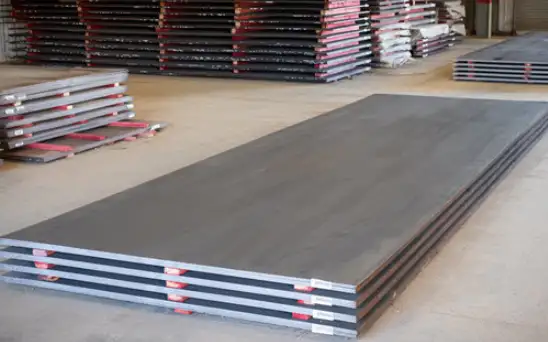
Metallurgy — how AR plate gets its properties
AR plates are usually produced by quenching and tempering; the process creates a hard surface and a tougher core microstructure. Carbon, manganese, and limited alloying elements (Cr, Mo, Ni, B in some mills) are used to achieve the target hardness while retaining some toughness. Mill processes (rolling practice + quench & temper recipe) greatly affect the final microstructure and properties; therefore, “AR500” is a performance class, not a tightly defined chemistry.
For AR600, higher carbon/alloy content and more aggressive heat treatment are common to reach the ~600 BHN level. That increased hardening makes the metal more wear-resistant but reduces ductility and increases sensitivity to forming/cracking if not handled correctly.
Practical fabrication and welding notes
-
Welding: AR steels can be welded, but preheat, interpass temperature control, and chosen filler metal must reflect the plate hardness and thickness. Selection of an appropriate filler (matched or over-matched) and a welding procedure that minimizes hydrogen and thermal shock are essential. When joining AR plate to lower-strength steels, choose filler metals that account for dissimilar base metal strengths. Always follow a qualified procedure and obtain post-weld cooling rates that do not cause excessive hardness near the weld.
-
Cutting: Plasma cutting and laser cutting are common, but the harder the plate, the more wear on consumables and the more careful the parameter selection required. AR600 will cause faster wear on cutting tips and abrasive equipment than AR500.
-
Forming & Bending: AR500 is more formable than AR600; plate thickness and bending radius must be planned conservatively for AR600 to avoid cracking. Some AR600 product lines are supplied with mill-certified bend radii and formability notes.
-
Thermal treatment after fabrication: Grinding, stress-relief, or localized heat from welding can change local microstructure and hardness. For critical applications, re-inspection and hardness checks after fabrication are recommended.
Ballistics and target steel — why many users ask about AR500 vs AR600
In shooting and armor contexts, hardness affects deformation on projectile impact. AR600 can defeat higher-velocity rifle rounds at thinner areal densities compared to AR500; that’s why some manufacturers prefer AR600 for armor plates where weight matters. However, very hard plates may spall more and are less tolerant of multi-hit damage patterns unless properly backed and spall-coated. For most recreational steel targets and many industrial armor uses, AR500 remains widely used because it balances toughness and cost.
Important safety note: never shoot AR plate that is not certified for ballistic use; the plate’s hardness, heat-treatment, backing, and manufacturer guidance determine safe firing practices.
Cost, availability, and lead times
-
Material cost: AR600 typically costs more per kg than AR500 because of tighter mill processing, higher alloying, and lower market volumes. However, because AR600 can be used in thinner sections for the same wear/ballistic performance, the total system cost sometimes narrows.
-
Lead time and stock: AR500 is more widely stocked globally; AR600 inventories are smaller and often produced to order. For urgent projects, AR500 is usually faster to source.
MWAlloys procurement advantage
At MWAlloys we work directly with select Chinese mills and maintain stock for common AR500 and AR600 thicknesses. We offer 100% factory pricing, direct mill paperwork, and expedited shipping for stocked items. For very large or specialized orders we can negotiate mill scheduling and provide mill test reports (MTRs) and heat treatment records. (If you need a quote, tell us thickness, length, and quantity; typical stocked thicknesses include 6mm–50mm depending on grade.)
Comparative table — when to pick AR500 vs AR600
| Decision factor | Pick AR500 when... | Pick AR600 when... |
|---|---|---|
| Cost control | Budget pressure; good wear performance needed but not absolute maximum. | Weight savings justify higher material cost, or top-tier wear performance required. |
| Forming / bending | You need to bend/form plate on press brakes. | Little/no forming — plate used flat or in simple geometries. |
| Welding complexity | Fabrication includes a lot of welding or joining to dissimilar steels. | Minimal welding or with qualified procedures and experienced welders. |
| Ballistic performance | Low-to-moderate ballistic threats or target plates for recreational shooting. | High-velocity rifle threats or weight-critical armor systems (subject to ballistic testing). |
| Abrasion severity | Heavy but tolerable abrasion and impact; long service life sought economically. | Extreme sliding abrasion and severe gouging (mining, aggregate), where maximum BHN extends wear life. |
Test methods and acceptance criteria engineers should require
-
Brinell hardness (ASTM E10): Verify BHW/HBW at surface and a few millimeters beneath for acceptance.
-
Tensile test (ASTM A370): Use MTR tensile numbers to confirm strength claims.
-
Charpy impact (ASTM A673/A370 or EN equivalents): For low-temperature or ballistic applications, request Charpy V-notch energies at the specified temperature.
-
Mill test reports (MTRs): Chemical composition (C, Mn, Cr, Ni, Mo, B), hardness locations, heat treatment record, and traceability must be supplied with each heat.
When specifying material, call out both the hardness acceptance range and the required toughness (Charpy J or ft-lb at a defined temperature). This prevents “hard but brittle” deliveries that fail in service.
Application snapshots
-
Mining buckets, crushers, and chutes: AR600 in high-wear contact zones, AR500 for the rest of the structure.
-
Concrete and aggregate handling: AR600 for liners and wear plates exposed to sliding abrasive material; AR500 for adjacent support pieces.
-
Shooting range targets / armor plates: AR500 common for targets and commercial armor; AR600 used where weight reduction and higher rated ballistic performance are needed — always follow ballistic test data and safety practices.
-
Heavy duty wear components (shredders, screens): AR600 or mill variants of “600-class” steel to maximize service life despite increased cost.
Handling, storage, and in-service inspection
-
Storage: Keep plates dry and off the ground to prevent localized corrosion and staining that complicates hardness testing.
-
Inspection: Periodically check hardness and surface condition in critical wear zones; monitor for cracking, especially near welds and formed edges.
-
Spall control & safety: In ballistic service, fit spall liners or coatings and observe manufacturer recommendations to prevent dangerous spall fragments.
Frequently Asked Questions
-
What is the main difference between AR500 and AR600?
AR600 delivers higher Brinell hardness (roughly 570–650 HBW) than AR500 (roughly 470–540 HBW), giving superior wear and ballistic resistance at the expense of easier forming and sometimes ductility. -
Can AR600 be welded like AR500?
Yes, but AR600 often requires more careful welding procedures (preheat, controlled interpass temperatures, selection of suitable filler metal) because of its higher hardenability and greater risk of local embrittlement. Qualification is recommended. -
Is AR600 always a better choice for armor?
Not always. AR600 may provide higher ballistic performance by weight, but the final armor qualification depends on system design, backing, spall control, and certified ballistic testing. For many civilian use cases AR500 is adequate. -
How much more expensive is AR600 than AR500?
Prices fluctuate by market and country. AR600 typically commands a premium per kg; however, thinner AR600 plates can sometimes substitute for thicker AR500, partially offsetting the price difference. Ask suppliers for side-by-side quotes with equivalent wear life calculations. -
Can AR500 or AR600 be cold-formed?
AR500 can be formed more readily than AR600. When forming AR600, use larger bend radii and consult the mill for approved forming limits. -
Are there recognized standards for AR plate?
AR grades are performance classes; there’s no single universal ASTM spec that defines AR500/AR600 chemistry. However, mills and buyers frequently use EN/BS dimensional standards (e.g., BS EN 10051 for plate tolerances) and ASTM tests (E10 for Brinell hardness, A370 for mechanicals). Specify required tests and acceptance criteria in purchase orders. -
Is AR600 more likely to crack in service?
Without proper design, welding practice, and inspection, higher hardness steels can be more susceptible to cracking under impact or cyclic loads. That risk is manageable with correct material selection, appropriate toughness criteria, and qualified fabrication. -
Which industries use AR600 most?
Heavy mining, aggregate handling, high-abrasion processing equipment, and some ballistic systems where weight is critical. -
How should I specify plate hardness on an order?
Specify a numeric Brinell acceptance range, required test standard (ASTM E10), required Charpy energy and temperature if toughness is critical, and request MTRs. Example: “AR600, 580–640 HBW surface hardness; Charpy V-notch ≥ XX J @ -20°C; provide MTRs.” -
Can MWAlloys supply AR500 and AR600 with export documentation and fast shipping?
Yes. MWAlloys works with approved Chinese mills, supplies MTRs, and offers stocked items at factory pricing with rapid dispatch for standard thicknesses. For bespoke orders we coordinate mill scheduling and testing.
Final recommendations
-
For general heavy wear and ease of fabrication: prefer AR500.
-
For the most severe sliding abrasion or when weight reduction is a top priority: consider AR600 — but insist on MTRs and qualified fabrication.
-
For ballistic or target applications: follow ballistic certification and safety guidance; AR600 offers higher ratings by weight but does not remove the need for safe backing and spall control.
-
Always require MTRs, hardness maps, and (when applicable) Charpy results.
Authoritative references
<li><a href="https://www.steelwarehouse.com/ar500/" target="_blank" rel="nofollow">AR500 Steel Plate — Steel Warehouse (datasheet & mechanicals)</a></li> <li><a href="https://www.cmc.com/en-US/What-We-Do/America/Impact-Metals-Spec-Sheets/TruWEAR-Spec-Sheets/TruWEAR-AR600-Plate" target="_blank" rel="nofollow">TruWEAR AR600 Plate — CMC/IMPACT Metals (technical specification)</a></li> <li><a href="https://www.leecosteel.com/news/post/understanding-abrasion-resistant-steel-plate/" target="_blank" rel="nofollow">Understanding Abrasion-Resistant Steel Plate — Leeco Steel technical article</a></li> <li><a href="https://www.baohuisteel.com/blog/introduction-to-baosteels-ar600" target="_blank" rel="nofollow">Introduction to Baosteel's AR600 — Baosteel (mill perspective)</a></li> <li><a href="https://knowledge.bsigroup.com/products/continuously-hot-rolled-strip-and-plate-sheet-cut-from-wide-strip-of-non-alloy-and-alloy-steels-tolerances-on-dimensions-and-shape-1" target="_blank" rel="nofollow">BS EN 10051 (BSI Knowledge) — Plate tolerances & related EN guidance</a></li>