

Custom Monel 400 hex nuts provide one of the most dependable options in aggressive industrial environments, and in many seawater, offshore and chemical process bolted joints they deliver longer service life and fewer failures than stainless steel or coated carbon steel nuts. When a joint must hold torque in chloride rich, acidic, alkaline or mildly reducing media, custom Monel 400 hex nuts typically give the best balance between corrosion resistance, mechanical strength, and lifecycle cost, which is why many engineers and procurement teams treat them as a default choice in critical service.
What makes custom Monel 400 hex nuts the right choice in critical bolted joints?
Designers and buyers usually move to custom Monel 400 hex nuts when standard stainless or plated hardware cannot survive plant conditions or qualification testing. Several technical reasons drive that decision.
Key performance advantages in harsh environments
- Excellent resistance in seawater and brine at ambient and elevated temperature.
- Strong resistance to stress corrosion cracking in many chloride environments.
- Good mechanical strength from cryogenic temperature up to roughly 480 °C.
- Little tendency to suffer from hydrogen embrittlement in many service conditions.
- Stability in many acids and alkalis, especially hydrofluoric and hydrochloric media at controlled concentration.
- No risk of coating damage because the alloy itself provides corrosion resistance.
In bolted joints on heat exchangers, pumps, offshore platforms and desalination units, corrosion of nuts often triggers leakage or full joint failure. Monel 400, a nickel copper alloy, maintains integrity where 304 and 316 stainless nuts can pit, crevice corrode or crack under tension.
Custom hex nuts become relevant when:
- A design calls for nonstandard sizes, unusual thread pitches or special nut heights.
- Industry standards do not cover the combination of size, shape and material that the joint requires.
- Design engineers want matched nuts to special Monel 400 bolts or studs.
- Qualification testing shows that commodity nuts do not meet performance targets.
MWalloys focuses on this custom space where detailed engineering input, reliable metallurgy and flexible production capability matter more than commodity pricing.
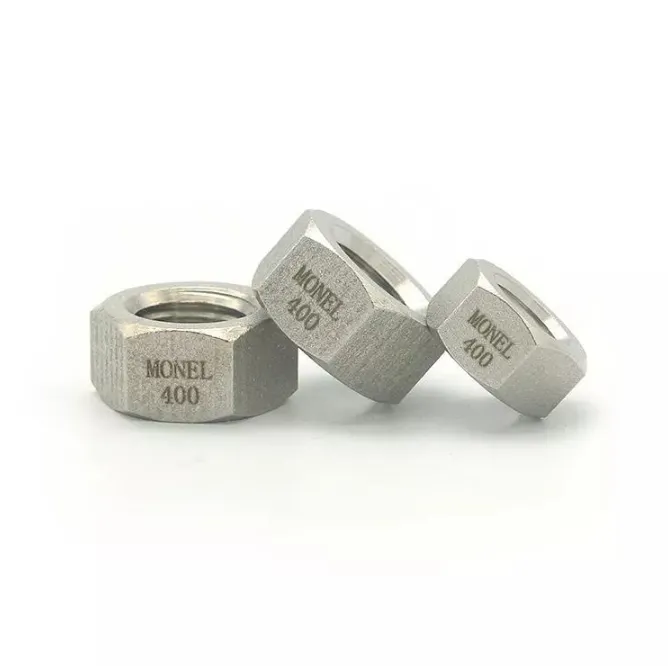
What is Monel 400 alloy and how does it behave in service?
To evaluate whether custom Monel 400 hex nuts fit a given project, engineers need to understand the alloy itself. Monel 400 (UNS N04400, W.Nr. 2.4360 / 2.4361) is a solid solution nickel copper alloy with small amounts of iron, manganese and trace elements. It originated in early twentieth century metallurgy and remains one of the most widely used nickel copper alloys in marine and chemical industry.
Chemical composition of Monel 400
Typical composition limits, based on common product standards, appear in the table below.
Table 1. Typical chemical composition of Monel 400
| Element | Typical content (mass percent) |
|---|---|
| Nickel (plus cobalt) | 63.0 min |
| Copper | 28.0 – 34.0 |
| Iron | 2.5 max |
| Manganese | 2.0 max |
| Silicon | 0.5 max |
| Carbon | 0.3 max |
| Sulfur | 0.024 max |
Nickel and copper create a single phase solid solution over the full range of composition between pure nickel and pure copper. That structure gives Monel 400 a combination of toughness and corrosion resistance in many media that attack steel and even some stainless grades.
Corrosion performance in typical environments
Engineers frequently select Monel 400 hex nuts in the following environments:
- Seawater and brines, including splash zone and tidal exposure
- Salt laden coastal atmospheres
- Hydrofluoric acid, fluorides and HF containing catalysts
- Non oxidizing or mildly oxidizing mineral acids at appropriate concentration
- Alkalis, caustic solutions and neutral salts in many cases
- Crude oil, sour gas service within certain limits, and refinery streams
Key characteristics:
- Very low corrosion rate in quiet or flowing seawater over a wide temperature range
- High resistance to chloride induced stress corrosion cracking in many neutral and alkaline solutions
- Good resistance to pitting compared with common stainless steels in reducing chloride media
- Some sensitivity to strong oxidizing conditions such as hot, aerated nitric acid
When an environment shifts from reducing to strongly oxidizing, Monel 400 may not remain suitable. In such cases engineers might consider higher alloyed nickel materials. However, in marine and mildly reducing chloride rich service, Monel 400 hex nuts usually have a long record of reliable use.
Mechanical properties relevant to hex nuts
Monel 400 gains strength through cold work rather than precipitation hardening. For hex nuts produced from cold drawn bar or forged stock, common minimum mechanical values look similar to those in the next table.
Table 2 – Typical room temperature mechanical properties
| Condition | Yield strength 0.2 percent offset (MPa) | Tensile strength (MPa) | Elongation in 50 mm (%) | Hardness (HB) |
|---|---|---|---|---|
| Annealed plate / bar | 170 – 240 | 380 – 550 | 30 min | 110 – 180 |
| Moderately cold worked | 240 – 345 | 550 – 690 | 20 min | 180 – 240 |
| Heavily cold worked | 345 min | 690 – 860 | 15 min | 240 – 300 |
For hex nuts, properties depend on starting bar or forging stock, deformation during nut forming and any subsequent stress relief. Many Monel 400 nuts supplied by MWalloys target proof strengths comparable to ASTM A194 Grade 2, while maintaining the corrosion resistance of a nickel copper alloy.
Temperature range and toughness
Monel 400 maintains ductility and impact toughness at very low temperature and retains useful strength at elevated temperature. Important points:
- No ductile brittle transition within cryogenic range down to liquid hydrogen temperature
- Mechanical strength reduces gradually with rising temperature, but nuts retain useful load capacity up to roughly 480 °C in many designs
- No phase transformation that might suddenly embrittle standard fastener sizes in normal industrial temperature ranges
This combination of low temperature toughness and high temperature stability allows custom Monel 400 hex nuts to support bolted joints in LNG facilities, refrigeration units, warm process brines and high temperature caustic environments.
Which standards and specifications apply to Monel 400 hex nuts?
Custom Monel 400 hex nuts sit at the intersection of material standards and dimensional fastener standards. Engineers and buyers should align both areas when preparing a specification.
Common material standards involving Monel 400
Material forms used to manufacture nuts typically follow standards such as:
- ASTM B164: Nickel copper alloy rod, bar and wire (including UNS N04400)
- ASTM B574 or similar nickel alloy bar standards, where applicable by client requirement
- ASTM B127: Monel 400 plate, sheet and strip, sometimes used in special nut designs
- ASME SB164, SB127: Boiler and Pressure Vessel Code equivalents
Material certificates usually reference UNS N04400 together with one of these product standards. When ordering custom Monel 400 hex nuts, buyers should request test reports indicating heat chemistry and mechanical properties that meet the selected material standard.
Dimensional standards for hex nuts
Dimensional requirements for hex nuts often align with standards such as:
- ASME B18.2.2: Square and hex nuts, including heavy hex patterns
- ISO 4032: Hex nuts, style 1
- ISO 4033: Hex nuts, style 2
- ISO 8673: Hex nuts, high type
- DIN 934, DIN 6915 and similar European specifications
Even when a project requires nonstandard geometry, MWalloys engineers usually start from these base standards and then modify across width across flats, height, chamfer condition or thread engagement to match joint design needs.
Industry specific standards and approvals
In sectors where failure risks carry heavy penalties, additional standards and approval documents come into play:
- NACE MR0175 / ISO 15156 covering materials in H2S containing environments within oil and gas production
- NORSOK standards relating to offshore equipment
- Naval or defense standards in marine and naval construction
- Client specific specifications for refineries, petrochemical plants and nuclear installations
While Monel 400 generally shows good resistance in many sour environments, details such as partial pressure of H2S, chloride level and stress state need careful review. MWalloys can assist in aligning nut material, hardness level and heat treatment with relevant sour service requirements.
How are custom Monel 400 hex nuts engineered and manufactured?
Production of custom Monel 400 hex nuts requires understanding of both metallurgy and precision machining or hot forging processes. Nickel copper alloys differ in machining behavior from carbon steel or stainless, and thoughtful process selection improves quality as well as cost.
Material sourcing and traceability
Quality begins with correct bar or forging stock. Key steps:
- Selection of mill sources with proven experience in nickel copper alloys
- Verification of chemical composition against UNS N04400 limits
- Review of mechanical test data by heat and product form
- Positive material identification through spectrometric testing at goods inwards
- Full heat traceability maintained through production, packaging and documentation
MWalloys maintains controlled stocks of Monel 400 bar in common diameters and can source special diameters or forged blanks when projects require large nuts or unusual shapes.
Forming routes for hex nuts
Two main routes exist for hex nut manufacture:
- Machining from bar or billet
- Best suited to small batches, very large sizes, intricate geometries and tight tolerances
- Involves sawing or cutting blanks, facing, turning, drilling, tapping or threading and chamfering
- Allows flexible changes during prototype development or qualification phases
- Hot forging followed by machining
- Suitable in larger runs where unit cost reduction matters
- Forging produces near net hex shape then machining refines threads and faces
- Forging can improve grain flow and fatigue resistance in some applications
Monel 400 has a tendency to work harden, so both machining and forging require controlled parameters. Sharp tools, proper coolant, moderate cutting speeds and appropriate reduction of area in forging help maintain surface integrity and dimensional accuracy.
Threading and tolerance control
Threads in Monel 400 hex nuts can follow:
- Unified threads: UNC, UNF, UN, 8UN
- Metric threads: coarse and fine series
- Special threads: ACME, trapezoidal, buttress where required
MWalloys uses precision taps, thread milling or single point threading depending on size and batch volume. Key checks include:
- Thread plug gage verification to the required class, such class 2B or 3B in Unified system, or 6H in metric system
- Control of minor diameter to maintain load carrying capacity while avoiding excessive stress concentrations
- Surface finish control on thread flanks and roots, since roughness can affect fatigue strength and galling tendency
Thread tolerances often follow ASME B1.1, B1.13M or ISO 965 series, unless project specifications call out alternative fits.
Heat treatment and stress relief
Monel 400 does not require quench and temper treatments. However, operations such as cold heading, thread rolling and heavy machining can introduce residual stresses. Controlled stress relief heat treatment provides benefits:
- Reduces risk of distortion during storage or service at raised temperature
- Lowers residual stress that might interact with external loading in stress corrosion scenarios
- Stabilizes dimensions when nuts operate close to upper temperature limits
Typical stress relief treatments involve temperatures in the range 260 to 425 °C with soak time dependent on section size. Cooling usually proceeds in air or still furnace atmosphere.
Quality control and testing
Quality measures at MWalloys typically include:
- Dimensional inspection on width across flats, height, thread dimensions, chamfers and bearing surface flatness
- Visual inspection for laps, folds, surface tearing and machining marks
- Hardness testing on representative nuts per heat and batch
- Optional proof load testing on selected sizes
- Non destructive examination when project specifications require, including dye penetrant testing on critical surfaces
- Full documentation package – material test report, dimensional report and certificate of conformity
For nuclear, aerospace or high integrity offshore projects, additional tests such as Charpy impact, microstructure evaluation or corrosion testing can be arranged.
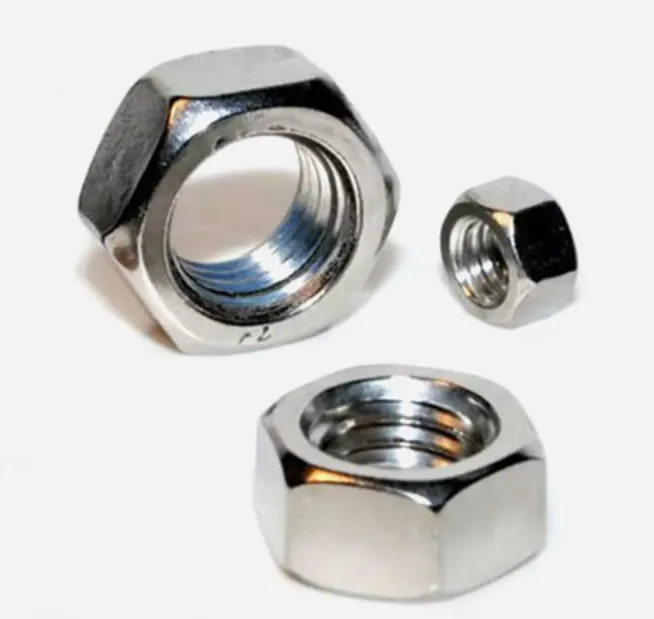
What design options are available when specifying custom Monel 400 hex nuts?
Standard six sided nuts often do not meet every engineering requirement. Custom Monel 400 hex nuts can incorporate many design variations to suit specific joint geometries, access constraints or loading conditions.
Nut styles and geometries
MWalloys frequently supplies the following styles in Monel 400:
- Standard hex nuts with regular height.
- Heavy hex nuts with increased across flats and greater height for higher load capacity.
- Jam nuts in reduced height for locknut applications where thickness is limited.
- Slotted or castellated nuts for use with cotter pins and mechanical locking systems.
- Cap nuts where thread protection or aesthetic appearance matters.
- Step nuts or special profile nuts that seat in recesses or machined grooves.
- Flange nuts with integral bearing face where separate washers are undesirable.
Engineers should evaluate wrench clearance, load path, required bearing area and available axial space when choosing the style. In many pressure containing joints heavy hex nuts provide better load distribution onto the flange surface.
Surface condition and coatings
In many Monel 400 applications, additional coating is unnecessary because the base alloy resists corrosion very effectively. However, several surface treatments remain relevant:
- Silver plating on bearing surfaces and threads to reduce friction and minimize galling in high temperature or high load assemblies.
- PTFE or polymer coatings to aid lubrication, though care is required to avoid damage in rough handling.
- Shot peening on highly loaded nuts to improve fatigue strength in vibration sensitive assemblies.
Each treatment influences friction coefficient, torque tension relationship and long term performance. Engineers should align nut friction characteristics with those of mating studs or bolts so that target preload can be achieved consistently.
Thread fit, class and running clearance
Thread fit choice affects assembly ease and clamp load consistency:
- Tighter fits such class 3B or 6H deliver better alignment and reduced play, at the cost of more difficult installation in the presence of debris or plating thickness variation.
- More generous fits such class 2B or 6G ease installation in field conditions, particularly offshore platforms where contamination is common.
Custom Monel 400 hex nuts can be supplied with special allowance to compensate coating thickness or to match existing field studs previously exposed to corrosion or wear.
Integration with gaskets and flange design
Nut size and seating face interact with gasket selection and flange geometry. Points to verify:
- Sufficient bearing area beneath nut to avoid local crushing of gasket or flange facing.
- Adequate clearance between nut corners and raised face outside diameter.
- Proper washer selection when gasket manufacturers recommend specific washer hardness or dimensions.
MWalloys technical staff can assist in checking these interactions on new flange designs or retrofits where existing hardware has shown problems.
Size range and capability
The practical range of custom Monel 400 hex nuts supplied by MWalloys is summarized in the table below.
Table 3. Typical size range supplied by MWalloys
| Thread system | Nominal diameter range | Typical nut styles available |
|---|---|---|
| Metric coarse / fine | M6 to M72 and above by request | Hex, heavy hex, jam, flange, slotted, cap |
| Unified UNC / UNF | 1/4 inch to 2 3/4 inch, larger on request | Hex, heavy hex, jam, slotted, cap |
| 8UN and special | 1 inch to 4 inch | Heavy hex, special profile, step nuts |
| Custom threads | Per drawing | All feasible shapes per design review |
Sizes outside these ranges can often be produced using special forgings or large diameter bar. Lead times depend on nut geometry, order quantity and availability of starting material.
How do Monel 400 hex nuts compare with stainless steel and other nickel alloys?
Procurement teams frequently ask why Monel 400 hex nuts cost significantly more than stainless steel nuts and how performance compares with alternative nickel alloys. A structured comparison helps justify selection.
Comparison with austenitic stainless steels
Stainless grades such 304 and 316 remain common in many plants because they combine moderate corrosion resistance with relatively low cost. However, in several key areas Monel 400 offers benefits:
- Higher resistance to general corrosion in seawater.
- Better performance in many non oxidizing acids and alkalis.
- Lower tendency to stress corrosion cracking in chloride containing solutions under tensile stress.
- Better resistance to pitting in reducing chloride media.
On the other hand, stainless steels often retain an advantage in strongly oxidizing environments. Mechanical strength at room temperature can be similar, though specific fastener grades such A4-80 may equal or exceed values of solution annealed Monel 400.
Comparison with high nickel alloys such Inconel 625 or Hastelloy C276
Compared with more highly alloyed nickel chromium molybdenum materials, Monel 400 occupies a middle ground:
- Usually lower cost per kilogram than Inconel 625 or Hastelloy C276.
- Less resistance to very strong oxidizing media or hot concentrated acids.
- Often sufficient resistance in seawater, neutral chlorides and mild acids without need to step up to higher alloy grades.
- Similar good toughness across wide temperature range.
Engineers sometimes reserve Inconel 625 or C276 nuts for the most aggressive process streams, while adopting Monel 400 in marine or moderately corrosive roles where its nickel copper chemistry provides ample margin.
Simplified comparison table
The next table presents a simplified comparison for reference in material selection.
Table 4 – Monel 400 hex nuts compared with alternative materials
| Property / criterion | Monel 400 | 316L stainless | Inconel 625 | Hastelloy C276 |
|---|---|---|---|---|
| Primary alloy family | Nickel copper | Chromium nickel stainless | Nickel chromium molybdenum niobium | Nickel chromium molybdenum |
| Relative material cost | Medium to high | Low to medium | Very high | Very high |
| Seawater corrosion resistance | Excellent | Fair to good, risk of crevice and pitting | Excellent | Excellent |
| Resistance to chloride SCC | Very good in many neutral / alkaline solutions | Limited, sensitive under stress | Very good | Very good |
| Strength at room temperature | Medium to high (cold worked) | Medium | High | High |
| Resistance in strong oxidizing acids | Limited | Moderate | Good | Excellent |
| Ease of machining | Challenging, work hardens | Moderate | More challenging | More challenging |
| Typical use of hex nuts | Marine, desalination, HF service, sour service within limits | General plant hardware | High temperature, high pressure, critical chemical service | Very aggressive chemical process streams |
This comparison shows why Monel 400 often emerges as the practical compromise in many projects: strong marine performance, robust resistance to several chemical media and manageable price compared with more exotic nickel alloys.
What should procurement teams check before ordering custom Monel 400 hex nuts?
A high integrity bolted joint depends on clear communication between design engineers, procurement staff and fastener manufacturers. Purchasers specifying custom Monel 400 hex nuts should confirm several points before release of a purchase order.
Material grade and certification
Key checks include:
- Confirmation that nuts will be manufactured from Monel 400 / UNS N04400.
- Indication of applicable material product standard such ASTM B164 or equivalent.
- Requirement that manufacturer supply mill test reports with heat number, chemical compostion and mechanical properties.
- Agreement on hardness range, especially in sour service governed by NACE MR0175 requirements.
Where dual certification or alternative alloy grades appear in client documents, technical clarification before order placement avoids confusion.
Dimensional details and drawings
Procurement staff should either:
- Provide detailed drawings with full dimensions, tolerances and thread specification.
- Or, reference standard nut geometry such ASME B18.2.2 heavy hex with explicit thread description and any deviations.
Important details:
- Thread designation including series, diameter, pitch and class of fit.
- Nut height, width across flats, chamfer details and bearing face requirements.
- Any special features such groove, slot, drilled hole for lockwire or special markings.
- Required fillet radii or undercut dimensions when fatigue performance matters.
MWalloys can assist with drawing development when a client only has conceptual requirements.
Quality and inspection requirements
Depending on project criticality, a purchase specification might include:
- Mandatory 3.1 or 3.2 inspection certificate to EN 10204.
- Third party inspection attendance during final dimensional checks.
- Sample or batch proof load testing.
- Positive material identification on finished nuts.
- Non destructive testing requirements.
- Packaging and marking instructions, including heat number stamping or barcoding.
Early clarification of these points enables smooth scheduling and avoids delay during release.
Commercial aspects and logistics
Monel 400 raw material cost and limited production capacity require careful planning. Procurement teams should consider:
- Required delivery date and realistic manufacturing lead time.
- Batch size, since very small orders can carry significant unit surcharges.
- Options to split deliveries when a portion of nuts is needed early.
- Packaging requirements to prevent damage or contamination in transit and storage.
- Storage conditions at site, with plastic bags or desiccant when humidity control is necessary.
MWalloys often helps clients optimize order quantities by reviewing multi project needs or future shutdown plans.
How do installation and maintenance practices affect Monel 400 bolted joints?
Even the best designed custom Monel 400 hex nuts cannot compensate for poor installation practices. Clamp load control and surface condition management remain vital.
Lubrication and galling control
Nickel alloys, including Monel 400, show a tendency to gall under high contact pressure where sliding occurs between contacting threads. Proper lubrication reduces that risk and helps achieve target preload.
Common practices:
- Application of suitable anti seize compound compatible with process conditions and temperature range.
- Avoidance of dry assembly except in rare cases where lubricant contamination would create an unacceptable risk.
- Consistent application method to maintain repeatable friction coefficients across a joint.
Silver plating on nut threads and bearing surfaces can greatly reduce galling and improve torque tension consistency, particularly in high temperature service where conventional lubricants degrade.
Torque, preload and tensioning methods
Bolt preload drives gasket seating stress and joint integrity. Nut material, friction coefficient and thread dimensions together determine torque values.
Guidelines:
- Engineers should calculate torque based on required preload, thread friction and bearing friction for the specific coating or lubrication condition.
- Controlled tightening methods such hydraulic tensioners, torque wrenches or load indicating devices help achieve uniform preload.
- Multi pass tightening sequences help gaskets compress evenly in large flange joints.
MWalloys can supply indicative torque tables on request, though final responsibility for torque values rests with the joint designer who understands all interaction effects.
Inspection, reuse and replacement
Monel 400 nuts often outlast coated carbon steel nuts in corrosive settings, yet they are not immune to wear or damage.
During maintenance:
- Inspect threads for signs of galling, deformation, corrosion products or cracking.
- Check bearing surfaces and chamfers for fretting or indentation that might affect future preload distribution.
- Replace any nut showing damage, severe discoloration from overheating or loss of marking that jeopardizes traceability.
- In sour service or high fatigue environments, planners may adopt a policy of single use nuts even where visual condition seems acceptable.
Proper documentation of nut replacement cycles assists long term asset integrity management.
Which industries rely heavily on custom Monel 400 hex nuts?
Numerous sectors use custom Monel 400 hex nuts whenever seawater, chlorides or special chemical media create demanding service conditions.
Marine and offshore structures
Applications include:
- Flange joints on seawater cooling lines and firewater systems.
- Splash zone bolted connections on offshore platforms.
- Fastening of deck equipment exposed to spray and salt laden air.
- Pump casings, strainers and valve bodies handling seawater or brine.
In these roles, Monel 400 hardware helps avoid frequent nut replacement campaigns and reduces the risk of seized or severely corroded nuts that complicate maintenance.
Oil, gas and petrochemical installations
Within oil and gas, Monel 400 hex nuts show up in:
- Sour water service lines where sulfides and chlorides coexist.
- HF alkylation units where hydrofluoric acid attacks carbon steel and many other alloys.
- Downstream units where seawater cooling and corrosive media intersect.
Project specifications in refinery revamps often call out Monel 400 nuts matched with Monel studs or with higher alloy bolts in selected joints exposed to particularly aggressive media.
Desalination and water treatment
In seawater reverse osmosis (SWRO) and multi stage flash (MSF) desalination plants, Monel 400 finds wide use in:
- Pump housings and associated bolting.
- High pressure piping flange joints on brine headers..
- Mechanical seals and couplings exposed to concentrated brine.
Here, corrosion resistance and immunity to chloride stress cracking help maintain uptime in plants that often run continuously for long periods.
Chemical processing and specialized service
Additional niches include:
- Hydrofluoric acid handling equipment.
- Non oxidizing acid service where stainless steels corrode too rapidly.
- Certain chlor alkali applications.
- Equipment in nuclear power auxiliary systems where seawater cooling interacts with safety related components.
In each case, material selection requires evaluation of full process chemistry, temperature and stress state.
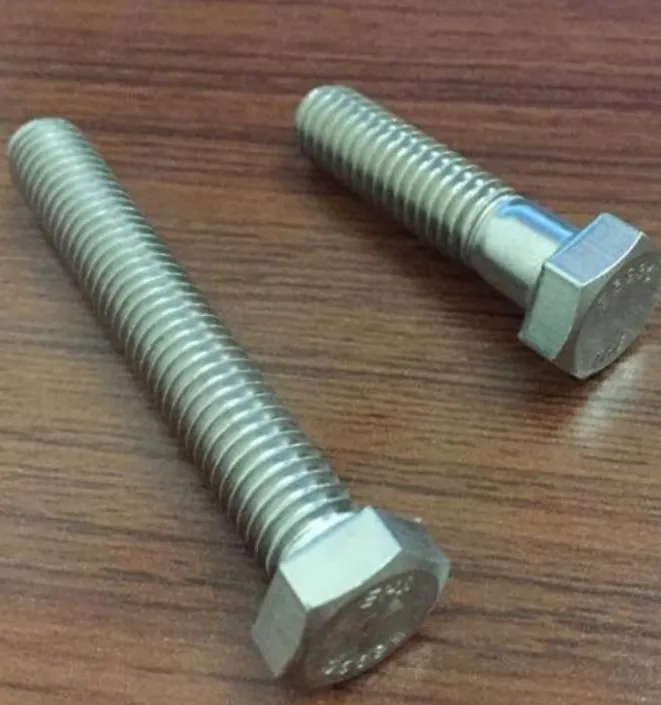
Monel 400 Hex Bolts Manufacturer, Supplier
How does MWalloys support engineering and procurement teams on Monel 400 hex nuts?
MWalloys operates at the intersection of materials engineering, precision manufacturing and project logistics. With a focus on high performance nickel alloys, the company can provide more than simply hardware supply.
Engineering collaboration
Support typically includes:
- Review of process conditions and media to confirm that Monel 400 hex nuts provide adequate resistance.
- Assistance in selecting nut style, thread fit and surface treatment to align with installation methods.
- Advice on torque targets, lubrication choices and galling mitigation strategies.
- Support during qualification tests such tension tests, load relaxation evaluations or corrosion trials.
MWalloys engineers routinely interpret design codes and client specifications, turning them into clear fastener requirements that fabrication shops and site teams can apply.
Manufacturing flexibility
Key capabilities include:
- Short run production of prototype or urgent replacement nuts.
- Batch production with consistent flow when a project demands hundreds or thousands of pieces.
- Machining of complex nut shapes from bar, plate or forgings.
- Silver plating and other surface treatments through qualified subcontractors with audited quality systems.
- Customized packaging and marking tailored to project traceability systems.
This flexibility allows project managers to secure both one off special nuts and long term repeat supply under frame agreements.
Quality assurance and documentation
MWalloys aligns quality processes with international standards, delivering:
- Full EN 10204 certification levels on request.
- Heat traceability and marking on each batch, with individual stamping when required.
- Electronic documentation packages with MTRs, dimensional reports and inspection records.
- Support during customer or third party audits that review material control and manufacturing practices.
These elements help clients satisfy regulatory, classification society and internal quality requirements.
Frequently asked questions on custom Monel 400 hex nuts
Monel 400 Hex Nuts: Engineering & Procurement FAQ
1. When should an engineer move from stainless steel to Monel 400 nuts?
The switch is typically made when standard stainless steel (316/316L) suffers from pitting, crevice corrosion, or chloride-induced stress corrosion cracking. Monel 400 is the go-to upgrade for fasteners exposed to flowing seawater, hydrofluoric acid, or sour water systems where stainless grades lose their reliability.
2. Are Monel 400 hex nuts magnetic?
3. Can Monel 400 hex nuts be used at very low temperatures?
4. Do Monel 400 nuts require coating in seawater?
5. How do I specify threads on custom Monel 400 hex nuts?
- Thread System: Metric (M) or Unified (UNC/UNF).
- Nominal Diameter & Pitch: e.g., M30 x 2 or 1 1/4 inch - 8UN.
- Tolerance Class: e.g., 6H for Metric or 2B/3B for Unified.
Note: If you plan to use a thick coating, specify the thread allowance accordingly.
6. Are Monel 400 hex nuts suitable for sour gas (H2S)?
Yes, they are widely used in sour service. However, they must comply with NACE MR0175 / ISO 15156 hardness restrictions to prevent sulfide stress cracking. MWalloys can supply nuts with the specific heat treatment and hardness testing required for these regulated environments.
7. Can Monel 400 nuts be paired with different bolt materials?
It is possible, but caution is needed regarding galvanic corrosion. Pairing Monel 400 nuts with Monel 400 bolts is ideal. If pairing with Inconel or Duplex stainless steel, the potential for galvanic coupling in electrolytes (like salt water) should be evaluated by a design engineer.
8. What is the typical hardness range for these nuts?
9. What is the lead time for custom Monel 400 hex nuts?
10. What info should I provide for a quotation from MWalloys?
- Material Grade: Monel 400 (UNS N04400)
- Nut Style: Heavy Hex, Finished Hex, or Jam Nut
- Thread Details: Diameter, Pitch, and Class
- Quantity & Standards: ASTM F467, ASME B18.2.2, etc.
- Quality Docs: MTC, NACE compliance, or PMI testing.
By combining the inherent corrosion resistance and toughness of Monel 400 with precise manufacturing and responsible engineering practice, custom Monel 400 hex nuts from MWalloys provide a robust solution in bolted joints where failure is unacceptable. Whether an application lies in marine, offshore, chemical or desalination service, a carefully specified Monel 400 nut often represents the most dependable long term choice, even when initial unit cost exceeds that of more common alloys.