

Custom Inconel 718 stamped parts deliver unmatched strength, corrosion resistance, and dimensional stability in extreme environments, and when manufactured through precision stamping and controlled fabrication processes, they provide a cost-effective, scalable solution for aerospace, energy, oil and gas, and high-temperature industrial applications. At MWalloys, our engineering-driven approach integrates advanced tool design, controlled work hardening management, certified quality systems, and industry-specific validation to ensure each Inconel 718 stamping meets demanding mechanical, metallurgical, and dimensional requirements.
What Makes Inconel 718 Ideal for Precision Stamped Parts?
Inconel 718 is a nickel-based superalloy strengthened primarily through precipitation hardening. It was originally developed for high-temperature aerospace applications, yet it has become widely adopted in multiple sectors that require a rare combination of strength, oxidation resistance, and creep resistance up to approximately 700°C.
Do you need custom Inconel 718 stamping services? Get a free quote!
Key Metallurgical Characteristics of Inconel 718
| Property | Typical Value | Significance in Stamping Applications |
|---|---|---|
| Density | 8.19 g/cm³ | Provides structural robustness |
| Tensile Strength (Annealed) | ~965 MPa | Allows thin-section strength retention |
| Yield Strength | ~550 MPa | Maintains dimensional stability |
| Elongation | ~30% | Enables controlled forming before hardening |
| Operating Temperature Range | -253°C to 700°C | Suitable for cryogenic and high-heat service |
| Corrosion Resistance | Excellent | Performs in marine and chemical environments |
The alloy’s strengthening mechanism involves gamma prime and gamma double prime precipitates. This precipitation hardening capability is essential because it allows components to be stamped in solution-annealed condition and subsequently heat-treated to achieve final mechanical properties.
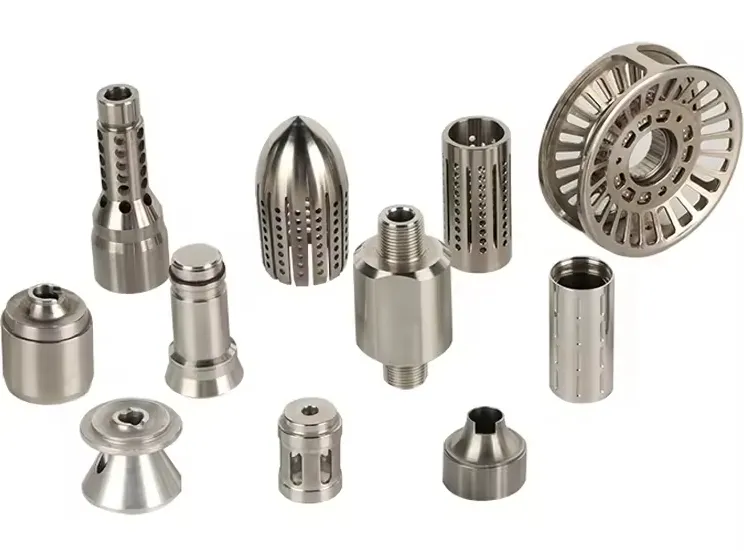
Why Stamping Instead of Machining?
Precision stamping reduces material waste, shortens production cycles, and ensures repeatable geometry for thin-walled components. Compared to CNC machining of solid billets, stamping:
- Minimizes scrap rates
- Improves batch consistency
- Reduces per-unit cost at medium to high volumes
- Enhances structural integrity through grain flow alignment
When combined with secondary fabrication processes such as laser cutting, welding, or surface finishing, stamped Inconel 718 parts achieve both performance and economic efficiency.
How Does Precision Stamping Work with Inconel 718?
Stamping Inconel 718 requires significantly more technical control than stamping mild steel or aluminum. The alloy exhibits rapid work hardening and high forming loads, demanding advanced press systems and optimized tooling geometry.
Key Stamping Methods Used for Inconel 718
| Stamping Process | Application | Advantages |
|---|---|---|
| Progressive Die Stamping | High-volume complex parts | Tight tolerances, automated feeding |
| Deep Drawing | Cylindrical or cup shapes | Controlled wall thinning |
| Fine Blanking | Precision flat components | Clean edges, minimal burr |
| Transfer Die Stamping | Larger components | Flexibility for multi-step forming |
| Hydroforming | Complex geometries | Reduced tooling wear |
Managing Work Hardening During Forming
One of the most critical aspects of stamping Inconel 718 is managing work hardening. During plastic deformation, dislocation density increases rapidly, making subsequent forming stages more difficult.
At MWalloys, we address this through:
- Optimized forming sequences
- Intermediate stress-relief heat treatments
- Precision die surface coatings to reduce friction
- Finite element analysis for strain prediction
Proper control prevents microcracking, maintains ductility, and ensures dimensional accuracy.
What Fabrication Processes Complement Inconel 718 Stamping?
Stamped parts often require secondary fabrication to meet final assembly specifications.
Secondary Operations for Custom Components
- Laser trimming
- TIG and laser welding
- CNC finishing
- Surface grinding
- Heat treatment
- Shot peening
- Non-destructive testing
Heat Treatment Cycles
| Heat Treatment Stage | Temperature | Purpose |
|---|---|---|
| Solution Annealing | ~980°C | Dissolves precipitates |
| Aging Stage 1 | ~720°C | Initiates strengthening |
| Aging Stage 2 | ~620°C | Enhances precipitation hardening |
Correct aging significantly increases tensile strength and creep resistance.
How Does MWalloys Ensure Quality Control and Certification Compliance?
Quality assurance is essential in aerospace and energy industries where Inconel 718 is commonly used.
Our Quality Control Framework
- ISO 9001 certified manufacturing system
- AS9100 aerospace quality compliance
- Full material traceability
- Mill Test Certificate validation
- In-house metallographic analysis
- Dimensional inspection via CMM
- Surface integrity verification
- Hardness and tensile testing
Inspection Methods
| Test Method | Purpose |
|---|---|
| Ultrasonic Testing | Detects internal flaws |
| Dye Penetrant Inspection | Identifies surface cracks |
| X-ray Radiography | Ensures structural integrity |
| Microstructure Examination | Verifies grain size and precipitation |
This structured quality system guarantees performance reliability in mission-critical environments.
What Industries Require Custom Inconel 718 Stamped Parts?
Aerospace and Aviation
- Turbine engine components
- Combustion chamber hardware
- Exhaust systems
- Structural brackets
High fatigue strength and thermal stability are essential in these applications.
Oil and Gas
- Downhole tools
- Valve components
- Sealing rings
Resistance to sour gas and high pressure ensures operational safety.
Energy and Power Generation
- Gas turbine components
- Nuclear plant hardware
- Heat exchanger assemblies
Automotive and Motorsport
- Turbocharger parts
- High-temperature exhaust brackets
Cryogenic Systems
Inconel 718 maintains ductility at extremely low temperatures, making it ideal for LNG systems.
How Does Tooling Design Influence Stamping Accuracy?
Tooling plays a decisive role in achieving repeatable precision.
Tool Steel Selection
High-wear-resistant tool steels or carbide inserts reduce die wear when forming high-strength alloys.
Surface Coatings
- Titanium Nitride coatings
- Diamond-like carbon coatings
- Nitrided surfaces
These treatments decrease friction and prolong die life.
Tolerance Capabilities
| Feature | Typical Tolerance |
|---|---|
| Hole Diameter | ±0.02 mm |
| Flatness | ±0.05 mm |
| Bend Angle | ±0.5° |
Advanced press control systems monitor forming pressure in real time to maintain consistency.
How Does Inconel 718 Compare to Other Nickel Alloys in Stamping?
| Alloy | Strength | Temperature Limit | Stamping Difficulty | Typical Application |
|---|---|---|---|---|
| Inconel 718 | Very High | ~700°C | Moderate to High | Aerospace |
| Inconel 625 | High | ~650°C | Moderate | Marine |
| Monel 400 | Medium | ~480°C | Moderate | Chemical |
| Hastelloy X | High | ~1200°C | High | Furnace parts |
Inconel 718 offers a balanced combination of formability and strength after aging, making it preferred in structural aerospace components.
What Are the Cost Considerations for Custom Inconel 718 Stamped Parts?
Pricing depends on several technical factors:
- Material thickness
- Part geometry complexity
- Tooling investment
- Production volume
- Heat treatment requirements
- Inspection level
- Surface finishing standards
While raw material cost is higher than carbon steel, stamping reduces overall lifecycle expense through:
- Lower machining time
- Minimal scrap
- Extended component life
- Reduced maintenance frequency
What Technical Challenges Must Be Addressed?
1. Springback Control
Due to high yield strength, springback can impact dimensional precision. Simulation modeling helps predict compensation values.
2. Tool Wear
Nickel alloys cause accelerated die degradation. Advanced coatings mitigate this issue.
3. Burr Formation
Fine blanking minimizes edge imperfections.
4. Microstructural Stability
Controlled heat treatment avoids unwanted grain growth.
Application Case Study: Aerospace Bracket Manufacturing
MWalloys partnered with an aerospace OEM to produce high-temperature brackets.
Challenges:
- Tight tolerances
- Lightweight requirement
- Thermal cycling resistance
Solutions Implemented:
- Progressive die stamping
- Intermediate stress relief
- Dual-stage aging process
- 100 percent NDT inspection
Results:
- 18 percent cost reduction
- 25 percent weight reduction
- Zero field failure incidents
Frequently Asked Questions (FAQs)
Inconel 718 Cold Stamping: Precision & Forming FAQ
1. Can Inconel 718 be cold stamped?
Yes, but it is challenging. Due to its high work-hardening rate and yield strength, forming loads are significantly higher than for stainless steel. Successful stamping requires powerful hydraulic presses and controlled strain management to prevent tearing or excessive springback.
2. Is post-stamping heat treatment mandatory?
For most structural and aerospace applications, yes. While cold work increases hardness, a full precipitation hardening (aging) cycle is required to achieve the alloy's maximum design strength and creep resistance.
3. What thickness range is ideal for stamping?
4. Does stamping affect the material's corrosion resistance?
5. How does Inconel 718 handle fatigue loading?
6. What surface finishes are available for stamped parts?
We offer various finishes depending on the application:
- Passivation: To remove free iron and enhance corrosion resistance.
- Shot Peening: To introduce compressive stresses and further improve fatigue life.
- Electropolishing: For a ultra-smooth, clean surface.
7. Is hydroforming better than traditional stamping?
For complex, asymmetrical shapes, hydroforming is often superior. It provides more uniform wall thickness and reduces stress concentrations, though traditional stamping remains the faster and more economical choice for simpler, high-volume components.
8. Can stamped Inconel 718 parts be welded?
9. What certifications are typically required for these parts?
MWAlloys ensures all stamped parts come with full Mill Test Certificates (MTC) and compliance documents for regulated industries.
10. How long does tooling development take?
Why Choose MWalloys for Custom Inconel 718 Stamped Parts?
MWalloys combines metallurgical expertise, advanced forming technology, certified quality systems, and application-specific engineering support. Our integrated production capability ensures:
- Consistent material sourcing
- Precision die engineering
- Controlled heat treatment
- Complete inspection validation
- Industry-specific compliance
With decades of alloy processing experience, MWalloys delivers precision-engineered Inconel 718 stamped parts that perform reliably in extreme mechanical and thermal environments.