
For bridge-grade requirements and projects where impact toughness, Charpy V-notch testing, and fracture-critical performance are contractually specified, ASTM A709 is the correct choice; for general structural steelwork (buildings, columns, beams, non-fracture-critical members) where minimum yield strength and cost-efficiency matter, ASTM A572 (Grades 42–65) is usually the economical option. If you need both strength and bridge-specific toughness, specify A709 or dual-certified A572/A709 material.
What are A709 and A572 specifications?
-
ASTM A709 / A709M — Standard Specification for Structural Steel for Bridges. It is written with bridge engineers in mind: multiple grades, options for enhanced toughness, weathering/resistance (W), and several high-performance steels (HPS). This standard explicitly includes impact/toughness requirements for many bridge applications.
-
ASTM A572 / A572M — Standard Specification for High-Strength Low-Alloy Columbium-Vanadium Structural Steel. It covers Grades 42, 50, 55, 60 and 65 and is widely used for general structural applications (buildings, columns, beams, plates). It focuses on strength, formability and weldability.
Core technical differences
-
Purpose and intent: A709 is tailored for bridges and critical structural members where cyclic loading, fracture toughness and colder service temperatures can be important; A572 targets general construction. That difference in intent drives the extra testing and options in A709.
-
Toughness (Charpy) requirements: A709 often includes mandatory Charpy V-notch impact testing (temperature and energy levels) for tension components or fracture-critical parts; A572 typically does not require Charpy testing unless the purchaser specifies it. This is one of the most practical distinctions between A709 Grade 50 and A572 Grade 50.
-
Weathering / corrosion resistance ("W" designation): A709 offers weathering (W) versions and high-performance steels (HPS) with improved atmospheric corrosion resistance and toughness. A572 does not standardize weathering variants in the same way.
-
High-performance grades: A709 includes HPS grades (e.g., HPS 50W, HPS 70W, HPS 100W) designed to offer higher toughness and strength with controlled chemistry. These are frequently chosen for long-span bridges and critical members.
-
Chemical and microalloying control: Both standards control chemistry, but A709 may specify additional alloy elements or tighter controls to secure notch toughness at low temperatures for bridge service.
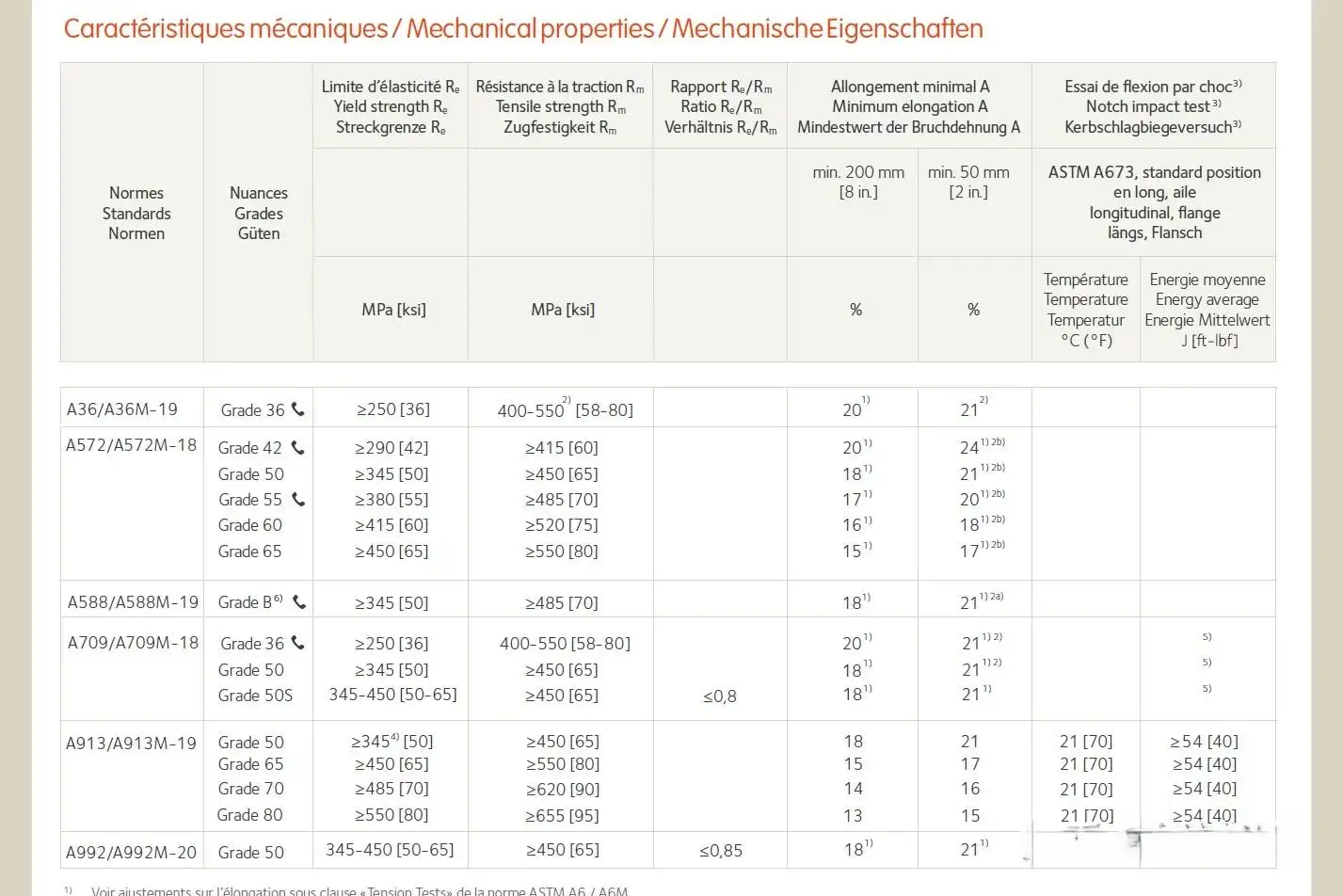
Mechanical properties
Table A — Common yield/tensile values (nominal per ASTM)
| Standard / Grade | Min Yield (ksi / MPa) | Typical Min Tensile (ksi / MPa) | Typical Use |
|---|---|---|---|
| A572 Grade 42 | 42 ksi (290 MPa) | ~60 ksi (414 MPa) | General building members |
| A572 Grade 50 | 50 ksi (345 MPa) | ~65 ksi (448 MPa) | Common structural shapes |
| A572 Grade 55 | 55 ksi (380 MPa) | ~70 ksi (483 MPa) | Heavier-duty sections |
| A572 Grade 60 | 60 ksi (415 MPa) | ~75 ksi (517 MPa) | Heavy sections, some bridges |
| A572 Grade 65 | 65 ksi (450 MPa) | ~80 ksi (552 MPa) | High-strength structural use |
| A709 Grade 36 | 36 ksi (250 MPa) | ~58–70 ksi | Bridges (lower strength) |
| A709 Grade 50 / 50W | 50 ksi (345 MPa) | ~65 ksi (448 MPa) | Bridge components (toughness req.) |
| A709 HPS 70W | 70 ksi (485 MPa) | higher | Long-span bridge members; HPS series. |
(Numbers summarized from ASTM tables and major steel producers — use for comparative planning; see cited ASTM pages and manufacturers for exact certified test values.)
Note: ASTM lists precise minimums, elongation requirements and testing protocols. For detailed design or procurement (thickness limits, tensile elongation %, acceptance criteria), refer directly to the official ASTM documents.
Chemical composition
Both standards limit carbon, manganese, phosphorus and sulfur and allow microalloying (Nb, V, Ti) to control grain size and toughness. Practically speaking:
-
A572 grades vary slightly by carbon and manganese as yield increases (higher grades often have slightly higher C or other adjustments).
-
A709 grades intended for bridges may include controlled additions (Cr, Ni, Cu, Mo) or be produced to tighter limits to secure low-temperature toughness and atmospheric resistance in "W" grades.
(If you require an exact element table for a specific grade and thickness, specify the grade and thickness and we will provide the mill-certified composition range from the ASTM text.)
Fracture toughness & the role of Charpy V-notch tests
-
Why toughness matters: Bridges are subject to repetitive live loads, variable temperatures and sometimes fracture-critical geometries. A brittle fracture in a bridge member can propagate catastrophically, so specifying adequate fracture toughness is non-negotiable for many bridge designs. The Charpy V-notch test offers a practical measurement of energy absorption at low temperatures and is used as a screening tool for toughness.
-
A709 vs A572 in practice: In many procurement contexts, A709 Grade 50 requires Charpy V-notch testing at a specified temperature and minimum energy; A572 Grade 50 typically does not require Charpy testing by default. This difference often makes A709 slightly more expensive but reduces fracture risk in cold conditions or fracture-critical parts.
HPS (High Performance Steel) and "W" weathering options
-
What HPS brings: HPS grades within A709 (HPS 50W, HPS 70W, HPS 100W) combine higher yield strength, improved toughness, and enhanced atmospheric corrosion resistance. These make long-span or harsh-environment bridges lighter, more durable, and sometimes lower life-cycle cost.
-
W (weathering) designation: Materials with the "W" designation demonstrate improved atmospheric-corrosion resistance (less maintenance, slower section loss). A709 includes weathering options—A572 does not standardize them the same way. Use weathering steels where aesthetics and long-term maintenance savings are priorities.
Welding, fabrication and qualification practicalities
-
Weldability: Both A572 and A709 grades (especially lower carbon and well-controlled microalloyed variants) are generally weldable with common processes (SMAW, GMAW, SAW). Preheat and procedure must follow the Welding Code (e.g., AWS D1.1) and consider thickness and carbon equivalent.
-
PQR / WPS considerations: If you weld A709 (with Charpy requirements), PQR plates should have comparable toughness to the production metal to ensure the procedure qualifies for the intended service. Some fabricators prefer to weld with A572 test plates when acceptable, but for fracture-critical weld procedure qualification, using A709 material may be required by code or owner.
-
Cold bending / forming: Higher grades (60, 65) will be less forgiving in close-radius forming; consult the mill and design codes for allowable bending radii and permitted forms at thickness.
When to choose A709 and A572?
-
Specify A709 when:
-
The contract is for bridges or owner explicitly requires A709.
-
Fracture toughness and low-temperature impact energy are specified.
-
Weathering or HPS grades are needed for long life or harsh environments.
-
-
Specify A572 when:
-
The project is general structural steelwork (buildings, non-fracture-critical members).
-
Cost and broad availability are prime concerns.
-
No mandatory Charpy testing is required by contract or code.
-
-
Dual certification: Many mills produce plates dual-certified to A572 Grade 50 / A709 Grade 50. When the purchaser wants the toughness of A709 but the cost/availability benefits of A572, dual certification or explicit Charpy acceptance can be requested. Dual-certified stock can simplify procurement.
Procurement, mill test reports and QA
When ordering from a mill or supplier, request:
-
Mill Test Report (MTR / certified chemical and mechanical test results) with heat number traceability.
-
Specified Charpy tests (temperatures, energies) when ordering A709 or fracture-tough materials.
-
Welding/processing instructions if any fabrication will affect toughness (heat input limits, PWHT, preheat).
-
Dual-certification statement if you need both standards on the same plate.
-
Traceability paperwork to satisfy owner/agency (AASHTO, DOT) requirements.
MWAlloys supply proposition (how we can help)
We are MWAlloys, a factory-direct steel supplier with specialization in structural and high-strength plates. Our offering for ASTM A709 and A572 customers includes:
-
Factory price advantage — 100% mill/plant direct pricing; no distributor markup.
-
Dual-certified inventory — stock often available in A572 Grade 50 / A709 Grade 50 dual cert.
-
Fast stock delivery — we maintain common plate sizes and thicknesses in stock for immediate shipment from China warehouses; typical lead times depend on quantity and destination but we expedite export documentation and logistics.
-
Quality & traceability — full MTRs, Charpy test records (for A709 orders), inspection reports and full heat traceability.
-
Customization — cut-to-length, edge prep, temporary storage, assistance with export packing and FCL/LCL shipping.
ASTM A572 vs ASTM A709 comparison table
| Attribute | ASTM A572 | ASTM A709 |
|---|---|---|
| Primary market | Building & general structure | Bridges & critical bridge parts |
| Typical grades | 42, 50, 55, 60, 65 | 36, 50, 50W, HPS 50W, HPS 70W, etc. |
| Charpy requirement | Not mandatory | Often mandatory (depends on grade/contract) |
| Weathering / W option | Not standardized | W (weathering) options available |
| HPS high-performance series | No | Yes (HPS XXW) |
| Typical cost | Lower | Slightly higher for toughness/weathering/HPS variants |
| Dual certification | Available from some mills | Available (A572/A709 dual cert) |
Practical specification checklist for engineers & purchasers
-
Confirm whether the project is bridge work or building work. If bridge, default to A709 unless owner specifies otherwise.
-
If low-temperature service or fracture-critical members exist, require Charpy testing at the required temperature and minimum energy.
-
For long spans or corrosive atmospheres, consider HPS or W grades (A709 HPS series).
-
Specify mill certificates, welding qualifications and inspection plan in the purchase order.
-
If cost is a limiting factor and Charpy testing is not required, A572 Grade 50 is a common, cost-effective choice.
FAQs
-
Is A709 Grade 50 the same as A572 Grade 50?
Chemically and mechanically they are very similar, but A709 often requires Charpy testing and includes bridge-focused options (W, HPS). In many cases A572 G50 and A709 G50 can be considered equivalent for non-fracture-critical uses; verify contract requirements. -
Can I use A572 instead of A709 on a bridge?
Only if the owner/engineer and applicable agency accept it. For fracture-critical or low-temperature service, A709 or equivalent toughness testing is preferred/required. -
What is HPS 70W and when is it used?
HPS 70W is a high-performance bridge steel in A709 with ~70 ksi yield, improved toughness and weathering resistance. It’s chosen for long spans and reduced lifecycle maintenance. -
Does A572 have weathering steel options?
Not as a standardized variant. For weathering requirements, specify A709W or ASTM A588 (specific weathering grade). -
How do Charpy test requirements affect price?
Charpy testing and tighter chemistry/toughness control increase mill processing and QC, so materials with mandatory Charpy tests (A709) tend to cost more than basic A572 equivalents. -
Can plates be dual-certified A572/A709?
Yes. many mills produce plates with dual certification (usually A572 G50 / A709 G50), simplifying procurement for mixed requirements. -
Are there thickness limits where one spec is preferred?
Each standard has thickness ranges for specific grades and associated test requirements; consult the spec and the mill for allowable thickness vs grade. For thin plates, many grades are available; for thicker sections, check grade/thickness limitations in the ASTM text. -
What documents should accompany a shipment?
Mill Test Report (MTR), heat number traceability, Charpy reports (if required), inspection certificates, packing list and any third-party inspection reports requested. -
How does low temperature affect grade selection?
Low temperature increases brittle fracture risk. For cold service, select materials with proven toughness (A709 with Charpy requirements or HPS grades) and qualify weld procedures accordingly. -
Can MWAlloys supply both A572 and A709?
Yes. MWAlloys stocks common plates in A572 Grades and A709 (including dual-certified 50/50). We provide factory pricing, full certificates and expedited shipping. Contact us with your required grade, thickness, quantity and port of delivery.
Practical case note
For a municipal bridge replacement in a cold region, specifying A709 Grade 50W or HPS 70W (with Charpy requirements at the design temperature) reduces fracture risk and maintenance cost even if initial material cost is higher. For an office building frame where cost and availability drive selection, A572 Grade 50 usually suffices.
Closing recommendations
-
For bridge design or agency work, default to A709 unless an agency explicitly allows otherwise.
-
For general structural use, A572 balances performance and cost.
-
When toughness matters, insist on Charpy V-notch tests and mill certificates.
-
Ask suppliers (like MWAlloys) for dual-certified stock when procurement must satisfy mixed specs.
Authoritative references
- ASTM A709/A709M — Standard Specification for Structural Steel for Bridges (ASTM International)
- ASTM A572/A572M — Standard Specification for High-Strength Low-Alloy Columbium-Vanadium Structural Steel (ASTM International)
- Steel Bridge Design Handbook — Chapter on Bridge Steels (AISC / NSBA)
- FHWA Report: Influence of Material Toughness on Fracture Reliability in Bridges (Federal Highway Administration)