

AMS 6425 (commercial name Hy-Tuf, UNS K32550) is a premium vacuum-remelted, high-strength low-alloy steel engineered for severe aerospace structural applications such as landing gear and flap tracks; when processed to the 220–240 ksi tensile range it delivers a unique balance of tensile strength, fracture toughness, and fatigue resistance. MWalloys supplies AMS 6425 in bars, forgings, and tubing at direct factory pricing, with full traceability and material certification available on request.
1. What is AMS 6425?
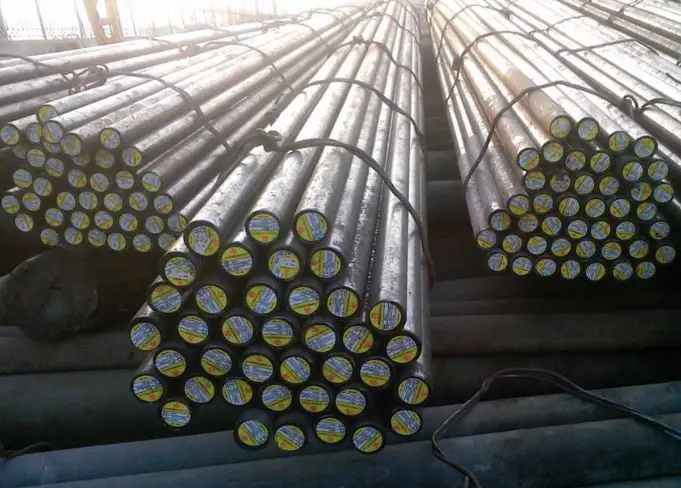
AMS 6425 is an SAE/AMS material specification covering a vacuum-refined, low-alloy, high-strength steel produced in forms such as bars, forgings, and tubing. It is often supplied under the trade name Hy-Tuf or Hy-Tuf VAC-ARC and is specifically designed for aircraft structural components that demand both very high tensile strength and retained toughness. The specification mandates vacuum remelting or vacuum arc remelt processes to ensure exceptional cleanliness and controlled inclusion content, which improves fatigue life and fracture resistance in high-stress parts.
Why this material is chosen: its alloying balance and melting practice let manufacturers reach strength levels (approximately 1517 to 1655 MPa) while retaining ductility and impact performance needed for landing gear and similar parts. That combination makes AMS 6425 a favorite when the component must resist cyclic loading, surface damage, and occasional overload without brittle failure.
2. Key chemical composition and microalloying rationale
AMS 6425’s formulation centers on a controlled carbon level plus additions of manganese, silicon, nickel, chromium, and molybdenum. Each element contributes specific mechanical and processing advantages:
-
Carbon (C): raises strength and hardenability; typically controlled near 0.23–0.28% to balance strength with toughness.
-
Manganese (Mn): improves hardenability and tensile strength; common range near 1.2–1.5%.
-
Silicon (Si): deoxidizer that slightly increases strength; typical 1.3–1.7%.
-
Nickel (Ni): contributes to toughness and low-temperature performance; often 1.65–2.0%.
-
Chromium (Cr) and Molybdenum (Mo): together enhance hardenability, tempering resistance, and strength at elevated hardness levels; Cr around 0.2–0.4% and Mo around 0.35–0.45%.
Table 1. Typical chemical composition (representative ranges)
| Element | Typical range (wt%) | Primary function |
|---|---|---|
| C | 0.23 – 0.28 | Strength and hardenability |
| Mn | 1.2 – 1.5 | Hardenability, tensile strength |
| Si | 1.3 – 1.7 | Deoxidation, strength |
| Ni | 1.65 – 2.0 | Toughness, low temperature ductility |
| Cr | 0.20 – 0.40 | Hardenability, strength |
| Mo | 0.35 – 0.45 | Hardenability, tempering stability |
| P | ≤ 0.025 | Impurity control |
| S | ≤ 0.025 | Impurity control |
| Fe | Balance | Matrix metal |
Notes: Values are typical industry ranges drawn from public datasheets and manufacturer literature for Hy-Tuf / AMS 6425. Actual delivered chemistry will be stated on mill certificates.
3. Mechanical performance and typical properties
When processed and heat treated to the published tensile range, AMS 6425 delivers exceptional mechanical numbers that place it within the high-strength category suitable for critical aerospace hardware.
Typical mechanical characteristics
-
Tensile strength: nominally 220–240 ksi (about 1517–1655 MPa).
-
Yield strength: depends on heat treatment and section size; yield will be substantial relative to the tensile figure but must be verified per lot.
-
Impact toughness: engineered to maintain good fracture toughness for landing gear duty, verified by Charpy and fracture mechanics testing protocols.
Table 2. Representative mechanical properties (quenched and tempered condition)
| Property | Representative value |
|---|---|
| Tensile strength (UTS) | 1517 – 1655 MPa |
| Hardness (typical HB) | ~230 HBW (varies with tempering) |
| Charpy V-notch | Specified minimums vary by application and thickness |
| Fatigue resistance | High, improved by VAR/VAR-ARC cleanliness |
Notes: These values are illustrative. Final values must comply with AMS 6425 lot certificates, and mechanical behaviour may shift by product form and heat treatment schedule.
4. Heat treatment, melting practice and processing notes
Processing is core to AMS 6425’s performance. Key manufacturing controls include vacuum remelting and precise heat treatment sequences.
Melting and refining
-
Vacuum arc remelt (VAR) or similar vacuum-based processes are specified to reduce non-metallic inclusions and to control solidification structure. This improves fatigue strength and fracture resistance for components that operate under cyclical loadings.
Typical heat treatment steps
-
Solution treatment / austenitizing: heat to a specified temperature to form a homogenous austenitic structure.
-
Quenching: rapid cooling to achieve martensitic or bainitic microstructure depending on the targeted property balance.
-
Tempering: reheating to tempering temperature(s) to achieve desired hardness, toughness, and yield ratio. Multiple tempering cycles may be used to stabilize properties.
Table 3: Example heat treatment window (illustrative)
| Step | Temperature range | Purpose |
|---|---|---|
| Austenitize | 840 – 900°C | Homogenize, prepare for quench |
| Quench medium | Oil or polymer | Form martensite/bainite |
| Temper | 400 – 600°C | Adjust hardness/toughness balance |
Important: Follow AMS 6425 and OEM-specific heat treatment instructions. Deviations alter properties and may void certifications.
5. Common aerospace and industrial applications
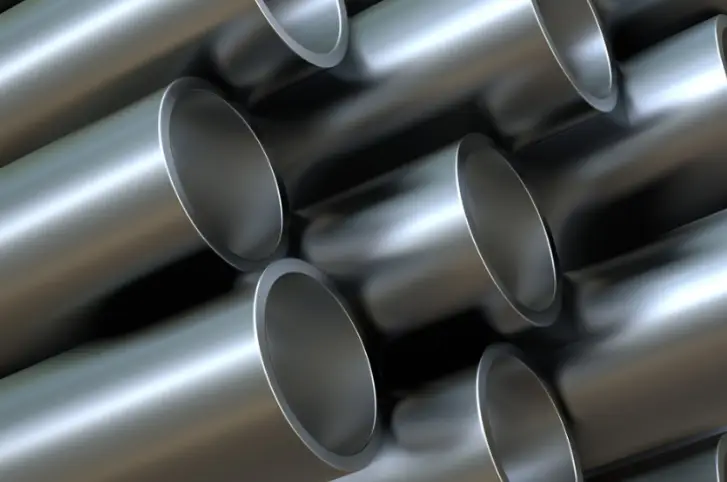
AMS 6425 is used where very high strength plus toughness are required. Typical parts include:
-
Landing gear components (pins, trunnions, yokes).
-
Flap tracks and actuation hardware.
-
High-duty structural pins and shafts.
-
Industrial components subject to repeated cyclic loads where clean microstructure increases life.
Designers favor AMS 6425 when fatigue-critical features must withstand high cycles without crack initiation and growth. The vacuum remelt pedigree and controlled chemistry help minimize inclusion-driven failures.
6. Manufacture, material forms and quality control
MWalloys supplies AMS 6425 in standard commercial forms: rounds, bars, forged blocks, and precision tubing. Each supply batch is accompanied by mill test reports (MTRs) listing chemical analysis, mechanical test results, heat treatment records, and VAR/VAR-ARC confirmation.
Factory-quality assurance steps
-
Full chemical analysis on representative samples.
-
Mechanical testing including tensile and hardness.
-
Non-destructive examination where required (ultrasonic or magnetic particle).
-
Traceable heat numbers and packaging to preserve identity through downstream processing.
Table 4: Typical product forms offered by MWalloys
| Product form | Typical sizes | Typical certifications |
|---|---|---|
| Bars | Ø10 mm to Ø200 mm and up | AMS 6425 MTR, heat treatment record |
| Forgings | Custom shapes | Full forging traceability |
| Tubing | Mechanical tubing sizes | NDE as required |
| Machined components | Per drawing | PMI, test reports on request |
MWalloys’ factory pricing model is direct: customers receive mill-direct pricing without distributor markups, making the offer attractive for OEMs and repair shops seeking certified AMS 6425 material.
7. Corrosion resistance and surface finishing options
AMS 6425 is not stainless; corrosion resistance is moderate and metallurgy-oriented. For corrosion-critical environments, finishing or protective coatings are common:
-
Cadmium plating (legacy aerospace coatings, subject to environmental rules).
-
Nickel plating or zinc-nickel coatings for corrosion protection.
-
Conversion coatings and primers for painted assemblies.
-
Passivation is not effective like it is for stainless steels; surface protection must be engineered.
Selection of coating must follow OEM and regulatory constraints and consider how plating alters fatigue life and tolerances.
Designers often compare AMS 6425 to other high-strength steels to select the best fit. Typical peers include 300M, ADI steels, and other Hy-Tuf variants.
Table 5. Quick comparison
| Alloy / Spec | Relative tensile range | Typical advantage |
|---|---|---|
| AMS 6425 (Hy-Tuf) | 1517–1655 MPa | High strength with VAR cleanliness |
| 300M | ~1400–1700 MPa | Excellent fracture toughness; widely used in landing gear |
| AMS 6418 | Similar range | Slight composition variation; check spec differences |
| Typical chromium-molybdenum steels | Variable | Often lower toughness without vacuum remelt |
Note: Exact equivalence depends on required fracture mechanics, certification history, and OEM approvals. Confirm substitution with engineering and procurement teams.
9. Procurement, traceability and factory pricing (MWalloys offer)
MWalloys positions itself as a direct manufacturer and supplier of AMS 6425 with the following procurement highlights:
-
Factory-direct cost structure: no distributor margin, bulk discounts available.
-
Full material traceability: heat numbers, MTRs, and remelt records.
-
Custom processing: blank forging, rough machining, final heat treatment, and plating per customer specifications.
How to order
-
Provide part drawing or material size, required AMS specification (AMS 6425), and any OEM special process requirements.
-
Approve sample or initial lot inspection if required.
-
Receive a pro forma quotation with factory unit pricing and lead time.
Pricing factors include billet size, remelt method, heat treatment steps, and required testing. MWalloys can provide competitive quotes for volume buys or long-term agreements.
10. Inspection, testing and acceptance criteria
For flight hardware and safety-critical items, inspection and testing regimes typically include:
-
Full MTR with certified chemical and mechanical tests.
-
Tensile testing on representative samples per AMS acceptance.
-
Hardness checks across delivered pieces.
-
Non-destructive evaluation when required by the drawing (UT, PT, MPI).
-
Fracture toughness or Charpy testing for specific thicknesses or critical components.
OEM drawings may impose additional acceptance criteria; always align procurement paperwork with engineering approval.
11. Machining, fabrication and repair recommendations
AMS 6425 is hardenable and work hardens if machined incorrectly. Practical tips from shop-floor experience:
-
Use sharp carbide tooling with positive rake to avoid rubbing. Cutting speeds must be conservative to prevent work hardening; feed rates that achieve shearing rather than rubbing help maintain tool life.
-
Preheat and post-weld heat treatments are necessary for repair welding. Welding should follow qualified procedures; often filler materials and controlled interpass temperatures are specified.
-
Drilling and reaming parameters: lower surface speed and steady feed; use coolant and peck drilling for deep holes. Avoid prolonged tool dwell at the cut edge.
12. Sustainability, recyclability and lifecycle considerations
AMS 6425 is ferrous and fully recyclable at end of life. From a sustainability viewpoint:
-
Recycled scrap can be incorporated in mill feed provided re-melt and chemistry controls ensure final properties.
-
Vacuum remelting promotes material life extension by providing improved cleanliness and fatigue performance, which can reduce replacement frequency in service.
Lifecycle analysis should weigh higher upfront processing energy against longer service life and fewer replacements.
13. Frequently asked questions
-
What does AMS 6425 stand for and where is it published?
AMS 6425 is an aerospace material specification published through SAE / AMS channels that defines chemical, mechanical and processing requirements for Hy-Tuf style low-alloy steels. -
Is AMS 6425 the same as Hy-Tuf?
Hy-Tuf is a commercial name commonly associated with the AMS 6425 specification; the trade name and spec are used interchangeably in industry sourcing. -
What forms of AMS 6425 can MWalloys supply?
Bars, forgings, mechanical tubing and machined blanks with full MTRs and heat treatment records. -
What tensile strength range should I expect?
Typical tensile strengths are in the 220 to 240 ksi bracket, which translates to roughly 1517 to 1655 MPa. Verification requires MTR review. -
Can AMS 6425 be welded?
Yes, but welding requires qualified procedures and appropriate filler metals. Post-weld heat treatment is usually necessary. Consult your welding engineer. -
How does AMS 6425 compare to 300M?
Both are high-strength steels used in landing gear. Selection depends on required toughness, historical approvals, and supplier capabilities. Each has distinct chemistries and processing histories. -
Do you offer chemical and mechanical certification?
MWalloys provides full mill test reports, showing chemistry, tensile results, hardness readings, and remelt certificates where required. -
What surface finishes do you provide?
Options include ground, turned, plated (zinc-nickel, nickel), and shot-peened surfaces tailored to application needs. -
Are there size limitations for AMS 6425 products?
Standard bar and forging sizes are broad, but extreme sizes may require special melt planning. Contact MWalloys for custom sizing. -
How quickly can you ship factory-direct material?
Lead time depends on current production, remelt scheduling, and required tests. Request a quote with required specs for an accurate commitment.
14. Quick reference tables and engineering checklists
Table 6. Acceptance checklist before installation
| Item | Required? |
|---|---|
| AMS 6425 MTR | Yes |
| Heat treatment record | Yes |
| VAR/VAR-ARC confirmation | Yes |
| Mechanical test results | Yes |
| NDE per drawing | Per drawing |
| Coating / plating paperwork | If specified |
Table 7. Selection quick tips for engineers
| Design concern | Recommendation |
|---|---|
| High cycle fatigue | Use vacuum-remelted AMS 6425 with tight surface finish control |
| Corrosion resistance | Specify plating or protective coatings |
| Repairability | Prequalify welding procedures and plan PWHT |
| Tight tolerances | Order near-net shapes to minimize machining of hardened material |
Technical sources and verification statement
The statements in this document reference SAE AMS material specifications and multiple manufacturer datasheets and technical summaries for Hy-Tuf / AMS 6425. Key technical references include the AMS 6425 specification, material data pages from recognized specialty alloy producers, and aerospace supply literature. For certification and regulatory compliance please consult the actual AMS 6425 specification text and the OEM drawing that governs part manufacture.
Closing notes from MWalloys
MWalloys provides certified AMS 6425 products at factory pricing for OEMs, MROs and component manufacturers. We offer support for specification compliance, custom forgings, machining, and finish treatments. For quotation and material certificates, please send part drawings and required AMS clauses; we will respond with a mill-direct proposal and expected lead time.