

AMS 5589 is the SAE/AMS specification most commonly used for seamless tubing made from nickel-based Alloy 718 (UNS N07718), and it governs chemistry, production route, heat treatment, dimensional tolerances and qualification tests for corrosion- and heat-resistant tubes used in aerospace and high-temperature industrial systems; for procurement decisions, Alloy 718 tubes produced to AMS 5589 deliver exceptional strength at temperatures up to roughly 700°C (1300°F), excellent oxidation resistance and weldability, but come at a premium price that varies by supply chain, finish and quantity — MWalloys offering factory-direct pricing positions you to reduce landed cost and control certification, traceability and lead time.
1. What AMS 5589 is and why it matters
AMS 5589 is an aerospace material specification that defines requirements for seamless corrosion- and heat-resistant nickel-alloy tubing commonly produced from Alloy 718 formulations. The spec defines acceptable chemical composition windows, acceptable melting and remelting practices, mechanical property verification, nondestructive evaluation (where required), dimensional tolerances and marking/traceability protocols that buyers demand for safety-critical systems. Meeting AMS 5589 means the tube is produced and certified to an industry-accepted baseline suitable for aircraft, engine, and other high-reliability applications.
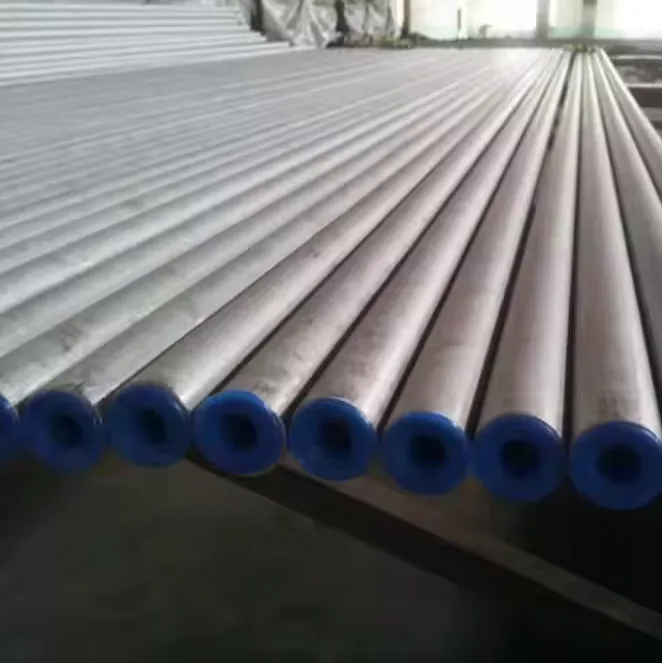
Why that matters to engineers and procurement teams: AMS 5589 provides a contract-grade assurance that the tube will perform predictably in creep, tensile and corrosion regimes typical of service conditions for hot gas, hydraulic and thermal systems; it also standardizes acceptance tests so that parts from different suppliers can be compared quantitatively.
2. Where AMS 5589 fits in the Alloy 718 family
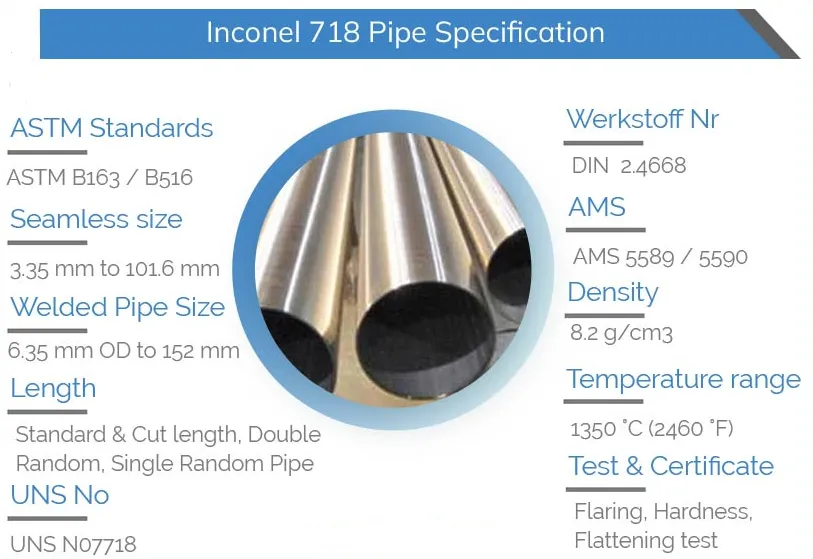
Alloy 718 (commonly marketed as Inconel 718) is a precipitation-hardenable nickel-chromium alloy containing iron, niobium (columbium), molybdenum, titanium and aluminum. The Alloy 718 family has multiple AMS and ASTM designations depending on product form: AMS 5596 covers plate and sheet, AMS 5662/5663/5664 are used for bars and forgings, AMS 5832 for welding wire and AMS 5589/5590 for tubing. AMS 5589 is focused on seamless tubing forms and contains amendments and revision letters (for example AMS5589G) that refine melting, heat treatment and test requirements over time.
3. Chemical composition (representative limits)
Below is a concise table showing typical composition ranges for Alloy 718 used in AMS 5589 tubing. These values are representative of UNS N07718 / Inconel 718 and reflect the common commercial specification windows. Always refer to the actual AMS 5589 document for exact contractual limits for a given revision.
| Element | Typical weight % (representative for Alloy 718) |
|---|---|
| Nickel (Ni) | 50.0 – 55.0 (nominal ~52.5) |
| Chromium (Cr) | 17.0 – 20.0 (nominal ~19.0) |
| Iron (Fe) | Balance (roughly 17 – 20) |
| Niobium + Tantalum (Nb+Ta) | 3.0 – 5.5 (nominal ~3.6) |
| Molybdenum (Mo) | ~2.8 – 3.3 (nominal ~3.0) |
| Titanium (Ti) | ~0.4 – 1.2 (nominal ~0.9) |
| Aluminum (Al) | ~0.2 – 1.0 (nominal ~0.5) |
| Carbon (C) | ≤ 0.08 |
| Others (Co, Mn, Si, S, P) | Trace limits per AMS 5589 |
Note: The table above is a practical summary; the AMS 5589 text provides the formal allowable ranges and impurity limits for contractual acceptance.
4. Mechanical properties and service temperature window
Alloy 718’s combination of solid-solution strength and precipitation hardening delivers excellent tensile, creep-rupture and fatigue behavior at elevated temperatures. Typical properties commonly referenced for design and procurement are summarized below — perform supplier-specific tests for final design values.
| Property (typical, heat-treated) | Representative value |
|---|---|
| Room temperature tensile strength (UTS) | ≈ 1250 – 1400 MPa (varies with heat treatment) |
| Yield strength (0.2% offset) | ≈ 760 – 1035 MPa |
| Elongation (in 2 in or 50 mm) | ≥ 12% (typical) |
| Creep capability | Strong to ~700°C (1300°F) for many duty cycles |
| Oxidation resistance | Effective to roughly 980°C (1800°F) for short exposures |
Designers should treat these as starting points and request actual test certificates and heat-treatment records from the mill. The peer-reviewed material datasheets and manufacturer technical notices provide detailed curves and formal test matrices.
5. Manufacturing routes, product forms and inspection
AMS 5589 requires controlled melting, possible secondary remelting (consumable electrode remelt or vacuum induction remelt) and specified forming and heat treatment steps to ensure microstructural control. Important elements under the spec include:
-
Melting and remelting: AMS variants call out permissible melt practices and allowed remelting processes (for improved cleanliness and control).
-
Seamless tubing process: Methods include hot-extrusion/rotary piercing and cold drawing to final size depending on tolerances and surface finish.
-
Nondestructive testing (NDT): Ultrasonic or eddy-current inspection may be required for certain sizes and end uses. The spec often specifies LCS (laboratory chemical analysis and certification) or LCS + UT (ultrasonic testing) acceptance criteria.
Certification accompanying delivery usually includes mill test reports (MTRs) that show batch heat numbers, chemical analysis, mechanical testing (if performed), heat treatment records and any NDT results.
6. Typical sizes, tolerances and finishing options
Alloy 718 tubing produced to AMS 5589 is available in a wide range of nominal outside diameters and wall thicknesses for aerospace plumbing, heat exchangers and manifold applications.
| Size category | Typical OD range | Wall thickness range | Common finish/notes |
|---|---|---|---|
| Small-diameter precision tubes | 0.125" – 0.500" (3.18 – 12.7 mm) | 0.020" – 0.065" | Cold-drawn, annealed, tight tolerances |
| Medium-diameter tubing | 0.500" – 1.500" (12.7 – 38.1 mm) | 0.028" – 0.120" | Hot-finished or cold-drawn |
| Large-diameter seamless tube | >1.5" OD | Custom wall thickness | Typically hot-worked, may require additional machining |
Finishes include bright annealed, pickled and passivated options, and special surface treatments for fused coatings or plated corrosion protection if requested. Many vendors will also supply cut-to-length with end deburring, inspection certificates and material traceability marking.
7. Heat treatment and processing notes
Alloy 718 achieves its high strength through a solution anneal followed by a two-step aging (precipitation hardening). A commonly used aging cycle is:
-
Solution treatment: ~980°C to 1010°C (depending on product) followed by rapid cooling.
-
Age hardening: Two-stage aging, typically 718°F–1325°F ranges converted from Celsius, with hold times guided by AMS and mill practice.
The exact cycles vary by product and AMS revision, so always verify the supplier’s heat-treatment records. Improper thermal processing can produce unwanted phases that impair ductility and high-temperature performance. For welded assemblies, post-weld heat treatment and controlled filler metals may be required; refer to AMS welding and filler metal specs (for example AMS 5832 for welding wire).
8. Typical applications and real-world performance notes
Alloy 718 tubes produced to AMS 5589 are common in high-reliability fields:
-
Aerospace and turbomachinery: Fuel lines, hydraulic tubing, bleed-air systems and structural gas-path components.
-
Power generation and heat exchangers: High-temperature fluid conduits and tubing in heat-recovery or gasifier systems.
-
Oil and gas / chemical processing: High-pressure, corrosion-prone service lines.
-
Cryogenic hardware: Because Alloy 718 maintains toughness at low temperatures, it is sometimes used in cryogenic applications where strength is required.
Practical performance notes from field reports and manufacturer data demonstrate that Alloy 718 retains creep resistance at working temperatures up to ~700°C and resists oxidation well under cyclic exposures, which supports its widespread use in engine and hot-section assemblies.
9. How AMS 5589 compares with alternative alloys and specs
Selecting AMS 5589 (Alloy 718) tubing is a tradeoff between high-temperature strength and cost. The table summarizes common alternatives and when to pick each.
| Alloy / Spec | Typical advantage | Typical limitation |
|---|---|---|
| Alloy 718 (AMS 5589 tubing) | High yield and tensile strength at elevated temperatures; good weldability; standardized aerospace spec | Higher cost relative to many stainless steels and some nickel alloys |
| Inconel 625 (AMS 5666/ASTM B443 for tubing) | Excellent corrosion resistance, especially in chloride environments; better fabricability in some cases | Lower high-temperature strength than 718 |
| Alloy 600 or 601 (ASTM/ASME tubes) | Less expensive nickel-chrome options with good oxidation resistance | Lower strength at high temps; not precipitation-hardenable |
| Stainless steels (e.g., 316L, 321) | Lower cost and common availability | Poorer high-temperature strength; limited creep resistance |
Material selection should balance design temperature, mechanical loading, corrosion environment and life-cycle cost. For high-stress elevated-temperature designs, AMS 5589 Alloy 718 is often the preferred option.
10. Commercial considerations — sourcing, certification and pricing
Key procurement checkpoints
-
Confirm the AMS 5589 revision letter required by your contract (for example AMS5589G). Different revisions can change allowable test methods or remelt requirements.
-
Verify required mill test reports and NDT certificates (UT, eddy-current).
-
Decide whether remelted material (e.g., consumable electrode remelt, vacuum remelt) is required for your application.
-
Request full heat-number traceability and chemical analysis report for each heat.
-
Budget for premium lead times and higher unit cost compared with common stainless steels.
AMS 5589 Price comparison
Pricing for AMS 5589 Alloy 718 tubing varies significantly with order quantity, geometry, surface finish, remelted vs non-remelted, and certificate requirements. The ranges below are collected from vendor listings and marketplace quotations and are indicative only. use them for budgeting, not as firm offers.
| Source (example listing) | Product / scope | Indicative price range (USD) | Notes |
|---|---|---|---|
| Alibaba (bulk suppliers) | AMS 5589 seamless Inconel 718 tube | $7,000 – $7,500 per ton (examples vary) | Large minimum order quantities; factory export pricing. |
| PalgottaMetal / stockists | Seamless/welded Inconel 718 tubing | $125 – $1,870 per unit or per kg ranges quoted | Some stockists show wide ranges depending on product form. |
| TW Metals / aerospace distributors | Small OD, certified AMS 5589 tube (request quote) | Quote on request; pricing premium for certified small lots | Distributors often require RFQ for certified aerospace pieces. |
| eBay / merchant listings | Small cut lengths, certified AMS items | $500 – $2,000 (example, 2 pieces) | Marketplaces show single-lot prices and may include shipping and certificates |
| Typical commodity estimate | Inconel 718 raw material | $30 – $80 per lb (general market ballpark) | Price can swing quickly based on nickel market and supply chain. |
Important procurement note: Published online prices are volatile and often exclude testing, finishing, certification and export costs. For contract purchases, obtain formal quotes that itemize certificates, post-processing and packaging.
11. Specification-driven selection checklist (for buyers and engineers)
-
Which AMS 5589 revision do specifications call for? (G, F, etc.)
-
Is remelted material required? (CER, VIM, ESR)
-
What outside diameter, wall and finished length tolerances are acceptable?
-
Which NDT methods are mandatory for acceptance? (UT, eddy current)
-
Are special finishes needed (bright anneal, pickled/passivated)?
-
Are weldability and post-weld treatments expected at assembly?
-
What MTR traceability level is contractually required? (full heat-by-heat LF, lot-level)
-
Has the cost-benefit of remelted vs non-remelted material been evaluated?
Using this checklist reduces the common back-and-forth between engineering and purchasing and consumes less time during quotation and lead-time estimation.
12. FAQs
Q1: Does AMS 5589 only apply to Inconel 718 tubing?
A1: AMS 5589 is primarily associated with Alloy 718 seamless tubing; the spec language and chemistry align with UNS N07718 formulations in the aerospace supply chain.
Q2: Are remelted melts required under AMS 5589?
A2: Some AMS 5589 revisions or buyer-imposed requirements call for remelting (consumable electrode remelt or vacuum induction remelt) to improve cleanliness; verify the revision and contract specifics.
Q3: What inspection certificates should I demand with delivery?
A3: Typical deliverables include Mill Test Reports (MTRs) with chemical analysis, heat-treatment records, and NDT reports (UT or eddy-current), plus full traceability to melt number. This is standard for aerospace procurement.
Q4: How does AMS 5589 material behave at 600°C?
A4: Alloy 718 retains significant strength up to roughly 600–700°C, but creep behavior depends on stress level and time; use supplier creep-rupture data for design.
Q5: Is Alloy 718 weldable for assembly of tubing systems?
A5: Yes. Alloy 718 is weldable using appropriate filler metals and post-weld heat treatments; follow welding specifications (e.g., AMS filler metal specs) and control for strain-age cracking.
Q6: Can I substitute Inconel 625 for 718 in AMS 5589 applications?
A6: Not without engineering review. Inconel 625 offers better general corrosion resistance in some environments but has lower high-temperature strength compared to 718. The substitution may be acceptable for lower-stress systems but not for high-temperature load-bearing components.
Q7: What finish options affect price most?
A7: Remelted material, tight-dimension cold drawing, bright-anneal finishes and full NDT certificates increase unit cost. Surface polishing or plating further raise price. Bulk raw tube with minimal finish is lowest cost.
Q8: How should I manage lead time expectations?
A8: Aerospace-certified AMS 5589 tubing often requires longer lead times than commodity tubing due to certification paperwork and potential remelting steps. Ask suppliers for confirmed lead-times tied to revision and certificate scope.
Q9: Are there supply chain risks to consider?
A9: Yes. Nickel alloy availability, remelt capacity and geopolitical/market shifts can influence lead time and cost. Long-term agreements and factory-direct sourcing help stabilize pricing.
Q10: What is the best evidence that a tube meets AMS 5589?
A10: A current MTR citing AMS 5589 revision letter, full chemical analysis traceable to melt, heat treatment records and required NDT reports together constitute strong evidence of conformance.
13. Actionable procurement recommendations for MWalloys customers
-
Specify the AMS revision: Always include the exact revision letter in the purchase order; this prevents ambiguity about remelt and testing requirements.
-
Request example MTRs during RFQ: Ask suppliers to submit a representative MTR for the requested size to confirm chemical and heat-treatment capability.
-
Bundle certification scope: Define exactly which certifications are required to avoid unplanned cost additions at the end of the order.
-
Negotiate longer-term pricing: When possible, commit volumes to secure better factory-direct pricing; MWalloys can leverage factory relationships to offer improved landed cost.
-
Plan for NDT at acceptance: If the application demands UT or eddy-current testing, make this clear up-front. Adding NDT later often delays delivery and increases cost.
-
Consider local stocking: For recurring needs, pay a slight premium to keep small inventory stocked domestically to eliminate repeated lead-time delays.
Appendices and technical reference tables
Appendix A. Quick reference table: AMS 5589 essentials
| Topic | Short note |
|---|---|
| Material family | Alloy 718 / UNS N07718 (Nickel-chromium based, precipitation-hardenable) |
| Product form | Seamless tubing (AMS 5589) |
| Typical heat treatment | Solution anneal + two-step aging; follow AMS heat-treatment clauses |
| Common NDT | Ultrasonic, eddy-current (where required) |
| Typical applications | Aerospace fluid lines, heat exchangers, high-temp fluid handling |
| Traceability | Mill Test Report by heat number required for aerospace procurement |
Appendix B. Quick glossary
-
MTR: Mill Test Report (chemical analysis, mechanical test results, heat number)
-
LCS: Laboratory chemical analysis and certification service (often used in supplier listings)
-
VIM / ESR / REMELT: Vacuum induction melt / electro-slag remelt / remelt techniques for cleanliness control
Closing summary
AMS 5589 tubing made from Alloy 718 represents a proven combination of high-temperature mechanical performance and aerospace-grade traceability. For technical teams who require sustained strength in hot environments plus robust procurement records, AMS 5589 is an industry-standard choice. Commercially, the alloy’s higher material and processing costs mean that smart purchasing—factory-direct orders, clearly stated certificate requirements, and batch negotiation—generates real savings. MWalloys can provide factory-direct AMS 5589 tubing with full certification and volume-based pricing to reduce total cost of ownership for clients who require reliable, certified nickel alloy tubing for high-reliability systems.