
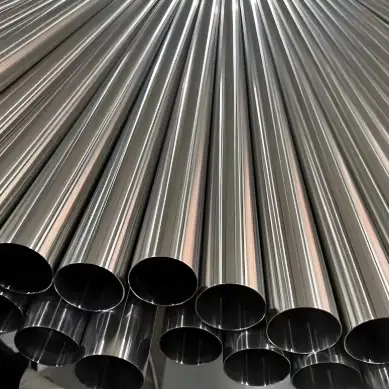
AMS 5566 is the SAE/AMS specification for cold-drawn, high-pressure hydraulic tubing made from Type 304 austenitic stainless steel (nominally ~19% Cr / ~10% Ni). It covers both seamless and welded-and-drawn tubing in specific tempers and sizes and is widely used in aerospace and industrial hydraulic systems where corrosion resistance, good strength, and excellent formability are required.
What is AMS 5566?
AMS 5566 is an aerospace material specification that defines requirements for corrosion-resistant steel tubing intended primarily for high-pressure hydraulic and control lines. The standard prescribes chemical limits, product forms (seamless or welded & drawn), required tempers (cold-drawn conditions such as 1/8 hard), dimensional tolerances, and acceptance tests appropriate to flight and other demanding hydraulic systems. This spec is the authoritative reference when traceability and consistency are required for aerospace tubing made from nominally Type 304 stainless.
Why Type 304 for hydraulic tubing
Type 304 austenitic stainless has long been a workhorse for tubing because it balances corrosion resistance, ductility, and cold-forming capability. For hydraulic lines you need a metal that can be cold-drawn to thin walls, welded, flared, bent and then retain adequate tensile/yield strength and fatigue endurance under cyclic pressure. The 18–20% chromium provides passive film formation for oxidation and general corrosion resistance; the 8–11% nickel stabilizes the austenitic matrix that gives the alloy its toughness and formability. Practical result: 304 in the AMS 5566 condition holds up well in aircraft hydraulic service and many industrial applications.
Chemical composition
| Element | Typical AMS 5566 (304) limits, wt.% |
|---|---|
| Carbon (C) | ≤ 0.08 |
| Chromium (Cr) | 18.0 – 20.0 |
| Nickel (Ni) | 8.0 – 11.0 (typical 9–10%) |
| Manganese (Mn) | ≤ 2.0 |
| Silicon (Si) | ≤ 1.0 |
| Phosphorus (P) | ≤ 0.040 |
| Sulfur (S) | ≤ 0.030 |
| Copper (Cu) | ≤ 0.75 |
| Molybdenum (Mo) | ≤ 0.75 (often not present in 304) |
| Iron (Fe) | Balance |
Notes: Exact official limits and footnotes are given in the AMS text and variants (MS, revisions) may refine test methods and minor element allowances; for design or procurement always refer to the current AMS document and supplier mill certificates. Typical manufacturer data sheets for AMS 5566 list ranges in the table above; 304L variants (for lower carbon) are covered by companion specs where intergranular corrosion resistance is a concern.
Mechanical properties and tempering
AMS 5566 tubing is most commonly supplied cold-drawn to a specified hardness/temper condition typically referred to as 1/8 hard (cold worked). Typical mechanical properties (representative values from supplier data for cold-drawn 304 tube) are:
-
Tensile strength (ultimate): roughly 75–110 ksi (approximately 520–760 MPa) depending on wall and OD.
-
Yield strength (0.2% offset): commonly in the 30–75 ksi range depending on gauge and condition.
-
Elongation (in 2"): 20–40% (varies with wall thickness and temper).
Because the tubing is cold drawn, strength is higher than annealed tubing but formability (for deep forming) is lower than annealed (solution treated) grades. For precise design numbers use the producer’s mechanical data for the given OD/wall.
Types and product forms: seamless vs welded & drawn
AMS 5566 covers Type 1 — seamless, and Type 2 — welded and drawn tubing. Welded & drawn tube is made by forming a strip, welding the seam, and drawing to size so the weld is worked into the tube body and the final product behaves much like seamless tube. Advantages and tradeoffs:
-
Seamless: generally higher fatigue resistance for very thin walls or extreme cyclic loads; preferred where the absolute absence of a seam is mandated.
-
Welded & drawn: cost-effective particularly for larger diameters and thin walls; modern processes produce welded & drawn tube meeting aerospace quality when properly controlled and nondestructively inspected.
Both forms can be cold drawn to the required temper and are accepted under AMS 5566 when they meet the standard tests and dimensional tolerances.
Dimensional ranges, tolerances and surface finishes
Suppliers commonly produce AMS 5566 tubing in nominal OD ranges from under 1/8" up to several inches, and wall thicknesses from very thin control-line walls (0.006" range) up to heavier hydraulic walls (0.218" and more for large diameters). Final tolerances depend on OD/wall and are specified in the AMS text or vendor tables; common finishes are cold-drawn bright (clean, smooth), and optional polishing or pickling to remove scale or welding discoloration. For critical hydraulic fittings, roundness and concentricity tolerances are important to ensure leak-free assemblies.
Manufacturing sequence and quality controls
Typical production steps for AMS 5566 welded & drawn tubing: strip preparation → forming → weld (e.g., TIG or seam welding) → anneal (if required by variant) → cold drawing to final size → straightening → testing → finish (pickling/passivation). Seamless tube starts from billet → piercing → elongation → hot and cold finishing → drawing.
Quality controls commonly required or requested by buyers:
-
Chemical analysis (certificate of compliance / mill test report)
-
Tensile test and hardness per lot sampling
-
Non-destructive examination of welds (eddy current, hydrostatic or pneumatic tests, visual)
-
Dimensional inspection (OD, wall, straightness, ovality)
-
Surface condition checks and passivation to ASTM A967 or comparable procedures
Aerospace customers often require traceability, lot/batch heat numbers, and third-party inspection reports.
Performance in service: corrosion, fatigue and pressure behavior
Corrosion: 304 provides good general corrosion resistance in many atmospheres and many aqueous environments, but it is vulnerable to pitting and crevice corrosion in chlorides and to stress-corrosion cracking at elevated temperatures in certain atmospheres. For service where chlorides, sulfides, or high-temperature sensitization are possible, consider 304L (lower carbon), 316/316L (Mo-bearing) or more corrosion-resistant alloys.
Fatigue & pressure: cold-worked AMS 5566 tubing has higher yield and tensile strength than annealed tube, which can improve pressure performance and reduce wall thickness needed for a given pressure class. However, the cold work may influence fatigue crack initiation behavior; proper design, bending practices, flaring and fitting installation are essential. Where cyclic pressure or vibration is heavy, specify appropriate inspection and, if necessary, higher-grade alloys. Manufacturer datasheets and aerospace engineering practice provide safe working pressures for specific OD/wall combinations and must be referenced in system design.
AMS 5566 vs alternatives: when to choose something else
-
304L (lower carbon): better resistance to intergranular corrosion after welding or exposure to sensitizing temperatures; choose 304L tubing if welds will be exposed to long high-temperature service or if post-weld heat treatment is not feasible.
-
321: stabilized with Ti; better high-temperature strength and resistance to intergranular corrosion than 304 in some thermal cycles.
-
316/316L or duplex: choose for chloride-rich environments or higher strength/corrosion resistance needs.
-
Nickel alloys (625, 825, etc.): for aggressive chemical environments or very high temperatures — more expensive but substantially better resistance.
Decision rules: match metallurgy to corrosive agents, service temperature, and mechanical loading. For many hydraulic lines where salt spray is not dominant, AMS 5566 (304) is cost-effective and appropriate.
Procurement and inspection checklist
When purchasing AMS 5566 tubing or specifying it on a drawing, include the following in your PO and drawing notes:
-
Full spec and revision (e.g., AMS 5566, revision N, date).
-
Material form: seamless or welded & drawn (Type 1 or Type 2).
-
Size & tolerance: OD, wall, straightness, ovality limits.
-
Temper/condition: cold-drawn (1/8 hard) or solution annealed if required.
-
Surface finish: cold-drawn bright; passivation requirement (e.g., ASTM A967).
-
Mill test report: chemical and mechanical.
-
NDT: eddy-current or hydrostatic acceptance criteria for welds.
-
Traceability: heat numbers, lot IDs, country of origin if required by procurement rules.
-
Packaging & shipping: protective end caps, oil free packing for aerospace.
Ask suppliers for actual mill certificates and, for flight hardware, QA flowdown documentation.
Typical use cases and examples
-
Aircraft hydraulic and fuel lines: primary historical use — high-pressure control and actuation tubing.
-
Aerospace instrumentation and pneumatic lines: where cleanliness and traceability are required.
-
Industrial hydraulic systems and instrumentation: pumps, valves, manifolds where 304’s balance of properties is adequate.
-
Marine and general industrial piping for control lines: lighter service where 316 is not necessary.
AMS 5566 equivalence table
| AMS 5566 (Type 304 tubing) | Closest common equivalents / notional crossrefs |
|---|---|
| UNS | S30400 (304) |
| EN / Euronorm | 1.4301 (X5CrNi18-10) |
| JIS | SUS304 / S30400 |
| Common names | Type 304 stainless, 18-8 stainless |
| ASTM crossrefs (tubing) | ASTM A269 / A213 (depending on product form) — note: ASTM covers more general tubing and does not replace AMS acceptance tests |
| AMS companions | AMS 5564 / 5565 / 5567 / 5569 (other tubing conditions and alloys) |
Comment: Exact equivalence depends on product form, temper and acceptance tests; AMS 5566 is a specification tailored to aerospace hydraulic tubing and includes acceptance criteria not found in generic ASTM product specs — therefore calling a product “equivalent” is acceptable for chemistry/mechanical similarity but procurement should still reference AMS 5566 if that standard’s tests and traceability are required.
FAQs
-
Is AMS 5566 the same as ASTM A269 or A213?
No — AMS 5566 is an aerospace material specification tailored to high-pressure hydraulic tubing with its own acceptance and testing requirements. ASTM A269/A213 are broader tubing standards; chemistry may overlap but the AMS standard includes aviation QA flows and tighter controls. -
Can AMS 5566 tubing be used where 316 is currently used?
Not as a straight swap in chloride-rich environments; 316 has superior pitting and crevice corrosion resistance because of Mo content. Use 304 (AMS 5566) where service conditions allow it. -
What does “1/8 hard” mean for AMS 5566?
It’s a cold-worked temper typically produced by cold drawing; it indicates increased strength compared with annealed tubing and is commonly used in AMS 5566 supply. Refer to the spec or vendor tables for precise mechanical ranges. -
Is welded & drawn AMS 5566 acceptable for flight hardware?
Yes, provided the welded & drawn product meets AMS 5566 acceptance tests, nondestructive exam, and traceability requirements. Many aerospace suppliers use welded & drawn successfully. -
How do I specify passivation?
Typically reference ASTM A967 or AMS-compatible passivation procedures and require mill cert evidence of the passivation bath and post-treatment rinsing. Specify this in the PO. -
Can AMS 5566 be bent and flared for tube fittings?
Yes — the material is formable, but bending and flaring practices must avoid crease and overstrain; after forming, inspect for ovality and wall thinning. Use tooling designed for the tube OD/wall. -
What are common failure modes in service?
Corrosion in chloride environments, fatigue from cyclic pressure or vibration, and damage from improper installation (kinking, excessive bending) are typical failure causes. Choose materials and installation practices to mitigate these. -
Is AMS 5566 available in 304L?
AMS 5566 principally targets 304; companion tubing specs and variants (e.g., AMS 5564/5569) address other tempers and alloys including 304L where lower carbon is required. Consult AMS text or supplier for exact coverage. -
How should AMS 5566 tubing be documented for aerospace procurement?
Require AMS 5566 revision level, mill test report, heat/lot traceability, NDT reports (if applicable), and QA flowdowns in the PO. Packaging and marking instructions are also important. -
For a retrofit in an industrial plant, what inspection is prudent before reuse?
Visual inspection for corrosion and pitting, dimensional checks, dye penetrant or eddy current inspection for weld integrity, and pressure testing where practical. Consider replacement if interior corrosion or wall loss is suspected.
Engineering notes & buyer tips
-
Always quote AMS spec revision number and request mill certificates.
-
For wet/damp environments with chlorides, evaluate 316(L) or duplex as an alternative.
-
When bending or flaring, allow for springback and control ovality.
-
For flight hardware, check supplier audit status and request lot-traceable documentation.
-
Consider surface passivation and packaging for cleanliness-sensitive systems.
Final summary
AMS 5566 defines a practical, widely used condition of Type 304 stainless steel tubing tailored to high-pressure hydraulic applications. It balances formability, corrosion resistance and strength by using cold-drawn tempers and tight manufacturing/inspection controls. While not suitable for every corrosive environment (chlorides, seawater, aggressive chemical service), AMS 5566 remains a cost-effective and proven choice for many aerospace and industrial hydraulic systems — provided the correct product form, finish and QA flowdowns are ordered and verified.