
A2 stainless steel, commonly referred to as 304 stainless steel, is one of the most widely used materials in various industries due to its excellent corrosion resistance, high tensile strength, and versatility. This alloy is especially favored for applications in environments where resistance to corrosion is crucial, including food processing, medical devices, construction, and automotive manufacturing. It combines the durability of stainless steel with ease of fabrication, making it an ideal choice for a range of engineering and industrial applications.
1. What is A2 Stainless Steel ?
A2 stainless steel, also known as 304 stainless steel, is an austenitic type of stainless steel. It consists primarily of iron, chromium (18%), and nickel (8%), which contribute to its remarkable resistance to rust and oxidation. A2 stainless steel is widely used for various industrial and domestic purposes due to its resistance to corrosion, high strength, and ease of fabrication. This steel grade falls under the 300 series of stainless steels, which are recognized for their high durability and formability. With a non-magnetic nature and excellent weldability, A2 stainless steel is particularly beneficial in environments where hygiene and longevity are of paramount importance.
2. Chemical Composition and Properties of A2 Stainless Steel
The chemical composition of A2 stainless steel typically includes:
-
Iron (Fe): 70.7-81.7%
-
Chromium (Cr): 18-20%
-
Nickel (Ni): 8-10.5%
-
Manganese (Mn): 2% max
-
Silicon (Si): 1% max
-
Carbon (C): 0.08% max
-
Phosphorus (P): 0.045% max
-
Sulfur (S): 0.03% max
This alloy composition provides A2 stainless steel with superior corrosion resistance, especially in acidic environments, and the ability to withstand high temperatures up to 870°C (1600°F) in intermittent use.
3. Mechanical Properties and Strength of A2 Stainless Steel
The mechanical properties of A2 stainless steel are one of the key reasons why it is so widely used in various sectors. These properties include:
-
Tensile Strength: Approximately 520 MPa (75,000 psi)
-
Yield Strength: Around 215 MPa (31,000 psi)
-
Elongation: 40% minimum
-
Hardness: 70 HRB (Rockwell B)
These characteristics make A2 stainless steel a high-performance material suitable for applications requiring both strength and flexibility. The high elongation value indicates that A2 stainless steel can withstand considerable deformation before breaking, which is essential in many manufacturing processes.
4. Corrosion Resistance of A2 Stainless Steel
- Composition: A2 stainless steel is often referred to as 304 or 18-8, and its composition includes at least 18% chromium and 8% nickel.
- Protective layer: Chromium in the steel reacts with oxygen to form a thin, invisible, and non-reactive layer of chromium oxide on the surface. This layer protects the underlying metal from rust and corrosion.
- General environments: It is suitable for a wide range of applications where there is no exposure to extreme conditions, such as kitchen equipment, medical devices, and general architectural elements.
- Limitations: It is susceptible to chloride-induced stress corrosion cracking and is not recommended for constant exposure to saltwater or harsh industrial chemicals. For these conditions, A4 stainless steel (316) is a better choice due to its addition of molybdenum, which enhances resistance.
- Mechanical properties: While A2 is known for its corrosion resistance, it also has moderate strength, good weldability, and is very durable, making it a popular choice for general-purpose fasteners.
5. Common Applications of A2 Stainless Steel
A2 stainless steel is used in a wide range of applications due to its durability, corrosion resistance, and ease of maintenance. Some of the most common applications include:
-
Food Processing: A2 stainless steel is commonly used in kitchen appliances, cutlery, food processing equipment, and utensils.
-
Construction: It is used for structural components, cladding, and reinforcement in building projects.
-
Medical Devices: A2 stainless steel is used in surgical instruments, dental tools, and implants.
-
Automotive Industry: It is used in the manufacture of exhaust systems, undercarriages, and various other components.
-
Pipes and Fittings: Due to its corrosion resistance, it is frequently used in plumbing and heating systems.
6. Advantages of Using A2 Stainless Steel
A2 stainless steel provides several key advantages:
-
Corrosion Resistance: Excellent resistance to corrosion, especially in fresh water and mildly acidic environments.
-
Ease of Fabrication: It can be easily formed, welded, and machined.
-
Durability: Resistant to wear and tear, providing long-lasting solutions in demanding environments.
-
Versatility: Suitable for a wide range of industries, from food production to aerospace.
7. Comparison: A2 Stainless Steel vs. Other Stainless Steels
When comparing A2 stainless steel to other types of stainless steel, its properties generally stand out for use in most common applications. Here is a basic comparison:
| Property | A2 Stainless Steel (304) | A4 Stainless Steel (316) | A1 Stainless Steel (201) |
|---|---|---|---|
| Corrosion Resistance | High | Excellent | Moderate |
| Tensile Strength | 520 MPa | 520 MPa | 500 MPa |
| Nickel Content | 8-10.5% | 10-14% | 3.5-5.5% |
| Typical Uses | Food, medical, construction | Marine, chemical | Budget applications |
8. Welding and Fabrication Techniques for A2 Stainless Steel
A2 stainless steel is known for its excellent weldability. It can be welded using a variety of techniques, including:
-
TIG Welding (Tungsten Inert Gas): Provides high-quality, precise welds.
-
MIG Welding (Metal Inert Gas): Suitable for larger applications.
-
Arc Welding: Can be used for thicker sections of material.
Special care should be taken during welding to avoid chromium carbide precipitation, which can compromise the material's corrosion resistance.
9. Heat Treatment and Hardening of A2 Stainless Steel
A2 stainless steel is generally non-hardenable by heat treatment; however, it can be hardened by cold working. This includes processes such as:
-
Cold Drawing: Increasing tensile strength through deformation.
-
Annealing: Used to relieve stress and improve ductility.
-
Pickling and Passivation: For enhancing surface quality and removing scale.
10. A2 stainless steel equivalent
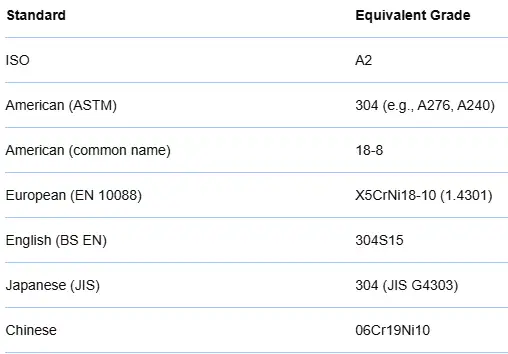
A2 stainless steel is equivalent to 304 stainless steel, with other common equivalents including X5CrNi18-10 (1.4301) under European standards and 304S15 under English standards. These grades are all based on an austenitic stainless steel composition of roughly 18% chromium and 10% nickel, which gives them good general corrosion resistance.
11. Cost Considerations and Price Trends for A2 Stainless Steel
The cost of A2 stainless steel can fluctuate based on market conditions, including raw material prices, production costs, and demand. Typically, A2 stainless steel is more affordable than higher-alloy stainless steels like A4 or A5 but may be slightly more expensive than carbon steels due to its superior properties.
12. Maintenance and Care of A2 Stainless Steel Products
While A2 stainless steel is highly durable and resistant to corrosion, it is still important to maintain and clean it regularly. Here are a few tips for maintaining A2 stainless steel products:
-
Regular Cleaning: Use non-abrasive cleaners to prevent scratching the surface.
-
Avoid Harsh Chemicals: Avoid exposure to chlorine and other harsh chemicals.
-
Preventing Staining: Periodically apply a stainless steel cleaner or polish to maintain its appearance.
13. Frequently Asked Questions (FAQs)
-
What is A2 stainless steel?
A2 stainless steel is a type of 304 stainless steel, known for its corrosion resistance, high strength, and ease of fabrication. -
What are the main uses of A2 stainless steel?
It is used in food processing, construction, medical devices, automotive, and piping systems. -
Can A2 stainless steel be welded?
Yes, A2 stainless steel can be welded using various methods, including TIG, MIG, and arc welding. -
How does A2 stainless steel compare to other stainless steels?
A2 is more affordable than 316 stainless steel but offers excellent corrosion resistance and strength for most common applications. -
Is A2 stainless steel magnetic?
A2 stainless steel is generally non-magnetic, though it can become slightly magnetic after cold working. -
How do you maintain A2 stainless steel?
Regular cleaning with non-abrasive cleaners and avoiding harsh chemicals will maintain A2 stainless steel. -
What is the difference between A2 and A4 stainless steel?
A2 has a lower nickel content and is less resistant to corrosion in marine environments compared to A4, which has higher nickel and molybdenum content. -
What is the tensile strength of A2 stainless steel?
The tensile strength of A2 stainless steel is approximately 520 MPa. -
Can A2 stainless steel be hardened?
A2 stainless steel is not hardenable by heat treatment but can be strengthened through cold working processes. -
Is A2 stainless steel environmentally friendly?
Yes, A2 stainless steel is highly recyclable, reducing its environmental footprint.