
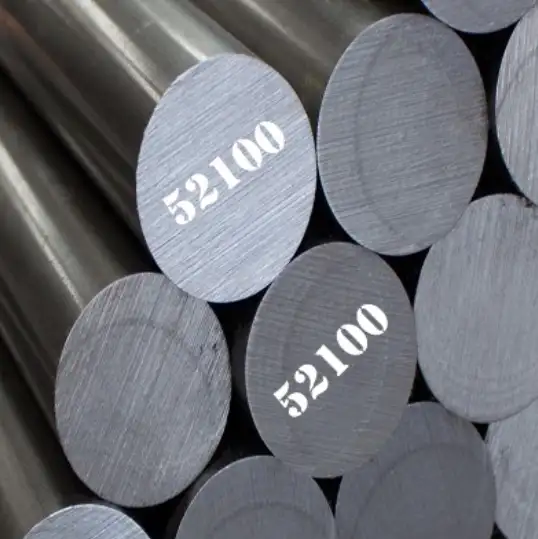
AISI/ASTM 52100 is a high-carbon, chromium-bearing bearing steel optimized for exceptional wear resistance, rolling-contact fatigue strength and achievable through-hardening (typical hardness range HRC 58–66 after heat treatment). It is the material of choice for precision rolling-element bearings, high-life shafts and wear parts when maximum hardness and fatigue life are required; however, it is not a corrosion-resistant alloy and requires protective measures in aggressive environments.
What is 52100 steel
52100 is an SAE/AISI designation for a high-carbon chromium alloy steel that originated in bearing manufacture. Historically used for rolling-element bearings for well over a century, 52100 belongs to the family of high-carbon, high-carbide steels engineered to produce a fine dispersion of chromium carbides in a martensitic matrix after appropriate heat treatment. Its combination of roughly 1.0–1.6% C and ≈1.3–1.6% Cr produces high hardenability, good wear resistance and outstanding rolling-contact fatigue life when heat treated correctly.
Chemical composition and metallurgical features
Below is a practical composition table summarizing typical analysis ranges used by suppliers and in public datasheets. Note that individual mill specifications and national standards (EN, JIS, GB) show small variations; always consult the mill certificate for lot acceptance.
Table — Typical chemical composition (wt%) for 52100 (nominal ranges)
| Element | Typical range (wt%) | Role / effect |
|---|---|---|
| Carbon (C) | 0.95 – 1.10 | Primary hardening element; increases hardness, wear resistance and carbide volume |
| Chromium (Cr) | 1.30 – 1.60 | Forms chromium carbides; improves hardenability and wear resistance |
| Manganese (Mn) | 0.25 – 0.45 | Improves hardenability and strength; deoxidizer |
| Silicon (Si) | 0.15 – 0.35 | Deoxidizer; contributes to strength |
| Phosphorus (P) | ≤ 0.025 | Impurity — keep low for fatigue performance |
| Sulfur (S) | ≤ 0.020 (often ≤0.015) | Impurity — low S improves fatigue and toughness |
| Iron (Fe) | Balance | Matrix element |
Sources and commercial datasheets consistently place 52100 as high-carbon (≈1.0%) and low alloy chromium (≈1.4%). Variants and equivalents from other standards (DIN 100Cr6, JIS SUJ2, GB GCr15) track very closely.
Metallurgical note: The alloy scope intentionally limits alloying to keep the matrix simple (martensite after quench) while producing evenly distributed chromium carbides that give wear resistance. The low levels of other alloying elements keep the steel responsive to conventional heat treatments used for bearings and shafts.
Physical and mechanical properties
Table — Typical physical properties (representative values at room temperature)
| Property | Typical value |
|---|---|
| Density | ~7.85 g/cm³ |
| Modulus of elasticity (E) | ≈ 210 GPa |
| Poisson’s ratio | ~0.29 |
| Thermal conductivity | ~45 W/(m·K) (room temp, approximate) |
| Specific heat | ≈ 460 J/(kg·K) |
| Magnetic behavior | Ferromagnetic below Curie point (becomes non-magnetic above austenitizing temp) |
Mechanical properties (depending on heat treatment):
-
In the annealed (soft) condition: tensile strength ~700–900 MPa, elongation 10–15% (approximate, depends on exact treatment).
-
In quenched & tempered / through-hardened condition: tensile strengths can exceed 1600 MPa with hardness commonly in the range HRC 58–66 depending on tempering.
Design note: Because mechanical properties vary strongly with hardening and tempering schedule, specify the exact heat treat target (e.g., HRC 60 ±2) along with core vs. surface hardness and fatigue life requirements when issuing drawings or purchase orders.
Heat treatment, quench/temper practices and hardness
Controlled heat treatment is central to unlocking 52100’s performance. The agitation, quench medium, austenitizing temperature and tempering schedule determine final hardness, toughness and residual stress state.
Common commercial heat treatment practice (general guidance; follow supplier’s datasheet):
-
Normalize (optional) — Some practices call a normalization cycle to refine grain and relieve residual stresses prior to hardening (e.g., 850–930°C, air cool). Normalizing helps reduce decarb and homogenize structure on thick cross sections.
-
Austenitize — Typical range: 800–830°C (1470–1525°F) depending on cross section; some knife/blade guides recommend 815–850°C. Time at temperature should match section thickness. Over-austenitizing raises grain size and can reduce toughness.
-
Quench — Oil quench is common for many sections to achieve a martensitic structure while managing distortion. For critical bearing components, controlled quench oils or interrupted quenching are used to reduce quench stresses. For small sections, air or faster oil quenches produce deeper hardening.
-
Cryogenic treatment (optional) — Subzero/quench to −70°C or liquid nitrogen treatments are sometimes specified to transform retained austenite and increase dimensional stability; widely used in high-performance bearing and knife applications.
-
Temper — Typical temper range: 150–300°C (300–570°F) to balance hardness vs. toughness; lower temp tempers retain higher hardness (HRC 60–66), higher temp tempers reduce hardness but improve toughness and reduce brittleness. For bearing steels, tempering schedules are tuned to target rolling fatigue life and spall resistance.
Table — Typical hardness after common treatments
| Treatment | Typical hardness (HRC) |
|---|---|
| Annealed (soft) | HRC 18–24 |
| Quenched (no temper) | HRC 62–68 (brittle unless tempered) |
| Quench + low temper (e.g., 150–200°C) | HRC 60–66 |
| Quench + medium temper (e.g., 200–300°C) | HRC 56–62 |
| Tempered for toughness (≥300°C) | HRC 52–58 |
Practical tip: For bearing components, target a through-hardness band (e.g., HRC 60 ±2) and require hardness mapping reports and microstructure images on the certificate.
Microstructure, wear behavior and fatigue performance
After appropriate heat treatment, 52100 typically exhibits a martensitic matrix with finely dispersed chromium carbides (M23C6-type or complex carbides depending on chemistry and cooling). The homogeneity and size of carbides affect both abrasive wear resistance and rolling-contact fatigue:
-
Fine, evenly distributed carbides provide consistent wear resistance and reduce localized stress raisers.
-
Coarser carbides or segregation can act as initiation sites for cracks under cyclic contact, reducing fatigue life.
Why 52100 resists rolling fatigue well: The high carbon content enables high hardness and compressive residual stresses after quench/temper; combined with adequate toughness, this yields a high endurance limit under Hertzian contact conditions typical of bearings. Material cleanliness (low non-metallic inclusions) and precise heat treatment are key to long life.
Corrosion behavior and comparison with stainless bearing steels
52100 is not a stainless alloy. Its chromium (≈1.4%) is far below stainless levels (≥11–12%), so corrosion resistance is limited. In general:
-
Atmospheric exposure: shows rusting if not coated, passivated or lubricated.
-
Wet or saline environments: accelerated corrosion and pitting can drastically shorten fatigue life and promote flaking/spalling.
-
Comparison to 440C: Stainless bearing steels like 440C offer better corrosion resistance at the cost of differing wear/toughness balance; in many corrosive environments, 440C or stainless alternatives outperform 52100 for service life, despite slightly different hardness or wear behavior.
Corrosion table — Relative behavior (qualitative)
| Environment | 52100 | 440C (stainless) |
|---|---|---|
| Dry, clean air | Good (when lubricated) | Good |
| Humid air | Rusts without protection | Better than 52100 |
| Salt spray / marine | Poor — rapid corrosion | Better — still may need seals |
| pH extremes | Poor | Better depending on pH |
Mitigations for 52100 in corrosive conditions: use protective coatings (e.g., phosphate, black oxide), corrosion inhibitors, sealed/lubricated housings, sacrificial coatings or switching to a corrosion-resistant grade if exposure is persistent.
Machinability, forming and welding guidance
Machinability:
-
Machining is easiest in the annealed (soft) condition. Hard 52100 (HRC 60+) requires carbide tooling, high rigidity, and slow feeds. Grinding and hard turning (CBN inserts) are common for finishing rolling elements and raceways.
Forming:
-
Cold forming should be done prior to hardening. Hot forming (above recrystallization) followed by normalization helps for complex shapes.
Welding:
-
Welding high-carbon steels like 52100 is challenging: high carbon content promotes cracking and hardness in the heat affected zone (HAZ). Common practice is to avoid welding finished parts; if a repair weld is necessary, preheat, use matching filler, and post-weld heat treat (PWHT) to temper the HAZ. Most bearing manufacturers prohibit welding of finished raceways and rolling elements.
International equivalents, specifications and standards
Table — Common international equivalents
| SAE/AISI | DIN/EN | JIS | GB (China) | Other common name |
|---|---|---|---|---|
| 52100 | 100Cr6 (EN) / 1.3505 | SUJ2 | GCr15 | Bearing steel / 52100 |
| UNS G52986 | — | — | — | — |
Equivalents are approximate; chemical and property tolerances may differ among standards. Confirm cross-reference carefully for critical parts.
Standards and test references often used with 52100:
-
ASTM standards for bearing steels and wrought products (e.g., ASTM A295 family references for bearing steels in some contexts)
-
EN and JIS documents covering 100Cr6 and SUJ2 respectively
-
ISO test standards for hardness, fatigue, and microstructure assessment.
Typical applications, selection guidance and design considerations
Primary applications:
-
Rolling element bearings (ball bearings, roller bearings) — the most common usage.
-
Precision shafts and spindles requiring high wear resistance.
-
High-life pin and roller components in transmission systems.
-
Tooling where high hardness and wear resistance are essential (some cutter and shear components).
Selection guidance:
-
If high wear + high contact stresses are primary drivers and the component will operate in a lubricated, controlled environment → 52100 is often ideal.
-
If exposure to moisture, salt or corrosive chemicals is expected, consider 440C or other stainless bearing steels, or apply protective measures to 52100.
-
When machining capability is limited, specify annealed condition supplies and outsource hardening; also consider substitution with lower-carbon but case-hardenable steels if a tough core plus wear surface is needed.
Design considerations that affect material performance:
-
Surface finish and geometry (stress concentrators increase spalling risk)
-
Lubrication quality and contamination (particles will wear carbides and matrix)
-
Heat treatment uniformity (core vs. surface hardness gradients)
-
Cleanliness and inclusion control (non-metallic inclusions reduce fatigue life)
Pricing drivers, procurement and supply considerations
Table — Price factors and procurement checklist
| Price driver | Effect on cost |
|---|---|
| Steel mill / brand certification | Premium for reputable mills, certified bearing-steel producers |
| Form of supply (bar, ring, forged blank) | Finished rings/forgings cost more than bars |
| Size & cross section | Larger sections increase processing and heat-treat costs |
| Heat treatment & inspection (QC) | Specified hardness mapping, micrographs, NDT add to cost |
| Traceability & certifications (e.g., ISO 9001, API where applicable) | Additional QA costs |
| Surface finish and grinding | Precision grinding of raceways is costly |
| Market raw material prices (C, Cr) | Steel market volatility affects final price |
Typical procurement notes: For high-value bearing components, buyers commonly request mill test certificates (MTC), certified chemical analysis, hardness charts, metallographic images (etched microstructure), and fatigue/life test data when applicable.
Approximate price ranges: Market prices fluctuate with scrap and alloy markets and with global demand. For rough budgeting, raw 52100 bars are priced as alloy steel stock (per kg/lb) with added processing. For precision bearing rings or finished parts the unit price rises significantly due to machining, heat treatment and QC. (Because pricing is volatile, obtain current mill/stock supplier quotes for firm procurement.)
Test methods, quality control and acceptance criteria
Typical inspection items for bearing components made of 52100:
-
Chemical analysis (spectrograph or wet chemistry) to verify nominal composition.
-
Hardness mapping (Rockwell or Vickers) — report core and surface values, and hardness gradients across section.
-
Microstructure inspection (metallography) to confirm martensitic matrix and carbide distribution, and to detect decarb or segregation.
-
Non-destructive testing (NDT) such as ultrasonic or magnetic particle for internal and surface defects on critical components.
-
Rolling-contact fatigue testing or accelerated life tests for high-duty designs.
Acceptance criteria example (must be tailored to spec):
-
Hardness: HRC 60 ±2 (through-hardened)
-
Decarburization depth: less than specified max (e.g., <0.2 mm depending on drawing)
-
Inclusion rating: per agreed standard (e.g., ISO 4967, ASTM E45 methodology)
-
No lamination, no internal voids detected by ultrasonic testing beyond specified limits
Practical procurement and manufacturing checklist
-
Specify the exact material designation (e.g., AISI 52100 / UNS G52986 / 100Cr6) and mill standard.
-
State form of supply, required heat-treatment state on delivery (annealed, normalized, quenched & tempered), and final hardness.
-
Include inspection and testing requirements (MTC, micrographs, hardness maps, NDT).
-
Define surface finish and geometric tolerances (raceway roundness, runout) if bearing function.
-
Confirm packaging and preservation for corrosion prevention during transit (oiled, sealed).
FAQs
1. What is 52100 steel best used for?
52100 is optimized for rolling-element bearings, precision shafts and wear parts where high hardness, surface wear resistance and excellent rolling fatigue life are required.
2. Is 52100 stainless?
No. 52100 contains about 1.3–1.6% chromium, far less than stainless grades; it will corrode without protective measures.
3. What hardness can I expect after heat treatment?
Typical through-hardness after appropriate quench and temper is HRC 58–66 depending on temper temperature and section size. Specify exact HRC target in procurement.
4. What are the main international equivalents to 52100?
Common equivalents include DIN 100Cr6, JIS SUJ2 and GB GCr15. Always verify tolerances and mill certs before substituting.
5. Can 52100 be welded?
Welding is not recommended for finished bearing components due to high carbon; if necessary, follow strict preheat and PWHT procedures and accept potential loss of fatigue life.
6. How does 52100 compare to 440C for bearings?
52100 typically provides excellent wear and fatigue resistance in lubricated environments; 440C provides superior corrosion resistance. Choose based on exposure and lubrication conditions.
7. Can I machine 52100 in the hardened condition?
Hard machining is possible with carbide or CBN tooling and rigid setups; however, machining is far easier and cheaper in the annealed condition prior to hardening.
8. Is cryogenic treatment necessary?
Cryogenic treatment can reduce retained austenite and improve dimensional stability and wear life in high-precision applications; it is optional and applied where small gains justify cost.
9. What causes premature failure in 52100 bearings?
Typical causes include contamination, inadequate lubrication, improper heat treatment, decarburization, inclusions, and corrosive environments. Each must be addressed during design and QA.
10. Where can I obtain certified 52100 material?
Purchase from reputable mills or specialty steel stockists that provide mill test certificates (MTC), heat-treatment records and inspection reports. Ask suppliers for metallographic images and fatigue data where relevant.
Recommendations for engineers and buyers
-
For bearing applications, require full traceability, microstructure, and fatigue test evidence for high-duty or safety-critical components.
-
For corrosive exposure, consider alternatives or protective coatings; avoid assuming 52100 is acceptable without corrosion risk analysis.
-
For precision parts, require finish grinding after heat treat and specify residual stress control, as quench distortion can affect geometry.
-
For cost optimization, specify supply in annealed condition to reduce machining costs, then outsource hardening to specialized heat-treat vendors with calibrated furnaces and quench control.