

AISI/SAE 4140 is weldable when handled with deliberate controls: clean preparation, low-hydrogen consumables, appropriate preheat and controlled interpass temperature, and where required, post-weld heat treatment. If those safeguards are followed and welding procedures are qualified, welded 4140 joints can meet the same strength and toughness demands that make 4140 popular for shafts, gears, and high-stress components. However, failure to control cooling rate, hydrogen and section temperatures risks hard, brittle heat-affected zones and cold cracking.
What is 4140 steel?
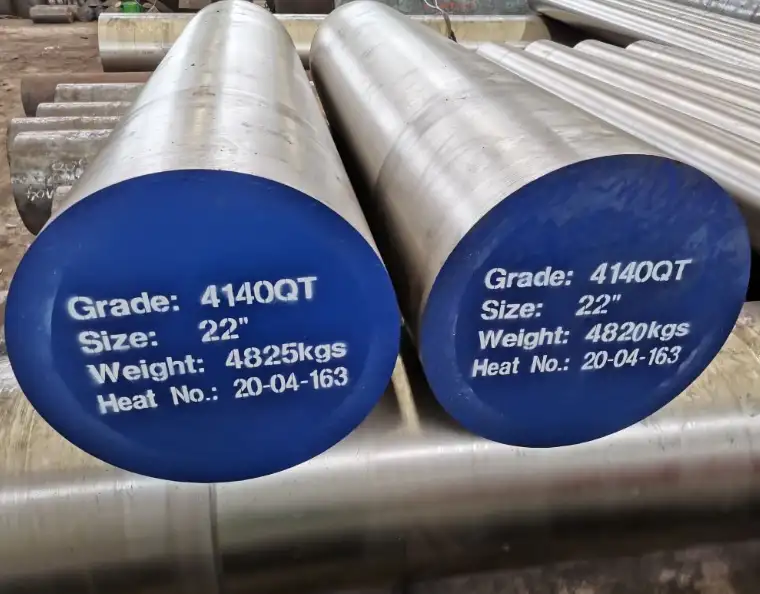
SAE/AISI 4140 is a chromium-molybdenum low-alloy, medium-carbon steel (commonly referenced as UNS G41400). Typical chemical ranges are roughly: C 0.38–0.43%, Mn 0.75–1.00%, Cr 0.80–1.10%, Mo 0.15–0.25% and Si 0.15–0.30%. That chemistry produces good hardenability, high fatigue strength, and toughness after appropriate heat treatment. Because of its hardenability, 4140 is widely used for highly stressed parts that may be supplied in normalized, tempered or quenched-and-tempered conditions.
Why that matters for welding: the carbon level and alloying raise the steel's tendency to form hard martensite during rapid cooling. Martensitic HAZ microstructures are hard and brittle and can crack if hydrogen or residual stresses are present. Management of cooling rate and hydrogen is therefore the central theme for successful welding.
2. Why weldability matters for components made from 4140
4140 is used where part failure has high cost or safety implications: shafts, axles, gears, couplings, and oilfield components. Welding is often required for repairs, attachments or fabrication of assemblies. Improper welding that produces high HAZ hardness or cracking can cause catastrophic in-service failure. The practical implication is this: welding 4140 is not impossible, but without qualified procedures the risk is materially higher than with low-carbon steels.
3. Metallurgical factors that control 4140 weldability
3.1 Carbon equivalency and hardenability
Carbon equivalency (CE) formulas — for example the classic IIW or AWS equations — combine carbon and alloying elements to indicate hardenability and cold-cracking susceptibility. 4140’s CE is higher than mild steel, so it requires more preheat or PWHT to avoid hard, brittle HAZ. Practical rule: treat 4140 more like a heat-treatable alloy than like mild steel when planning welds.
3.2 Prior condition of the material
-
Annealed or normalized: easiest to weld; lower hardness and lower cracking risk.
-
Quenched and tempered / pre-hardened: highest risk. Welding to pre-hardened sections commonly requires special controls or local softening (e.g., pre-heating to high temperatures or local anneal) and often PWHT after welding. Many sources advise against welding fully hardened 4140 unless unavoidable.
3.3 Section thickness and heat sink effect
Thin sections cool fast and produce less HAZ hardening; thick sections are large heat sinks but can create steep thermal gradients that encourage cracking. Preheat and interpass control must be scaled to section thickness.
3.4 Hydrogen and contamination
Hydrogen introduced from moisture, lubricants, oils, rust, coatings or wet electrodes dramatically increases cold-cracking risk. Use low-hydrogen consumables and stringent cleaning; control ambient humidity if necessary.
4. Preheat, interpass temperature, and cooling control
Why preheat and interpass temperature are used
Preheat slows the cooling rate, allowing diffusible hydrogen to escape and preventing formation of untempered martensite in the HAZ. Interpass temperature prevents the previously deposited weld metal or HAZ from cooling below the critical temperature between passes. These steps reduce thermal stresses and lower cracking susceptibility.
Recommended ranges (practical table)
These are engineering recommendations used in WPS drafting. Final values must be determined by carbon equivalency, thickness, part criticality, and qualification testing.
| Base metal condition | Thickness (mm / in) | Typical preheat (°C / °F) | Interpass temp (°C / °F) | Notes |
|---|---|---|---|---|
| Annealed / normalized | <6 mm (¼") | 100–150°C (212–300°F) | Maintain same | Light preheat for cleanliness and hydrogen control. |
| Normalized | 6–25 mm (¼–1") | 150–260°C (300–500°F) | 150–260°C | Common shop practice: 200–250°C typical. |
| Quenched/tempered | 6–25 mm | 200–260°C (400–500°F) | 200–260°C | Critical parts higher end; consider PWHT. |
| Thick sections >25 mm (>1") | >25 mm (>1") | 260–370°C (500–700°F) | Maintain preheat | Increase with CE and service criticality; some WPS call 250–370°C. |
Practical notes: many fabricators report reliable welding with preheat/interpass of 200–300°F (100–150°C) on small parts and 500–700°F (260–370°C) on critical, thicker or pre-hardened parts. Exact numbers depend on CE and prior heat treatment.
5. Post-weld heat treatment (PWHT)
PWHT relieves residual stress, tempers hard martensite in the HAZ and restores ductility. For critical components, PWHT is often required. Typical PWHT (stress relief tempering) recommendations for 4140 range approximately 550–650°C (1020–1200°F) with hold times commonly expressed as 1 hour per inch (25 mm) of thickness with controlled slow cooling. Exact cycles must follow design specifications, contract requirements or codes.
When PWHT is mandatory
-
Parts supplied quenched and tempered to high hardness and then welded.
-
High-pressure or fatigue-sensitive components.
-
When WPS or governing code requires post-weld tempering.
When PWHT might be optional
-
Small repairs on annealed 4140 parts with low CE and noncritical service; still exercise caution and test.
6. Filler metal and process selection
Choice of welding processes
-
GMAW (MIG/MAG) with appropriate low-hydrogen wire is common for production.
-
SMAW (stick) using low hydrogen (H4/H8) electrodes is widely used in field repairs.
-
GTAW (TIG) is used for precision welds and thin sections.
-
SAW may be used for heavy sections where heat input is controllable.
Filler metal selection (summary table)
| Application | Typical filler | Strength match | Notes |
|---|---|---|---|
| Strength and matching composition | ER80S-D2 (GMAW), E9018M-H4 (SMAW) or higher strength low-hydrogen consumables | Overmatch or match | Use alloyed, low-hydrogen fillers to approach base metal strength and toughness. |
| Conservative choice for repair | ER70S-2 (GMAW) with PWHT | Lower strength unless PWHT | Easier to weld but may require PWHT to avoid weak HAZ or to temper. |
| Dissimilar welding to mild steel | Fillers designed for transition; consider interlayers | Application-dependent | Pay attention to dilution and toughness. |
Guidance: match filler strength where possible. Many fabricators use ER80 series wires or electrodes for best mechanical property continuity; if using lower strength filler, plan PWHT and validate with mechanical tests and hardness surveys.
7. Welding procedure (WPS) essentials and sample parameters
A qualified WPS for 4140 must document: base metal condition, filler type and classification, preheat and interpass, heat input, travel speed, number of passes, joint geometry, PWHT, NDT acceptance criteria and qualifications for the welder and PQR records.
Sample WPS parameter summary (example for a normalized 4140 plate, 12 mm thick)
| Item | Value (example) |
|---|---|
| Base metal | AISI 4140, normalized |
| Thickness | 12 mm (0.47") |
| Process | GMAW (pulsed or short-circuit for thin welds) |
| Filler | ER80S-D2 (wire diameter 1.2 mm) |
| Shield gas | 98% Ar / 2% O₂ or Ar/CO₂ mix per shop standard |
| Preheat | 180–220°C (350–430°F) — maintain until weld cools to 100°C |
| Interpass | ≤220°C |
| Heat input | 1.0–2.0 kJ/mm (control to minimize excessive HAZ growth) |
| PWHT | 600°C for 1 hour per inch if required by design |
| NDT | Visual 100%; radiography or ultrasonic per code for critical parts |
| Hardness | Max HAZ 350 HV (or per spec); test per PQR |
This example must be converted to formal WPS language and validated via a PQR and mechanical testing (tensile, bend, Charpy V-notch where required).
8. Inspection and NDT after welding
-
Hardness survey: measure HAZ hardness across weld cross-section. For quenched/tempered 4140 parts the allowable HAZ hardness must be set by the design; uncontrolled HAZ hardness above ~350 HV (approx. 32–36 HRC) is often a sign that PWHT is required.
-
Visual and dimensional checks: cracks, undercut, lack of fusion.
-
NDT: radiography or ultrasonic inspection for critical components.
-
Metallography: for forensic or qualification work, to verify HAZ microstructure and effective PWHT.
9. Typical failure modes and repair strategies
9.1 Cold (hydrogen) cracking
Cause: high hardness in HAZ + diffusible hydrogen + tensile residual stress.
Mitigation: preheat, low-hydrogen consumables, controlled interpass, PWHT.
9.2 HAZ embrittlement and excessive hardness
Cause: rapid cooling to martensite; often seen when welding quenched 4140 without PWHT.
Repair: reheat to tempering temperatures (PWHT) to reduce HAZ hardness; if cracks are present, remove defective weld metal and HAZ to sound metal, re-weld per qualified WPS and apply PWHT.
9.3 Distortion and dimensional drift
Cause: thermal cycles and restrained welds.
Mitigation: weld sequencing, short runs, heat blankets and controlled cooling.
10. Recommended tables and visuals
-
Chemical composition table (official SAE ranges) — helps technical visitors quickly confirm grade.
-
Preheat / interpass / PWHT quick reference by thickness — practical for welders and inspectors.
-
Filler metal selection matrix — compares ER80 family vs ER70 family and gives pros/cons.
-
WPS checklist table — minimal required elements for a code-compliant procedure.
-
Hardness vs temper temperature table — to support PWHT selection and target mechanical properties.
11. FAQs
Q1: Can 4140 be welded without preheat?
A: It can be welded without preheat only in limited, noncritical cases (thin sections, annealed condition). For normalized, quenched or thicker parts, preheat is strongly recommended to avoid HAZ hardening and hydrogen cracking.
Q2: What preheat temp should I use for a 12 mm 4140 plate?
A: Typical shop practice is 150–250°C (300–480°F) depending on prior heat treatment and application. Use the higher end for pre-hardened or critical parts and qualify by PQR.
Q3: Do I need PWHT after welding 4140?
A: For critical parts, welded quenched and tempered material, or where HAZ hardness is high, yes. Typical tempering/PWHT temperature range is 550–650°C with a hold based on thickness. For small repairs on annealed material it may not be necessary.
Q4: Which filler metal is best for 4140?
A: Use low-hydrogen, higher strength fillers such as ER80S family or appropriately classified covered electrodes. The choice depends on desired mechanical properties and the need for PWHT.
Q5: How do I control hydrogen?
A: Use dry, low-hydrogen electrodes/wire, bake covered electrodes per manufacturer, clean base metal of oils and rust, control humidity, and use preheat to encourage diffusion.
Q6: What hardness is acceptable in the HAZ?
A: Acceptable HAZ hardness depends on design; many specifications limit HAZ hardness to a given HRC number (for example 30–36 HRC for some parts). Always set limits in consultation with design and test to validate toughness.
Q7: Can I weld quenched 4140 without tempering?
A: This is high risk. Welding quenched 4140 without subsequent tempering can leave the HAZ brittle and prone to crack. Plan PWHT or consult metallurgist.
Q8: Is TIG welding suitable for 4140?
A: Yes. GTAW/TIG provides excellent control for thin sections and for joining where precision and low dilution are required; still apply preheat when needed.
Q9: How should I qualify a WPS for 4140?
A: Perform a PQR with representative coupon(s), record all parameters, and carry out mechanical tests (tensile, guided bends, Charpy V where required) and hardness mapping.
Q10: What if I find cracks after welding?
A: Stop, investigate root cause, remove affected weld and HAZ to sound metal, re-clean, adjust preheat/hydrogen control and requalify procedure. Often PWHT is required before returning the part to service.
12. Practical checklist before welding 4140
-
Confirm material heat treatment and hardness.
-
Calculate carbon equivalency.
-
Clean weld area: remove oil, grease, paint, rust, scale.
-
Select low-hydrogen consumables and bake electrodes if required.
-
Set and verify preheat and interpass temperatures with temp crayons or thermocouples.
-
Prepare WPS and PQR or follow an existing qualified WPS.
-
Plan for PWHT if required by the design.
-
Schedule NDT and hardness checks after welding.
13. Closing expert notes
4140 is an engineering staple because of its balanced strength, toughness and wear resistance. Welding it safely is a predictable engineering exercise when the metallurgy is respected. For any critical component, do not treat 4140 like mild steel: plan preheat, control hydrogen and qualify your WPS with physical testing. When in doubt, consult a metallurgist or welding engineer, and rely on documented PQR/WPS records and post-weld testing to protect service life.