

Type 347 stainless steel stampings deliver reliable high-temperature performance, strong resistance to intergranular corrosion in welded zones, and good cold-forming behavior for medium to heavy stamped parts; for projects that require long-term oxidation resistance in the 400 to 800°C temperature window, 347 is a practical choice that balances cost and performance.
1. What is 347 stainless steel
347 is a niobium (columbium) and tantalum stabilized austenitic stainless steel developed to limit chromium carbide precipitation and reduce susceptibility to intergranular corrosion in the heat-affected zone of welded fabrications. Engineers select 347 when parts are expected to face elevated temperatures with cyclic heating, or when welding without heavy solution anneal after welding is required.
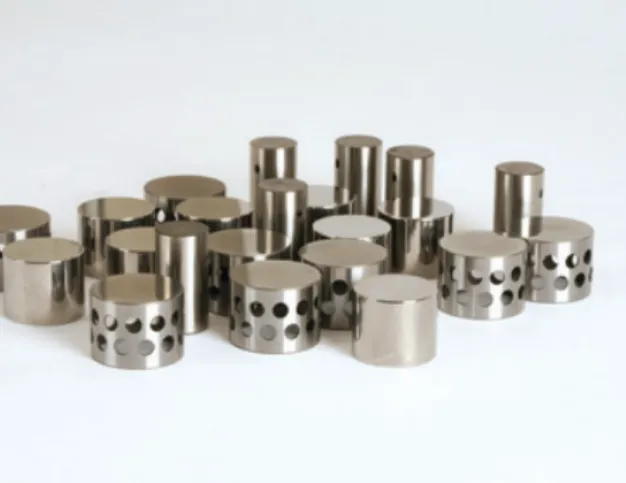
If your project requires 347 stainless steel stampings, contact MWalloys for a free quote.
2. Chemical composition, standards and specification table
Type 347 is referenced across specifications (AISI/ASTM/UNS) under UNS S34700 (EN 1.4550). The stabilizers niobium and tantalum bind carbon and prevent chromium depletion near grain boundaries. Typical composition limits and the usual trade standard ranges are shown below.
| Element | Typical range (weight %) | Notes |
|---|---|---|
| Carbon (C) | ≤ 0.08 | Control to limit carbides |
| Silicon (Si) | ≤ 0.75 – 1.00 | Deoxidizer |
| Manganese (Mn) | ≤ 2.00 | Deoxidizer, strength |
| Phosphorus (P) | ≤ 0.045 | Impurity control |
| Sulfur (S) | ≤ 0.030 | Impurity control |
| Chromium (Cr) | 17.0 – 19.0 | Corrosion resistance backbone |
| Nickel (Ni) | 9.0 – 13.0 | Austenite stabilizer |
| Niobium (Nb) | 10 × C min – 1.00 max | Nb ≈ 10×C minimum to ensure stabilization |
| Iron (Fe) | Balance | Remainder |
Sources and datasheets confirm stabilization chemistry and specification references.
3. Mechanical and thermal properties
Below are representative room temperature mechanical values and temperature behavior typical for commercially produced 347 stainless (normalized, solution annealed condition). Values vary with supplier and processing; request mill certificates for project-critical dimensions.
| Property | Typical value (room temp unless noted) | Notes / test condition |
|---|---|---|
| Tensile strength (ultimate) | ~75 ksi (≈ 515 MPa) | Typical from supplier datasheets |
| 0.2% offset yield strength | ~30 ksi (≈ 205 MPa) | Varies with cold work |
| Elongation (in 2 in) | ≈ 40% | Good ductility for forming |
| Hardness (Brinell) | ≤ 201 HB | Typical maximum |
| Melting point | ≈ 1400–1425 °C | Manufacturer data |
| Thermal expansion (20–538°C) | ≈ 18.6 µm/m·°C | Design for thermal growth |
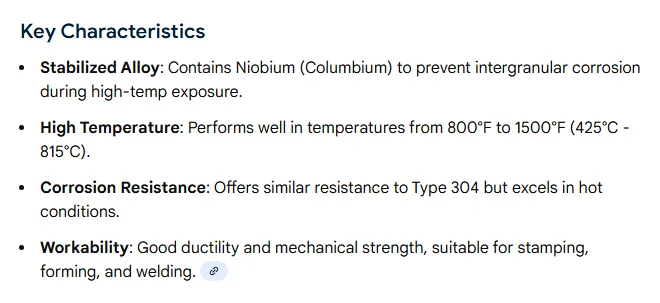
| Useful high temperature range | recommended exposure up to ~800–900°C for oxidation resistance; intermittent higher | Used in high temperature service with stabilization. |
Notes: cold working increases strength but reduces ductility and may introduce slight magnetism. For heavy cold drawing or deep drawing, intermediate annealing may be necessary.
4. Corrosion behavior and high-temperature performance
347 resists intergranular attack because niobium preferentially forms stable carbides, protecting chromium from forming chromium carbides at grain boundaries during slow cooling. For welded components, this stabilization reduces sensitization and the associated corrosion risk in service. At high temperatures, 347 retains strength and oxidation resistance better than plain 304 in many cycles. For prolonged exposure above 800°C some property adjustments and supplier guidance should be followed.
Practical note for corrosive environments: 347 is not a replacement for molybdenum-bearing grades like 316 or 317 when chloride pitting resistance is a priority. For marine or high-chloride exposures select a molybdenum-containing alloy.
5. Why use 347 for stamped components
Advantages for stampings:
-
Good deep drawing and bending performance for moderate forming ratios, with high toughness and ductility.
-
Stabilization means welded stamped subassemblies show reduced intergranular attack after welding cycles.
-
Better dimensional stability in elevated-temperature service when compared to unstabilized 18-8 grades.
Limitations:
-
Not as resistant to chloride pitting as molybdenum-bearing grades.
-
Machining tends to be stringy and requires heavier tooling similar to other austenitic steels.
6. Forming and stamping recommendations
This section provides explicit, field-proven recommendations that stamping engineers will use on the press floor.
Sheet thickness and typical part range
-
Common sheet thickness for 347 stampings: 0.3 mm to 6.0 mm. Thicker sections often require progressive dies or transfer presses with preforming. For heavy parts consider blanks from plate-stock plus secondary forming.
Tooling clearances and punch geometry
-
Clearance: use 6–10% of sheet thickness for shearing operations for cleaner cuts and reduced burr. For 1 mm sheet: 0.06–0.10 mm clearance.
-
Punch radii: keep inside radii ≥ sheet thickness to minimize fracture. Small radii increase risk of edge cracking in austenitic alloys.
Die design and lubrication
-
Progressive dies recommended for high-volume, complex forms.
-
Use robust tool steels with polished radii; 347 work hardens moderately, so stripper design must avoid excessive springback.
-
Use commercial stamping lubricants rated for stainless to reduce galling and tool wear.
Cold working limits and annealing
-
347 responds well to cold work but work hardens. For deep draws exceeding 40–50% area reduction, include an intermediate solution anneal step to restore ductility. Typical anneal range and rapid cooling guidance follow the heat treatment section.
Progressive forming sequence example
-
Blanking with fine clearance
-
Piercing and light drawn preform
-
Intermediate trimming and ironing
-
Final draw and flanging
-
Stress relief or solution anneal when required
These steps minimize strain localization and improve yield on first-pass production.
7. Welding, heat treatment and post-processing for stamped parts
Because 347 is stabilized, many welded assemblies avoid intergranular corrosion even without post-weld solution annealing. Nevertheless, for critical service or when parts will be exposed to sensitizing cycles, follow these practices:
-
Welding filler: use matching stabilized filler wire or austenitic filler such as 347-compatible wire. Avoid fillers that reintroduce susceptibility.
-
Post-weld heat treatment: full solution anneal at 1010 to 1193°C (1850–2000°F) followed by rapid cooling (usually water quench) is standard when full corrosion resistance is required. For many stamped assemblies, a controlled cooling practice combined with correct filler selection suffices.
-
Stress relief: lower-temperature stress relief treatments can reduce distortion but do not replace solution anneal for corrosion restoration.
Welding notes: the weld fusion zone and heat-affected zone must be evaluated for Nb(C,N) precipitate coarsening in prolonged high temperature cycles, which can affect creep properties for extreme service. For power plant or creep-critical parts follow supplier metallurgical guidance.
8. Surface finishes, passivation, cleaning and plating
Common finishes for stampings:
-
2B cold-rolled finish for general parts
-
BA (bright annealed) for reflective surfaces
-
No.4 brushed finish for consumer or architectural components
Post-fabrication cleaning:
-
Pickling and passivation remove heat tint and restore passive film. Use nitric or citric passivation procedures per ASTM A380 for best results. Surface conditioning improves corrosion performance in wet environments.
Electroplating or coatings:
-
If plating is required, ensure plating cycles and pre-treatment do not trap contaminants or produce hydrogen embrittlement. Stainless typically requires careful surface activation steps.
9. Quality control and inspection protocols for stamped parts
Production quality requires a combination of dimensional checks, metallurgical verification, and surface integrity inspection. Recommended checks:
-
Incoming material test report (MTR) verification and certificate traceability.
-
Dimensional inspection: first article, in-process SPC and final QA. Use CMM for critical geometries.
-
Non-destructive testing: for welded assemblies use dye penetrant or radiographic testing where applicable.
-
Metallurgical tests: where heat stability or high-temp service is required, request microstructure checks and grain boundary analysis to confirm stabilization.
-
Corrosion testing: ASTM A262 testing or customized intergranular corrosion tests for critical service conditions.
10. Cost factors, sourcing, lead time and procurement checklist
Factors that determine price and delivery for 347 stampings:
-
Raw material market pricing: nickel and niobium content influence unit cost compared with 304.
-
Sheet thickness and width: larger coils have unit advantages.
-
Complexity of dies: progressive die tooling amortization influences per-part cost for low-volume runs.
-
Surface finish and post-processing: BA finish, passivation, plating increase cost.
-
Certification and testing: requested metallurgy certificates and tests add time and cost.
Procurement checklist for buyers:
-
Confirm UNS/EN grade and mill certificate requirements.
-
Specify required surface finish and tolerances with GD&T.
-
Provide expected production volume and required lead times.
-
Clarify welding or assembly scope if the vendor supplies subassemblies.
-
Request sample first article inspection (FAI) with full documentation.
11. Comparative decision table: 347 vs common austenitic grades
| Decision factor | Choose 347 | Choose 304 | Choose 316 |
|---|---|---|---|
| Welded parts needing stabilization | Yes | No | No |
| High-temperature oxidation resistance | Good | Moderate | Moderate |
| Chloride/pitting resistance | Limited | Limited | Better due to Mo |
| Cost sensitivity | Higher than 304 | Lower | Higher due to Mo |
| Deep drawing and stamping | Good | Excellent | Good |
Use this table to quickly match grade choice to service requirements.
12. Typical applications and short case notes
-
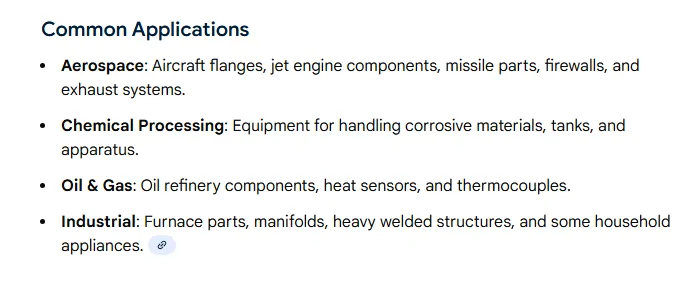
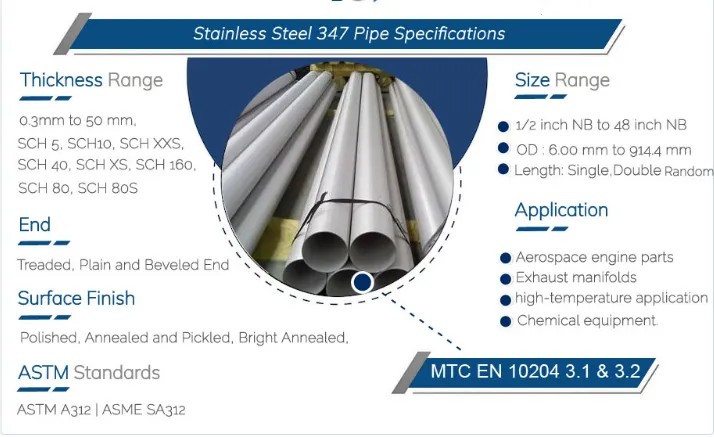
Exhaust and furnace components where intermittent high temperature and oxidation resistance required.
-
Boiler and heat exchanger parts where stabilization reduces intergranular corrosion after welding.
-
Petrochemical high-temperature piping fittings and stamped flanges when welding is frequent.
Case note: in power-generation refurbishment, 347 stampings are used for tube sheet collars and ducting where both forming accuracy and high-temperature stability are required. Suppliers often provide solution annealed blanks to limit in-shop heat treatment.
13. Practical stamping design checklist (for engineers and buyers)
-
Provide flat pattern prints and final part orientation for tooling layout
-
Specify minimum radii and maximum drawing depth per feature
-
Declare required tensile and yield targets and any cold-work limits
-
Identify surfaces that need buffed finishes or tight tolerances
-
Clarify whether final heat treatment or passivation is required after stamping or welding
14. Tables of process parameters and typical tolerances
Table A: Recommended clearances and punch radii
| Sheet thickness (mm) | Shear clearance (%) | Minimum punch radius (mm) |
|---|---|---|
| 0.5 | 6 – 8 | 0.6 |
| 1.0 | 6 – 10 | 1.0 |
| 2.0 | 6 – 10 | 2.0 |
| 3.0 – 6.0 | 8 – 12 | ≥ sheet thickness |
Table B: Typical tolerances achievable (high-volume progressive die)
| Feature type | Tolerance (mm) |
|---|---|
| Straight cut length | ±0.05 |
| Hole location | ±0.02 to ±0.05 |
| Flange perpendicularity | ±0.1 |
Note: tolerances depend on thickness, part size, and press capacity.
15. Environmental, recycling and sustainability considerations
347 contains higher alloying content such as nickel and niobium, which increases recycling value. Stainless scrap streams are mature; specify inclusion of mill certificates for recycled-content claims if sustainability certification is required. Recycling reduces lifecycle cost and supports circular manufacturing.
16. Frequently asked questions (FAQs)
Can I use 347 for heavily drawn deep-draw parts?
Is 347 a good substitute for 316 in high-chloride service?
Do I need post-weld annealing for stamped 347 assemblies?
What surface finishes can you supply on 347 stampings?
How does cold work affect mechanical properties?
Is 347 magnetic after forming?
What certifications should I request from the mill?
Can 347 be electroplated or powder coated?
What tooling materials are recommended for high-volume stamping of 347?
Does 347 require special storage or handling?
17. How MWalloys supports your 347 stainless steel stamping project
MWalloys supplies 347 blank coils and stabilised sheet, provides tooling and progressive die design services, and offers full traceability with mill certificates. We deliver 100% factory-price advantage and custom fabrication options including heat treatment, passivation, and assembly. For quotations send drawings, required finishes, volumes and delivery windows. We will prepare a detailed DFM report and tooling cost breakdown.
18. Final technical recommendations
-
For welded, high-temperature stampings that need good resistance to intergranular corrosion select 347 and require the buyer to specify whether full solution anneal is mandatory.
-
For chloride-laden environments select Mo-bearing grades instead.
-
Provide early DFM collaboration with your stamping supplier to optimize die life and per-part cost.