

No. 2B and No. 2D are both cold-rolled, annealed and pickled mill finishes used on stainless steel sheet and coil. 2B has a smoother, slightly brighter, low-reflective surface produced by a final light “skin” pass with polished rolls and is the default general-purpose finish for fabrication and downstream polishing; 2D is produced the same way except the final roll pass uses matte rolls or no bright finishing, giving a duller, low-reflective matte face more suited to industrial uses where appearance is not critical. For most food, pharmaceutical and visible architectural uses choose 2B; for heavy industrial engineering, structural backing, or where a low-glare surface is acceptable, 2D may be chosen.
What is a mill finish and why it matters
A mill finish is the surface condition of stainless steel as it leaves the rolling mill, after the basic metallurgical treatments (cold rolling, annealing and pickling). Mill finishes are the baseline for any later cosmetic or functional surface processing (brushing, polishing, electropolishing, patterned rolls). Choosing the right mill finish affects cleaning, corrosion resistance, weld appearance, forming behavior and ultimately cost. The mill finish is commonly specified by standardized designations (for example No. 1, 2D, 2B, BA) so purchasers and fabricators share a common expectation of appearance and performance.
Definitions and how 2D and 2B are produced
No. 2D (often written “2D”)
-
Production sequence: cold rolled → annealed → pickled or descaled → leveled (skin-pass) using matte/lightly polished rolls (or no bright final pass).
-
Appearance: smooth but matte (low reflectivity), uniform, slight haze; lacks directional grain. Suitable where glare reduction or non-decorative appearance is required.
No. 2B (often written “2B”)
-
Production sequence: cold rolled → annealed → pickled → final light cold roll pass using polished (bright) rolls (called skin-pass or temper pass).
-
Appearance: smoother and slightly brighter than 2D, low reflectivity but with a clean neutral sheen (not mirror). It is the most commonly supplied cold-rolled finish for sheet and coil. 2B is more readily polished to higher luster finishes if required.
Key production difference: same upstream metallurgy; the difference is the final roll surface and its polish — polished rolls → 2B; matte/no bright pass → 2D. This small mill adjustment is what changes surface roughness, reflectivity and downstream behavior.

Standards and specification language
Common standards that reference mill finishes and technical delivery conditions include:
-
ASTM A480 / A240 — general specification for flat stainless steel products (mill finish terminology frequently used in procurement).
-
BS EN 10088-2 — European technical delivery conditions for sheet, plate and strip (identifies ex-mill finishes and special finishes).
-
Industry guidance from associations such as ASSDA (Australia) and Euro Inox / IMOA provide practical descriptions and recommended applications for 2B and 2D.
How to reference finishes in purchasing documents: use the finish designation (e.g., “304, 2B finish, annealed and pickled” or “EN 1.4301, 2D finish per EN 10088-2”) and include any additional surface roughness (Ra) or secondary processing requirements (protective film, one-side direction, etc.) in the order.
Physical surface characteristics
While mill finish names are descriptive, engineers often want quantifiable parameters:
| Parameter | Typical 2D | Typical 2B | Unit / notes |
|---|---|---|---|
| Surface roughness (Ra) | 0.20 – 0.8 | 0.10 – 0.5 | micrometers (may vary by mill & thickness). |
| Reflectivity | Low / matte | Low-moderate / slight sheen | no mirror effect |
| Visible grain/directionality | Minimal | Minimal | both are essentially no-grain mill finishes |
| Cleanability (smoothness for hygiene) | Good | Better | 2B slightly easier to sanitize due to lower Ra |
| Suitability for bright polishing | Limited | Good | 2B is the standard base for further polishing |
Note: Ra ranges are typical values reported by mills; actual values vary with alloy, thickness and mill settings. For critical hygiene or optical applications specify an Ra tolerance in the purchase order.
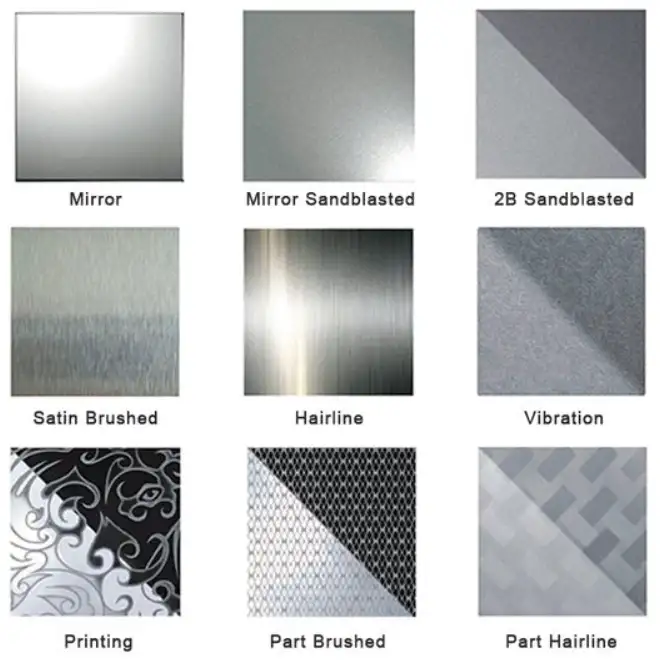
Manufacturing process (step-by-step)
-
Cold rolling: the hot-rolled strip is reduced to final thickness by cold rolling, which hardens the strip.
-
Annealing: the cold-worked stainless is annealed in a controlled furnace to restore ductility and remove residual stresses.
-
Pickling / descaling: acid pickling removes the oxide scale from annealing, leaving a clean stainless surface.
-
Skin-pass (temper pass): a short pass that evens out surface and improves mechanical properties — the type of rolls used here determines whether the finish is 2D or 2B.
-
For 2D: leveled with matte or non-polished rolls.
-
For 2B: final light pass uses highly polished rolls, producing a smoother, slightly brighter surface.
-
-
Packing / protective film: sheets/coils may be shipped with temporary protective film to prevent scuffs.
Manufacturing variables that influence finish: roll diameter, roll polish grade, metal temperature, degree of skin-pass, pickling chemistry and coil handling. These are controlled at the mill and should be specified when consistency is important.
Comparative properties — quick reference table
| Feature | 2D | 2B |
|---|---|---|
| Visual appearance | Dull, matte grey | Smooth, slightly brighter grey |
| Ra (typical) | higher | lower |
| Downstream polishing | more difficult | easier |
| Common uses | industrial applications, backing | food, pharma vessels, general fabrication |
| Cost (mill) | slightly lower | standard (slightly higher than 2D) |
| Formability | similar | similar |
| Standard mills’ default | used where appearance unimportant | default for many mills and buyers |
| Suitability for electropolishing | possible | excellent |
Interpretation: If you need a neutral, easy-to-clean surface that polishes well, 2B is usually preferred. If the surface will be coated, painted, or hidden and cost minimization is desired, 2D may be chosen.
Typical applications and selection rules
Choose 2B when:
-
The finished product is visible or semi-visible (appliance backs, exposed vessels).
-
You will perform mechanical polishing, buffing or electropolishing.
-
Hygiene and sanitation are important (food, pharma): slightly lower Ra helps cleaning.
Choose 2D when:
-
The part is structural, industrial, or will be concealed behind cladding.
-
Low glare or matte appearance is acceptable or desirable.
-
You want a cost-sensitive option for non-decorative components.
Examples by industry:
-
Food processing tanks, kitchen equipment: 2B (USDA/food industry often favors smoother finishes).
-
HVAC ducting ducts inside hidden service areas: 2D or No.1 depending on mechanical needs.
-
Chemical process plant interiors: 2B where corrosion control and cleaning are required.
-
Structural backing plates, supports: 2D.
Surface treatments after 2B or 2D
Secondary processes transform base mill finishes:
-
Mechanical polishing (grit/stone/cloth) — can convert 2B into a higher mirror or directional finish (e.g., 2G/No.4 finish depends on abrasive used).
-
Electropolishing — electrochemical smoothing that lowers Ra and improves passivity; 2B is an excellent starting point for electropolishing because of its lower initial Ra.
-
Passivation — nitric or citric passivation enhances the chromium-oxide protective film; apply after fabrication.
-
Brushing — creates directional grain (No.4), usually performed on 2B base.
-
Coatings / painting — sometimes applied to 2D surfaces for protective or decorative reasons.
Design note: If you plan electropolishing, specify the intended final Ra and note the original mill finish, since the achievable final Ra depends on starting surface and alloy.
Inspection, acceptance and handling
Acceptance checklist for incoming mill material:
-
Verify material grade and certificates (mill test cert / EN 10204).
-
Confirm finish designation (2B or 2D) on packing slip and inspect both sides.
-
Measure surface roughness (Ra) if contractually required.
-
Inspect for protective film and surface damage (scratches, coil crush marks).
-
For hygienic applications, request evidence of proper pickling and degreasing.
Handling tips: always use soft slings, protective blankets and store on dunnage to avoid contact scratches. For 2B, avoid abrasive contact during handling to preserve the smooth sheen.
Welding, fabrication and forming considerations
-
Weld finish: post-weld cleaning will often leave heat tints; passivation and/or pickling may be required to restore corrosion resistance. Starting with 2B makes it easier to restore to a uniformly bright finish after fabrication.
-
Forming: both 2D and 2B behave similarly in deep drawing and stamping because the difference is surface, not bulk metallurgy. However, skin-pass level and residual stress may affect springback; specify temper condition if critical.
-
Grinding & finishing after welds: specify whether local blending is acceptable or if full surface reprocessing (e.g., electropolishing) is required.
Corrosion behaviour, hygiene and cleaning
Surface roughness and continuity of the passive film control localized corrosion sensitivity. A smoother Ra (typical of 2B) reduces crevice formation and is easier to disinfect; electropolishing further improves localized corrosion resistance by smoothing micro-asperities and increasing chromium/nickel enrichment at the surface. For food and pharma, where sanitation and cleanability matter, list both the finish (2B) and any required post-treatments (electropolish, passivation) in the specification.
How to specify 2B or 2D in contracts and drawings
Use explicit, unambiguous language:
Key items to add: alloy, finish designation, Ra tolerance (if needed), whether the finish must be the same both sides, protective film, and certificate type. If final polishing or electropolishing is required, state that as a separate line item.
Detailed comparison matrices and special cases
Table A — By alloy and thickness (practical notes)
| Alloy | Thin gauge (<1.0 mm) | Medium (1–3 mm) | Thick (>3 mm) |
|---|---|---|---|
| 304/304L | 2B common; excellent for electropolish | 2B default | 2B or 2D depending on demand |
| 316/316L | 2B preferred for sanitary | 2B preferred | 2D used where economy prevails |
| Ferritic (430) | 2D sometimes used | 2B common | 2D for structural |
Table B — Post-processing lead times and cost drivers (mill → finished product)
| Operation | Typical added cost | Lead time driver |
|---|---|---|
| 2B mill finish | base price | none |
| 2D mill finish | slight discount | none |
| Mechanical polish (No.4, No.8) | moderate–high | process time & masking |
| Electropolishing | moderate | batch size & chemical handling |
| Passivation | low | bath capacity |
Practical selection checklist (quick)
-
Will the surface be visible? → Prefer 2B.
-
Will the part need electropolishing? → Prefer 2B base.
-
Is budget the overriding constraint and visual finish irrelevant? → Consider 2D.
-
Is cleaning/hygiene a key requirement? → 2B + passivation/electropolish.
-
Need to verify contractually? → Include finish designation, Ra, protective film and certification.
FAQs
-
Q: Can 2D be polished to a mirror finish?
A: Yes, but it typically requires more aggressive surface removal and finishing because 2D starts with a higher Ra and matte roll marks; 2B is a better starting point for mirror or No.4 finishes. -
Q: Is 2B or 2D sanitary for food contact?
A: 2B is the preferred mill finish for sanitary applications because of its smoother surface and easier cleanability; specify passivation/electropolish for critical hygiene. -
Q: Which finish is cheaper?
A: 2D may be marginally cheaper at the mill, but total cost depends on downstream finishing — if polishing/electropolishing is planned, starting with 2B can reduce finishing cost. -
Q: Are both finishes available for all stainless grades?
A: Yes; common grades such as 304, 304L, 316 and 316L are routinely supplied in 2B and 2D finishes. -
Q: Does finish affect corrosion resistance?
A: The base alloy controls bulk corrosion resistance; however, smoother surface (lower Ra) and proper pickling/passivation improve localized corrosion resistance. -
Q: Should I specify roughness (Ra) in my PO?
A: If surface finish or cleaning is critical, yes — specify Ra and side(s) to reduce ambiguity. -
Q: Can I get 2B on both sides?
A: Yes, mills can supply both sides as 2B, but specify if only one side must be finish-critical. -
Q: Does 2B hide scratches less than 2D?
A: The smoother 2B can show fine scratches more noticeably; protective film and careful handling are recommended. -
Q: Are there standard test methods for finish?
A: Visual, gloss meters and Ra profilometers are common methods; standards reference appearance classes (see EN/ASTM documents). -
Q: How do I restore a 2B finish after welding?
A: Local blending, pickling paste or full electropolishing and passivation are used — for sanitary work, re-passivate and verify with tests (e.g., chloride-testing as required).
Practical case example
A mid-sized food processing equipment maker needs 1.5 mm 304L sheet for tanks. They specified 304L, 2B finish, Ra ≤ 0.4 µm, one side protective film, pickled and annealed and required a mill test cert (EN 10204 3.1). The 2B base allowed the fabricator to spot-polish around welds and then electropolish the welded assembly to reach the customer’s final Ra target with minimal material removal.
Summary and recommended specification templates
Short recommendation: If you are not certain, specify 2B. It’s the industry default, easy to finish, widely specified in standards and well-suited for hygienic and visible applications. Use 2D only when appearance is unimportant and economy is the priority.
Two sample specification sentences:
-
“Material: EN 1.4301 (AISI 304) sheet, 2B mill finish both sides, annealed & pickled per EN 10088-2, Ra ≤ 0.4 µm, protective film one side, MTR per EN 10204 3.1 required.”
-
“Material: AISI 316L coil, 2D finish, annealed & pickled per ASTM A480, one side only, packaged on wooden dunnage.”